On this page
If you know how chlorine reacts with sodium hydroxide, you already know much of what exams ask about pseudohalogens. Cyanogen and thiocyanogen follow the same pattern; the new skill is tracking oxidation states inside a group of atoms.
What are pseudohalogens and pseudohalides?
Pseudohalogens are polyatomic analogues of halogens whose chemistry is similar enough that they can take the place of halogens in several kinds of compounds (Wikipedia: Pseudohalogen). The pseudohalide is the matching singly charged anion, just as chloride is to chlorine.
Lothar Birckenbach and Karl Kellermann introduced the idea in 1925, in a paper titled “Über Pseudohalogene (I)” (Berichte der deutschen chemischen Gesellschaft, DOI 10.1002/cber.19250580429).
The two molecules you will meet most often are:
Cyanogen, (CN)2, a linear molecule N≡C–C≡N, described as having two CN groups “analogous to diatomic halogen molecules, such as Cl2” (Wikipedia: Cyanogen).
Thiocyanogen, (SCN)2, connected as NCS–SCN, with behaviour “intermediate between dibromine and diiodine” (Wikipedia: Thiocyanogen).
Their anions, cyanide (CN⁻) and thiocyanate (SCN⁻), act like halide ions. They form insoluble silver salts such as AgCN and AgSCN, just as chloride gives AgCl. They also form compounds with halogens and with each other that resemble interhalogens (Wikipedia: Pseudohalogen). If you have studied how interhalogen compounds get their shapes, you will spot the family resemblance.
How does chlorine react with NaOH?
In cold, dilute sodium hydroxide, chlorine gives sodium chloride and sodium chlorate(I), the solution sold as bleach (Chemguide):
2NaOH + Cl2 → NaCl + NaClO + H2O
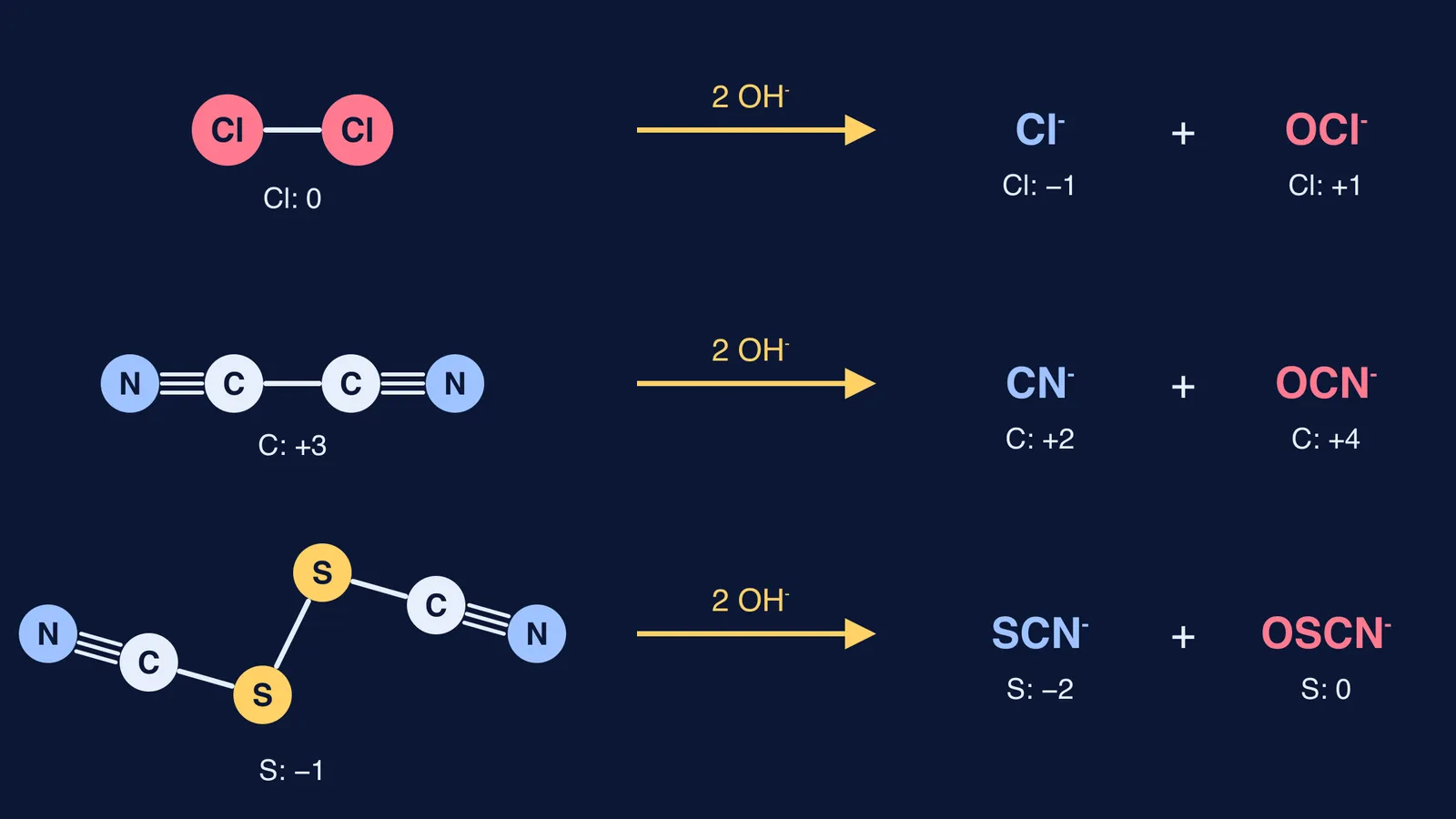
Chlorine goes from 0 to −1 in NaCl and to +1 in NaClO. One element is both reduced and oxidised, so this is a disproportionation. In hot, concentrated NaOH the oxidised product becomes chlorate(V) instead: 6NaOH + 3Cl2 → 5NaCl + NaClO3 + 3H2O (Chemguide). Our post on chlorine with cold versus hot NaOH goes through both cases in detail.
How do cyanogen and thiocyanogen react with NaOH?
They copy the cold-NaOH pattern. The general equation for a pseudohalogen Ps2 in alkali is Ps2 + 2OH⁻ ⇌ Ps⁻ + OPs⁻ + H2O, a reversible disproportionation (Wikipedia: Pseudohalogen).
For cyanogen, the products are cyanide and cyanate (Wikipedia: Cyanogen):
(CN)2 + 2NaOH → NaCN + NaOCN + H2O
Applied to thiocyanogen, the general equation predicts thiocyanate and hypothiocyanite:
(SCN)2 + 2NaOH → NaSCN + NaOSCN + H2O
Hypothiocyanite, OSCN⁻, is a real ion: in the human airways the enzyme lactoperoxidase makes it from thiocyanate and hydrogen peroxide (Wikipedia: Hypothiocyanite). One caution: in plain water, thiocyanogen goes further, and its sulfur disproportionates to give H2SO4, HCN and HSCN (Wikipedia: Thiocyanogen). For exams, the textbook comparison is the alkali equation above.
That warning comes from Wikipedia: Cyanogen and the PubChem entry for cyanogen.
Worked example: how do you prove it is disproportionation?
Students get stuck here because the “halogen” is now several atoms.
Fix the atoms that do not change. Take N as −3 and O as −2 throughout, the usual values.
Cyanogen, (CN)2: the molecule is neutral, so each C is +3 (C + (−3) = 0).
Cyanide, CN⁻: C + (−3) = −1, so C is +2. Carbon has been reduced.
Cyanate, OCN⁻: (−2) + C + (−3) = −1, so C is +4. Carbon has been oxidised.
Conclusion: carbon goes from +3 to +2 and +4. That is disproportionation, just as chlorine goes from 0 to −1 and +1.
Do the same for thiocyanogen, with C fixed at +4 and N at −3:
(SCN)2: each SCN unit is neutral, so S + 4 − 3 = 0 and S is −1.
SCN⁻: S + 4 − 3 = −1, so S is −2 (reduced).
OSCN⁻: −2 + S + 4 − 3 = −1, so S is 0 (oxidised).
One atom plays chlorine's role: its oxidation state drops by one in the anion and rises by one in the “hypo” ion. The general idea of disproportionation is the same in all three cases.
If you want to see where pseudohalogens sit among halogens, redox and oxidation states, the Fermi Concept Library gives every chemistry concept its own lesson and shows its place on the map.
What should you check before writing the answer?
Run through this list on any pseudohalogen question:
Did you write the neutral molecule as a dimer, (CN)2 or (SCN)2, not CN or SCN?
Does the cold-alkali product pair match Cl⁻ + OCl⁻: Ps⁻ + OPs⁻?
Did you balance with 2OH⁻ and one H2O, as for chlorine?
Did you find the atom whose oxidation state changes (C in cyanogen, S in thiocyanogen) instead of assuming it is N?
Are you sure the question is about alkali, not plain water, where thiocyanogen behaves differently?
When you practise, write the oxidation states before you balance. If a step goes wrong, the Fermi Problem Library has worked problems with a step-by-step solver that explains the reasoning rather than printing an answer, so you can see where your method slipped.