On this page
If you are revising ecology for NEET-UG or your Class 12 boards, the rivet popper hypothesis is a short passage worth knowing word for word. It sits in Chapter 13, Biodiversity and Conservation, of the NCERT Class 12 Biology textbook (page 221 of the 2026-27 reprint), in a section asking whether the number of species in a community really matters to how an ecosystem works.
What is the rivet popper hypothesis?
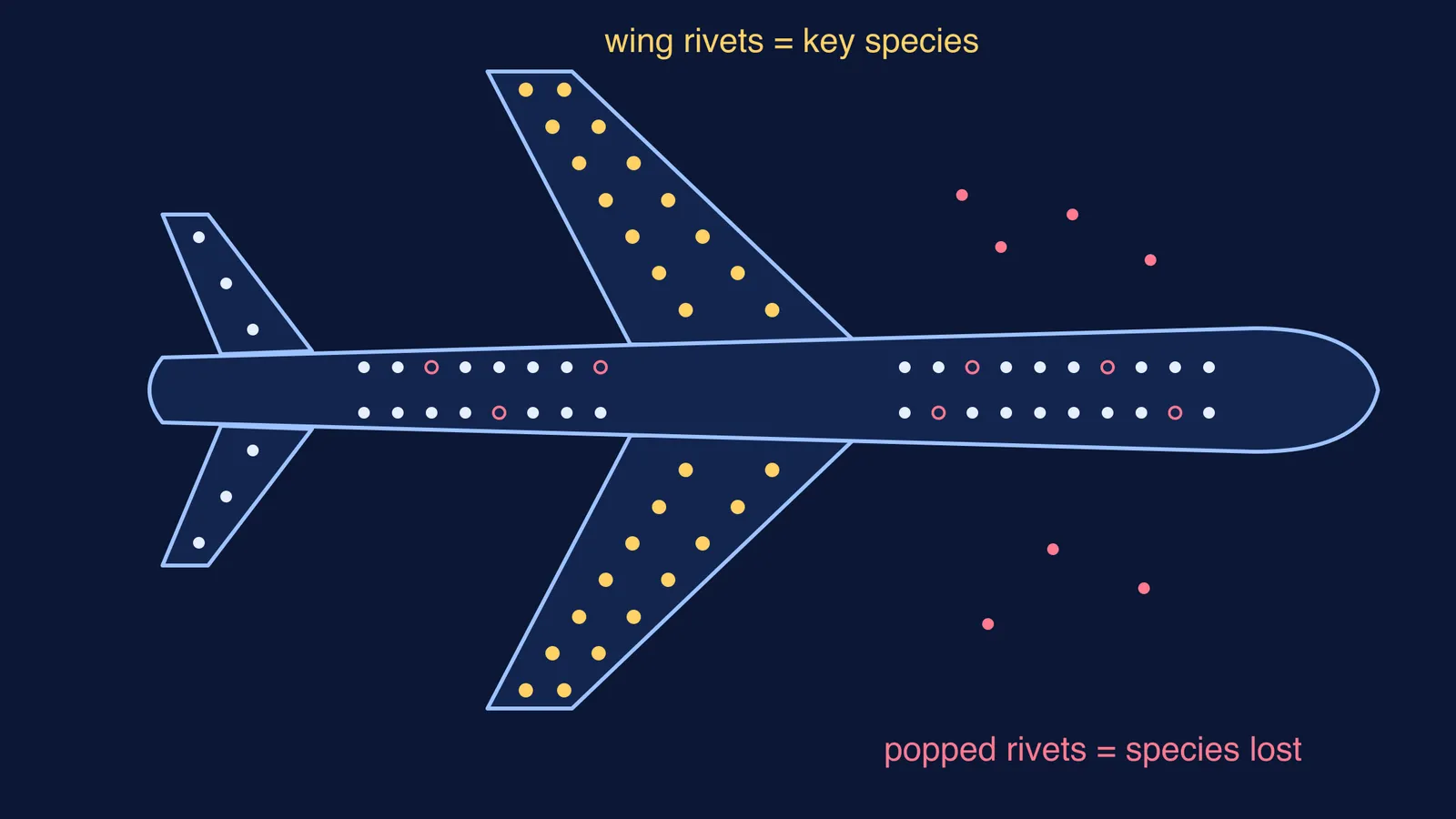
NCERT asks whether Western Ghats ecosystems would be less functional if one of their tree frog species were lost, then answers with an analogy used by Stanford ecologist Paul Ehrlich, set out on page 221 of the NCERT chapter. Learn the mapping as the textbook gives it:
The aeroplane is the ecosystem.
The thousands of rivets holding it together are the species.
A passenger popping a rivet to take home is a species becoming extinct.
Flight safety is the proper functioning of the ecosystem.
Rivets on the wings are key species that drive major ecosystem functions.
Losing a few rivets on the seats or windows is a less serious threat.
The textbook makes two separate points. First, popping one rivet may not affect flight safety, but as more and more are removed the plane becomes dangerously weak over time. Second, which rivet goes also matters: losing wing rivets is a far more serious threat than losing a few on the seats.
Where did the rivet analogy come from?
A teaching synthesis by Madhu Rao and Trond Larsen, published by the American Museum of Natural History, traces the idea to Ehrlich and Ehrlich (1981). They describe it as a hypothesis that an ecosystem's resistance can decline as species are lost, even while its performance looks unaffected, with sudden and drastic consequences once some threshold is passed. That reference is Paul and Anne Ehrlich's 1981 book Extinction.
The key word is threshold: each loss looks harmless on its own, until one too many. For the story of the scientist himself, read our profile Paul R. Ehrlich's rivet popper: why every lost species counts.
What do the wing rivets, or key species, stand for?
Ecologists later added a second idea. Brian Walker's 1992 paper in Conservation Biology proposed grouping species by the job they do in the ecosystem and giving conservation priority to groups with little redundancy, meaning few species that can stand in for one another. The AMNH synthesis explains the logic: a species in a crowded functional group may be more expendable if the others can keep doing that job. Ehrlich and Walker later wrote a short joint article, Rivets and Redundancy, in BioScience in 1998.
In plane terms, a wing rivet is one with no backup. Keystone species are one example: the AMNH synthesis describes them as species with large effects on ecosystem process and function, and notes that the starfish Pisaster ochraceus plays a clear keystone role on wave-exposed rocky shores but a weak one in sheltered habitats. So whether a species is a wing rivet can depend on where it lives. Our explainer on keystone species and their ecosystem role has more examples.
How could an exam question test the rivet popper hypothesis?
The NCERT passage is short, so a question can only test a few things. Prepare for each:
Whose analogy it is: Paul Ehrlich, the Stanford ecologist named in the textbook.
What each part stands for: aeroplane, rivets, popping, flight safety, wings.
What it argues: that species richness matters for ecosystem function, and some species matter more than others.
The neighbouring evidence: on the same page, NCERT notes that David Tilman's long-term outdoor plots with more species showed less year-to-year variation in total biomass, and that more diversity meant higher productivity. One paper from that work is Tilman and Downing's 1994 Nature study, Biodiversity and stability in grasslands.
Worked example. Assertion: losing a few species may not visibly affect an ecosystem at first. Reason: in the rivet popper analogy, the plane weakens only when wing rivets are popped. The assertion is true; it matches the textbook. The reason is false: NCERT says the plane becomes dangerously weak as more and more rivets of any kind are removed. Wing rivets make the threat more serious; they are not the only threat.
A five-minute revision routine
Read page 221 once, then write the six-line mapping from memory.
Explain aloud what the plane is, what popping does, and why wings matter more.
Link it to what pops the rivets, using our guide to the evil quartet causes of biodiversity loss.
Parents can help with one question at dinner: if a plane lost one seat rivet, would it fall? What about a hundred? What about one from the wing? If your child can explain the difference, they have understood the idea.
If ecosystem stability or functional groups are still unclear, the Fermi Concept Library gives each biology concept its own lesson and shows where it fits on the map. For assertion-reason practice, the Fermi Problem Library has worked problems with a step-by-step solver that explains the reasoning.