

On this page
Ecologists use specific terms to describe how different organisms fit into their environment. While some animals dominate a landscape by their sheer numbers, others maintain the balance of the ecosystem behind the scenes.
What is the meaning of a keystone species?
A keystone species is a plant or animal that plays a unique and crucial role in the way an ecosystem functions. Without them, the ecosystem would be significantly different or might cease to exist altogether.
The ecologist Robert T. Paine coined the term "keystone species" in a 1969 paper in The American Naturalist, defining it as a species with a disproportionately large effect on its environment relative to its abundance. He borrowed the concept from architecture to describe an organism that acts as the linchpin for an entire community.
If a keystone species is removed, it triggers a chain reaction called a trophic cascade. Other populations explode, outcompete their neighbours, and eventually cause the local biodiversity to crash. Understanding this effect on biodiversity is a core concept in conservation, just as it is vital to understand the vulnerability of endemic and endangered species.
Keystone species vs dominant species: what is the difference?
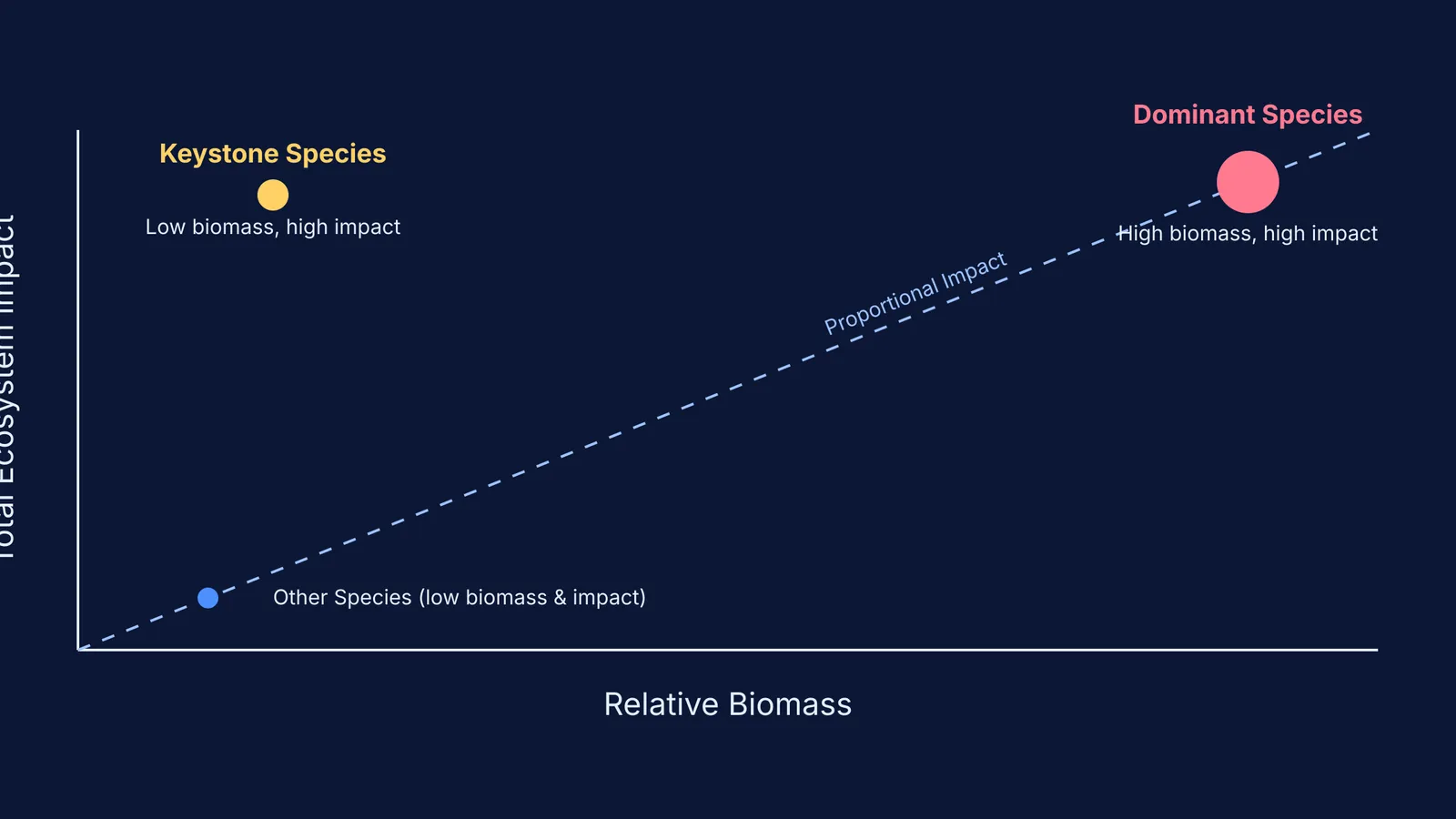
Students often confuse keystone species with dominant species. The fundamental difference lies in the concept of proportionality.
Dominant species have a large effect on their environment because they make up the bulk of the community's mass. For example, oak trees in an oak forest dictate the light, soil, and habitat for everything else. Their impact is large, but it is entirely proportional to their high biomass.
Keystone species have a large effect despite having low or moderate biomass. Their impact is highly disproportionate. A small pack of wolves can alter the behaviour of large herds of grazing animals, which in turn changes how entire forests grow.
When preparing for biology exams, identifying these ecological roles can sometimes feel like memorising disconnected facts. If you want to understand these connections rather than just rote-learning definitions, the Fermi Concept Library explains the mechanisms of ecology and food webs step by step.
Examples of keystone species
Keystone species are often apex predators, but they can also be mutualists or ecosystem engineers. Understanding these categories is essential for mastering community ecology.
The purple sea star
In his early experiments, Robert Paine removed the purple sea star (*Pisaster ochraceus*) from a stretch of rocky coastline. Without the sea stars to eat them, the local mussel population multiplied uncontrollably. The mussels monopolised the space on the rocks, crowding out algae, anemones, and snails, effectively cutting the local biodiversity in half (Paine, 1969).
Tropical fig trees
Fig trees (*Ficus*) are classic examples of mutualist keystone species. In tropical rainforests, most trees produce fruit during specific, distinct seasons. However, different fig trees produce fruit at different times, meaning there are always figs available somewhere in the forest year-round. During dry or lean seasons, figs are often the only high-energy food available. Because of this continuous cycle, over 1,200 species of birds and mammals depend on figs for their survival (Shanahan et al.). If the fig trees were removed, the animal populations would starve, and the forest would lose the animals that disperse seeds for many other plant species.
Beavers
As ecosystem engineers, beavers physically alter their environment by building dams. A relatively small number of beavers can turn a narrow, fast-flowing stream into a vast, still wetland. This physical change creates new habitats for fish, frogs, waterfowl, and aquatic plants.
How to spot a keystone species in exam questions?
If you are asked to identify a keystone species in a biology question, or asked why a specific animal qualifies as one, run through this simple four-point checklist:
Is the species rare or moderate in number? If it is the most common plant or animal in the ecosystem, it is likely a dominant species, not a keystone species.
Does it control a competitor? Look for predators that keep dominant herbivore populations in check, preventing them from destroying the plant life.
Does it provide a critical resource? Look for plants that offer food or water when no other species does, sustaining the community through difficult seasons.
What happens if it disappears? If removing the species causes the whole food web to unravel—similar to the catastrophic ecological losses seen in the recent extinctions of the dodo and Steller's sea cow—it is a keystone species.
By looking for these specific traits, you can quickly distinguish the keystones from the rest of the community in any case study.


