

On this page
When studying biology or ecology, it is easy to mix up the terms for how animals and plants are distributed and how safe they are. Knowing the exact difference between an endemic species and an endangered one helps you understand why conservation efforts are designed the way they are.
What is an endemic species?
Endemism is the state of a species being found exclusively in a singular defined geographic location, such as an island, a state, or a specific mountain range (Wikipedia).
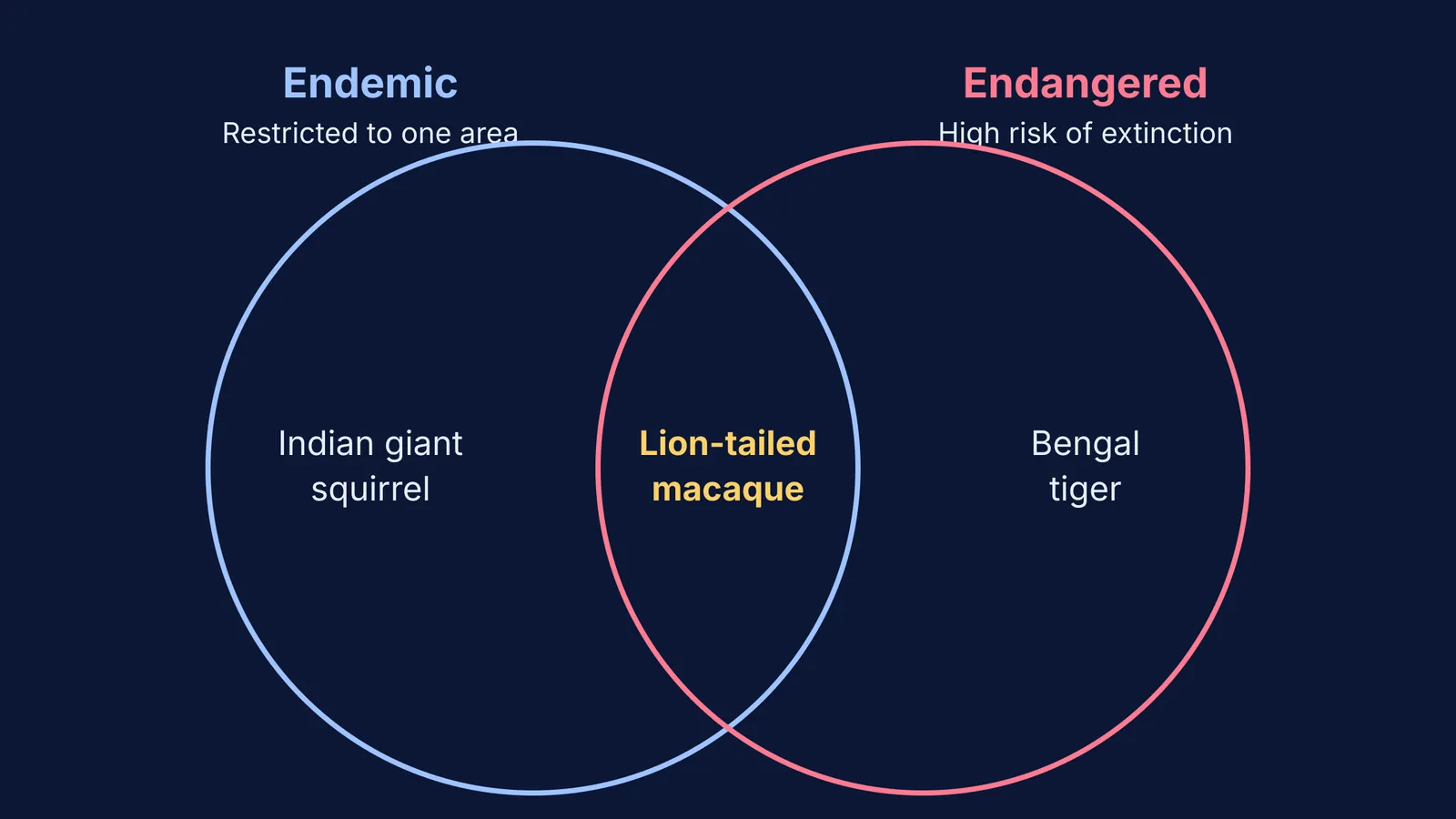
An endemic species is defined purely by its geography, not by how many individuals are left in the wild. If an organism is native to a place but can also be found naturally in other parts of the world, it is not endemic to that place. For example, the Indian giant squirrel is endemic to the woodlands and forests of India. It does not live natively anywhere else in the world. However, its population is currently large enough and stable enough across its range that it is not considered at a high risk of disappearing. In other words, a restricted habitat alone does not immediately mean a species is dying out.
What does endangered mean?
An endangered species is one that has a very high risk of extinction in the near future, either worldwide or in a particular region (Wikipedia).
This classification focuses entirely on the survival of the species, regardless of how widely it is spread geographically. Species typically become endangered due to severe habitat depletion, loss of genetic variation, or hunting. The Bengal tiger, for instance, has a large historical range covering India, Nepal, Bangladesh, and Bhutan. Even though it is not restricted to a single local area, severe habitat fragmentation and poaching have drastically reduced its numbers. Because its population has fallen significantly, it is classified as endangered, even though its footprint crosses several international borders.
If you struggle to recall ecological categories like this during exam preparation, the Fermi Concept Library breaks down biology definitions visually, mapping out how different ideas connect. You can also explore how biological classification systems handle outliers by reading our guide to viruses, viroids and lichens.
Can a species be both endemic and endangered?
Yes, and this is a very common pattern in conservation biology. Because endemic species live in a tightly restricted area, any damage to their local habitat quickly threatens their entire global population. They do not have backup populations in other countries to rely on.
The lion-tailed macaque is an Old World monkey endemic to the Western Ghats of South India. Because its rainforest habitat has become heavily fragmented by human activity, it is also classified as endangered. Similarly, the Nilgiri tahr is a stocky mountain goat endemic to the southern portion of the Western Ghats; dropping numbers due to historical hunting have left it endangered, though recent conservation efforts are helping the population slowly recover.
When small, local populations change over time due to environmental pressures, you can see how traits shift by looking at the mechanisms of stabilising, directional and disruptive selection.
How does the IUCN Red List group species?
The International Union for Conservation of Nature (IUCN) Red List, founded in 1964, is an inventory of the global conservation status and extinction risk of biological species (Wikipedia).
It provides scientifically based information to guide actions to conserve biological diversity. The IUCN Red List classifies species into nine distinct groups based on criteria such as population size, rate of decline, and the fragmentation of their geographic distribution:
Extinct (EX): There is no reasonable doubt that the last individual has died.
Extinct in the Wild (EW): The species survives only in captivity, cultivation, or outside its native range.
Critically Endangered (CR): The species is in a particularly and extremely critical state, facing an exceptionally high risk of extinction.
Endangered (EN): The species faces a very high risk of extinction in the wild.
Vulnerable (VU): The species faces a high risk of extinction in the wild.
Near Threatened (NT): The species is close to qualifying for a threatened category in the near future.
Least Concern (LC): The species is widespread and abundant in the wild.
Data Deficient (DD): There is inadequate information to make a direct or indirect assessment of its extinction risk.
Not Evaluated (NE): The species has not yet been assessed against the criteria.
The umbrella term "threatened" specifically covers the Critically Endangered, Endangered, and Vulnerable categories. The scale of the conservation challenge is vast: as of 2023, of the 150,388 species surveyed for the Red List, 42,108 are considered at risk of extinction (Wikipedia).


