On this page
Shine a laser through a narrow slit and the screen shows a bright central band with fainter bands on either side. A common exam question asks how wide that central band is. The answer comes from where the first dark fringes fall.
Where are the minima in single-slit diffraction?
For a slit of width a, the minima (zero intensity) are at θ ≈ nλ/a, with n = ±1, ±2, ±3, and the central maximum is at θ = 0, according to NCERT Class 12 Physics Part II, Wave Optics, section 10.6.1. The exact condition for a dark fringe is a sin θ = mλ, as derived in OpenStax University Physics Volume 3, section 4.1.
Here is why the first dark fringe sits at a sin θ = λ. Split the slit into a top half and a bottom half. At that angle, every point in the top half has a partner in the bottom half whose path to the screen is longer by exactly λ/2. Each pair cancels, so the screen is dark there.
What is the angular width of the central maximum?
The central maximum is the bright region between the first minimum on one side (n = +1) and the first minimum on the other (n = −1). Each of them is λ/a from the centre (NCERT, section 10.6.1). So:
Half angular width: θ = λ/a
Angular width of the central maximum: 2θ = 2λ/a, in radians, for small angles
How do you find the linear width on the screen?
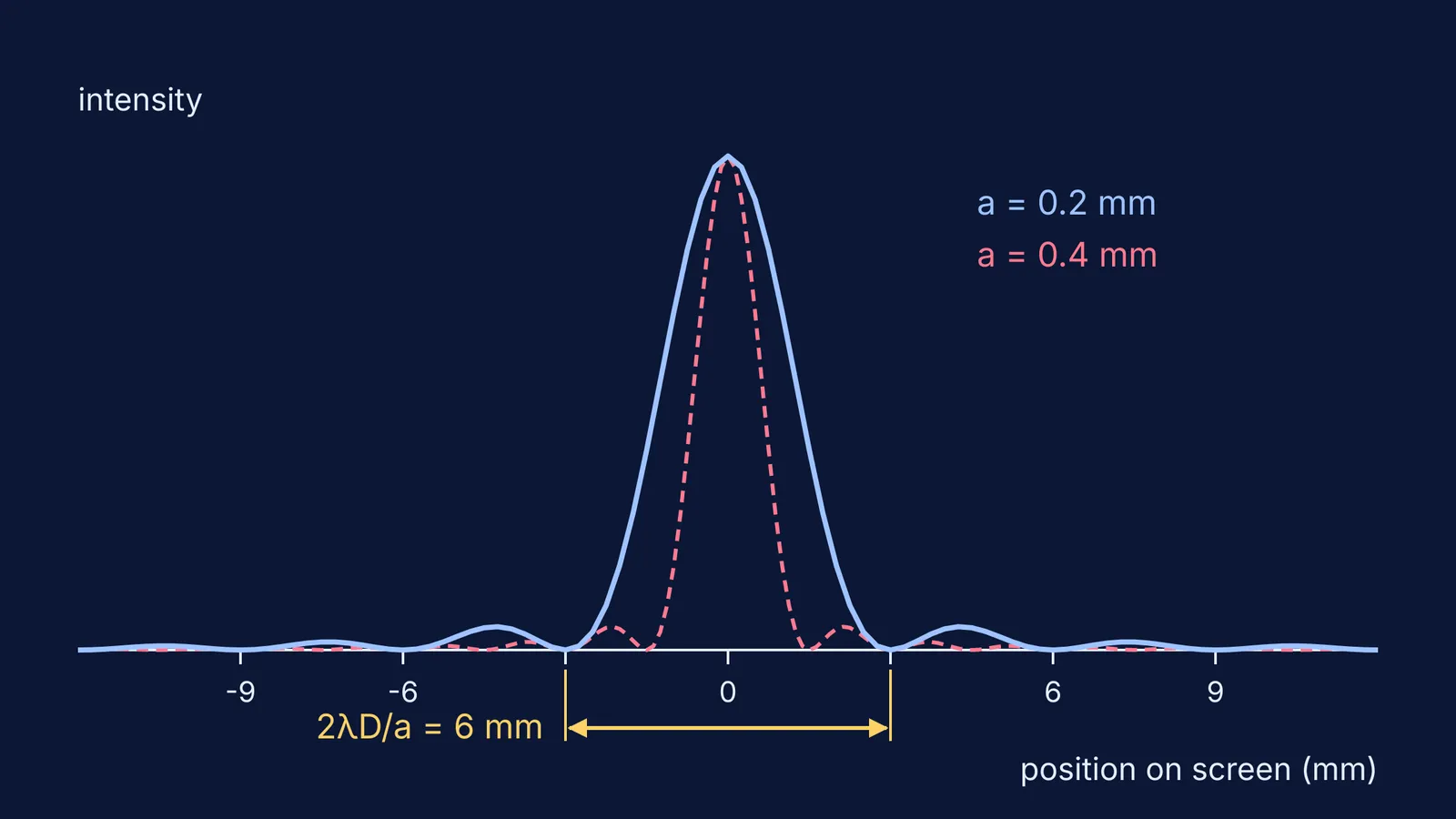
A ray at angle θ reaches a screen at distance D at a height y = D tan θ, which is about Dθ for small angles. With θ = λ/a, the first minimum is at y = λD/a. The linear width of the central maximum is therefore 2λD/a. If a convex lens just after the slit focuses the pattern, use its focal length f in place of D.
Worked example: a 0.2 mm slit
Light of wavelength 600 nm falls normally on a slit 0.2 mm wide, and the screen is 1 m away. Find the angular and linear width of the central maximum, using the minima condition from NCERT section 10.6.1.
Convert to metres: λ = 6 × 10⁻⁷ m, a = 2 × 10⁻⁴ m, D = 1 m.
Half angle: θ = λ/a = (6 × 10⁻⁷)/(2 × 10⁻⁴) = 3 × 10⁻³ rad.
Angular width: 2θ = 6 × 10⁻³ rad, which is about 0.34°.
Linear width: 2λD/a = (2 × 6 × 10⁻⁷ × 1)/(2 × 10⁻⁴) = 6 × 10⁻³ m = 6 mm.
Check the approximation: 0.003 rad is tiny, so sin θ ≈ tan θ ≈ θ holds well.
The dark fringes beyond the first are spaced λD/a = 3 mm apart, so each side band is about 3 mm wide, half the width of the central one.
If your answer is off by a factor of 2, the Fermi Problem Library has worked problems with a step-by-step solver that explains the reasoning rather than printing an answer, so you can see which step went wrong.
What happens to the central maximum if you widen the slit?
The slit width a is in the denominator, so the width of the central maximum is proportional to 1/a. OpenStax, section 4.2 states that an increase in the slit width decreases the width of the central peak. With the same 600 nm light and a screen 1 m away, 2λD/a gives:
a = 0.1 mm: central maximum 12 mm wide
a = 0.2 mm: 6 mm
a = 0.4 mm: 3 mm
a = 0.8 mm: 1.5 mm
Double the slit and the band halves. Keep widening it and the pattern closes up until it looks like a plain image of the slit, which is why diffraction is noticeable only for small slits. Go the other way and OpenStax notes that when a is close to λ, the central peak becomes quite broad.
Wavelength works the opposite way: a longer λ gives a wider band. NCERT's home version of the experiment, a narrow slit between two razor blades held in front of the eye while you look at a bulb filament, shows wider fringes for red light than for blue (NCERT, section 10.6.2). For how this differs from two-slit fringes, see interference vs diffraction of light.
A 30-second check before you write the answer
Is the length in the question a slit width (a) or a slit separation (d)?
Did they ask for the full width (2λD/a) or the distance from the centre to the first minimum (λD/a)?
Did you convert nm and mm to metres before dividing?
Is there a lens? Then use f, not D.
Is it the angular width? Then D does not appear at all.
To watch the band shrink as the slit opens, work through this single-slit diffraction simulation, predicting the pattern first.