

On this page
Every time a student encounters wave optics, one question always comes up: if both interference and diffraction create patterns of bright and dark bands by adding waves together, what is the actual difference between them?
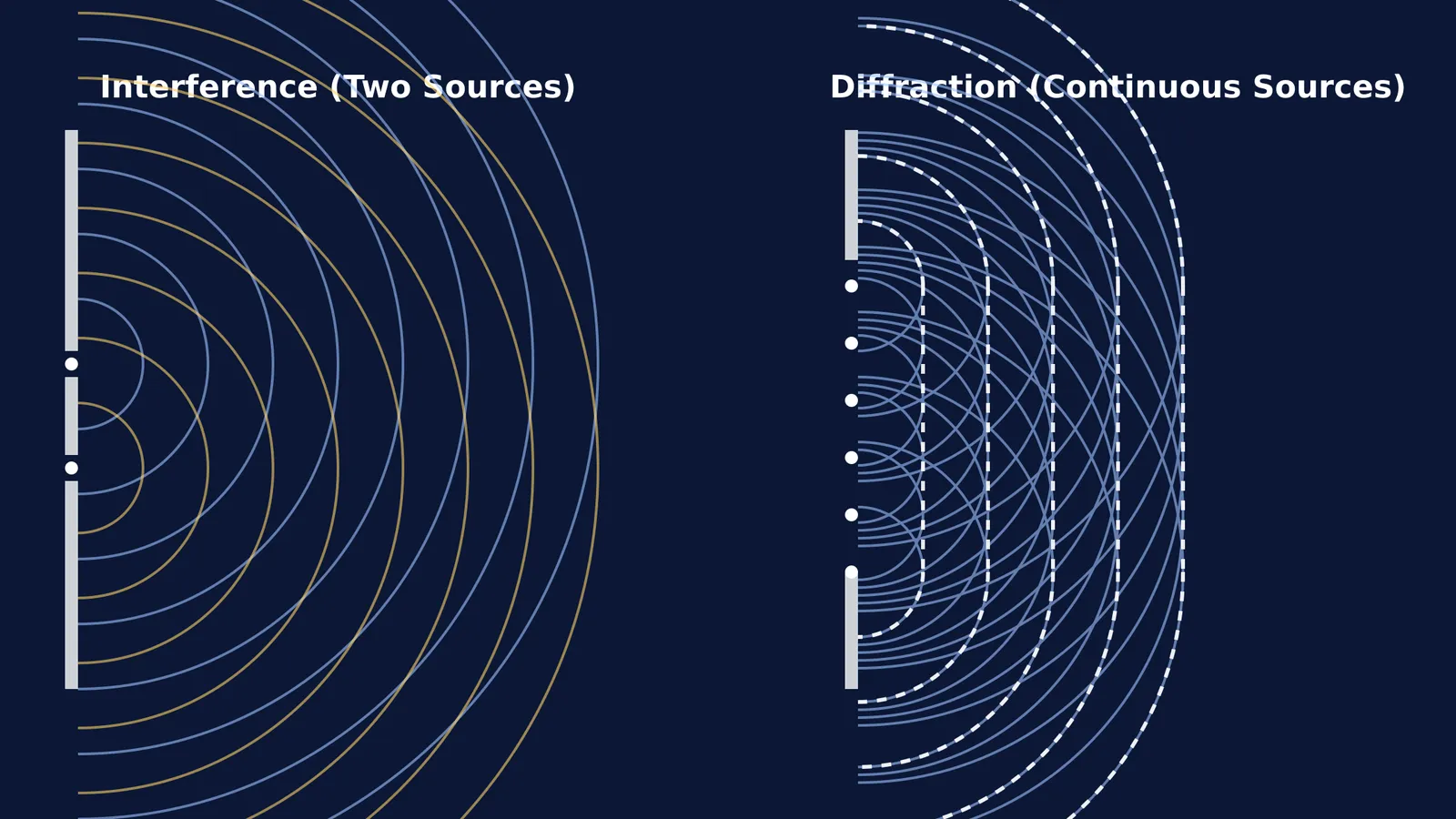
The physicist Richard Feynman famously addressed this in *The Feynman Lectures on Physics*, noting that no one has ever defined the difference satisfactorily. It is mostly a question of usage. As he put it, "when there are only a few sources, say two, interfering, then the result is usually called interference, but if there is a large number of them, it seems that the word diffraction is more often used" (Source).
What is the exact difference between interference and diffraction?
Both phenomena are driven by the exact same physical mechanism: the principle of superposition. The distinction comes down to where the overlapping wavefronts originate:
Interference is typically the superposition of waves from a discrete, small number of sources. The classic example is Young's double-slit experiment, where a wavefront is split into two distinct paths that recombine.
Diffraction is the bending of light around an obstacle or through a single opening. According to Huygens's principle, a single wide slit acts as an infinite number of tiny point sources. So, single-slit diffraction is actually the interference of countless waves originating from different parts of the same continuous wavefront.
If you are trying to picture how a wide slit acts as many tiny sources, the Fermi Simulation Lab has interactive simulations for the ideas that are easier to see than to read.
What is the difference in the fringe patterns?
Because of the number of sources involved, the bright and dark bands (fringes) that appear on a screen behave differently. According to the OpenStax *University Physics* textbook, the key visual difference lies in the width and intensity of the bands.
Interference fringes:
The bright and dark bands are of generally equal width.
The intensity of the bright fringes is relatively uniform (assuming the individual slits are extremely narrow).
Diffraction fringes:
The central maximum is twice as wide as the maxima on either side (Source).
The intensity drops rapidly as you move away from the centre.
How do you spot the difference in exam questions?
In exams like the JEE or NEET, determining whether you need the interference or diffraction formula is critical. Here is a simple framework:
Look for the number of slits: If the problem states "two coherent sources" or gives a distance between slits (d), use the interference condition for maxima: d sin θ = nλ.
Look for obstacle width: If the problem mentions a "single slit", an "aperture", or asks for the width of the central maximum, use the diffraction condition for minima: a sin θ = nλ (where a is the slit width).
You can review the derivation of both formulas and see how they are built from superposition in the Fermi Concept Library.
Why do real double-slit experiments show both?
In a real laboratory setting, the distinction blurs even further. The slits in a double-slit experiment are not infinitely narrow; they have a real width, a.
This means that light diffracts as it passes through each individual slit, and then those diffracted waves interfere with each other. The resulting pattern on your screen is a combination: the rapid fading of the diffraction pattern acts as an "envelope" that contains the evenly spaced interference fringes. This is why the bright interference fringes eventually fade out on the edges of the screen, and why certain "missing orders" occur when an interference maximum aligns with a diffraction minimum.
When you get stuck on questions where interference and diffraction overlap, the Fermi Problem Library has worked problems with a step-by-step solver that explains the reasoning rather than printing an answer. Remember that nature does not distinguish between the two — both are just waves adding up and cancelling out.


