On this page
Every bridge can sway, bounce or twist, each at its own natural frequency. Soldiers marching in step hit the deck in one rhythm. If that rhythm matches a natural frequency, each footfall adds energy at the right moment and the swing grows. Breaking step scatters the footfalls so that cannot happen.
What happened when soldiers marched in step on a bridge?
On 12 April 1831, 74 soldiers of the 60th Rifle Corps were crossing the Broughton Suspension Bridge in Salford, four abreast (Wikipedia: Broughton Suspension Bridge). The bridge began to vibrate in time with their footsteps, and some men changed their step to match it, making it worse. An iron column holding up the suspension chains fell, and one corner of the deck dropped into the river. No one died, but 20 men were injured, and the British Army then issued the order to break step when crossing bridges.
Most military manuals from the 1800s carried the same warning, and around 1860 the railway suspension bridge at Niagara Falls posted a notice that troops must be kept out of step (Taylor, Damper retrofit of the London Millennium Footbridge).
What are forced oscillation and resonance?
A forced oscillation is motion driven by a repeating outside push. Once it settles, it follows the frequency of the push, not the system's own frequency. Resonance is driving a system at its natural frequency, which gives the largest amplitude (OpenStax University Physics, Forced oscillations/Book%3A_University_Physics_I_-_Mechanics_Sound_Oscillations_and_Waves_(OpenStax)/15%3A_Oscillations/15.07%3A_Forced_Oscillations)).
For a mass m on a spring of stiffness k, with damping constant b and a driving force F0 cos(ωt), the same OpenStax chapter gives the steady amplitude as A = F0 / √[m²(ω² − ω0²)² + b²ω²], where ω0 = √(k/m). Two things follow from that one line:
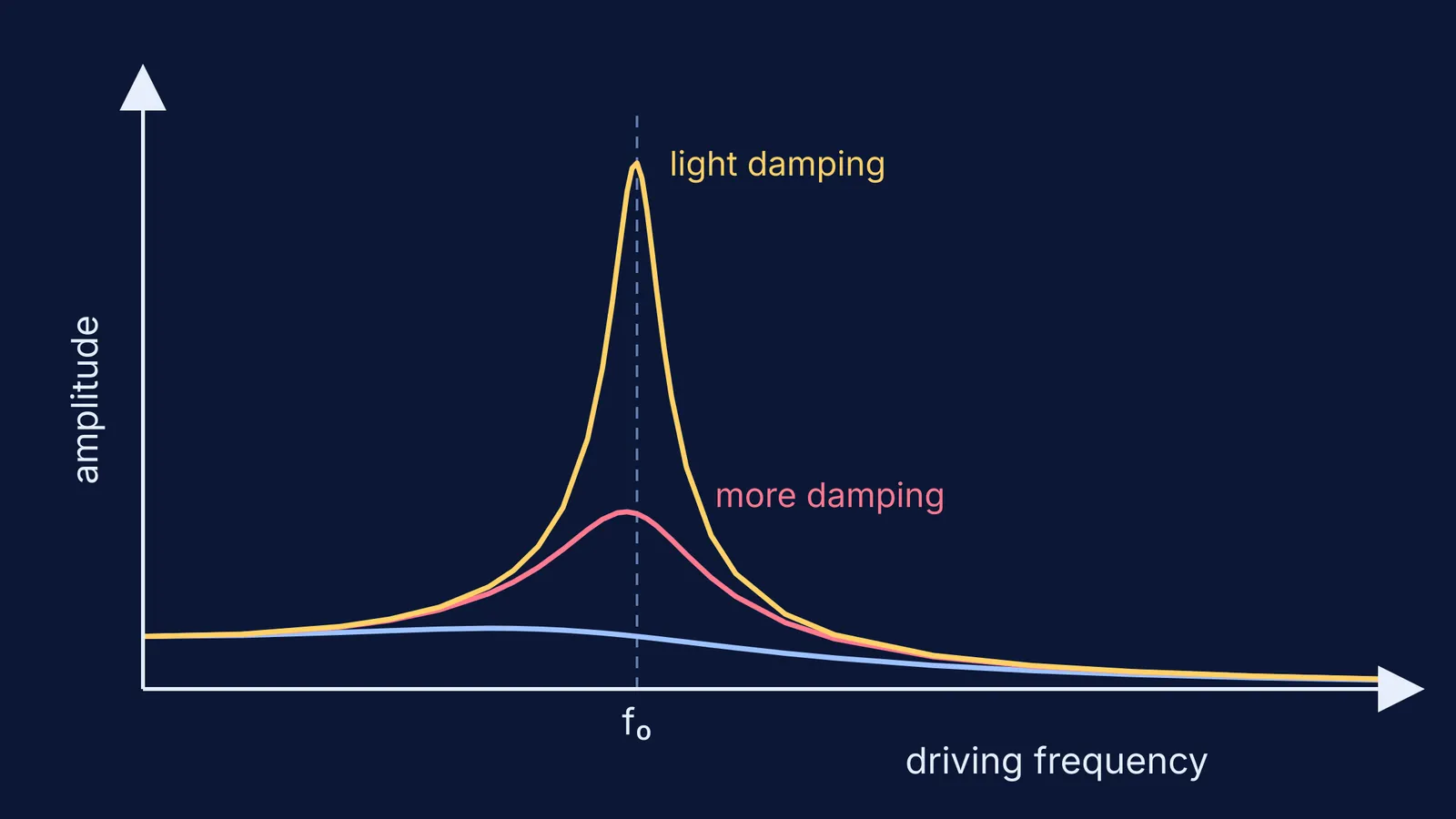
Far from ω0, the bracket is large and the amplitude stays small compared with the peak.
At ω = ω0 the first term vanishes, so only damping limits the swing. Less damping gives a taller, narrower peak.
The graph at the top plots this formula. Our damped vs forced oscillations explainer compares the two graphs.
How much does marching in step matter? A worked example
Divide the formula by the static stretch F0/k and write r = ω/ω0 and ζ = b/(2mω0). The amplification is then 1 / √[(1 − r²)² + (2ζr)²]. These numbers are illustrative, not from a real bridge.
Assume a footbridge with a natural vertical frequency of 2.0 Hz and light damping, ζ = 0.02.
A column marches at 120 steps a minute, which is 2 steps a second, so the driving frequency is 2.0 Hz and r = 1.
Amplification = 1 / (2 × 0.02) = 25. The deck moves 25 times as far as it would under a steady push of the same size.
Now march at 96 steps a minute: 1.6 Hz, so r = 0.8. Amplification = 1 / √[(0.36)² + (0.032)²] ≈ 2.8.
Break step: footfalls land at random moments, no single frequency gets a push every cycle, and the pushes partly cancel.
The factor of about nine between steps 3 and 4 is why the rule exists: the peak is sharp. Our forced oscillation resonance simulation guide shows the peak forming. The Fermi Simulation Lab has interactive simulations for ideas easier to see than to read.
Which bridges have failed or wobbled because of resonance?
Angers, France, 1850. The Basse-Chaîne suspension bridge collapsed on 16 April 1850 with 483 soldiers on it, and 226 people died (Wikipedia: Angers Bridge). A thunderstorm was making the deck oscillate, the soldiers may have fallen into step with it, and the cable anchors were corroded.
London, 2000. The Millennium Bridge opened on 10 June 2000; with up to 2,000 people on the deck it swayed sideways at 0.5 to 1.1 Hz, with accelerations up to 0.25 g, and it was closed on 12 June (Taylor, Damper retrofit). Engineers added 37 viscous dampers and 52 tuned mass dampers, and it reopened on 22 February 2002 (Wikipedia: Millennium Bridge).
In London nobody was marching. A walker pushes sideways at half their step rate, and tests found that walkers on the swaying deck fell into step with it, which Taylor calls "synchronous lateral footfall". Their combined push drove the deck at resonance.
How do you answer this question in an exam?
A three-mark answer needs four points:
Marching in step applies a periodic force, so the bridge does forced oscillations.
If the marching frequency equals a natural frequency of the bridge, resonance occurs and the amplitude becomes very large.
The large amplitude can damage or collapse the bridge.
Breaking step makes the footfalls irregular, so there is no single driving frequency to match.
Add a sketch of amplitude against frequency, peaking at f0. If damping still feels shaky, our pendulum damping practical shows amplitude falling over time. The Fermi Concept Library gives forced oscillations, resonance and damping each their own lesson and place in the map.