

On this page
Diffraction is the bending of waves around an obstacle or the spreading out of waves beyond an opening, as described by HyperPhysics. If you leave a door open, you can hear people talking in the next room even if you cannot see them. Both sound and light are waves, but their diffraction behaves entirely differently in everyday life.
The reason comes down to one relationship: the width of the gap compared to the length of the wave.
Why is diffraction noticeable only for small slits?
When a wave meets a slit of width *a*, the amount it spreads out depends on the ratio of its wavelength (λ) to that width. The mathematical condition for the central spread of a wave passing through a single slit is roughly proportional to λ/*a*.
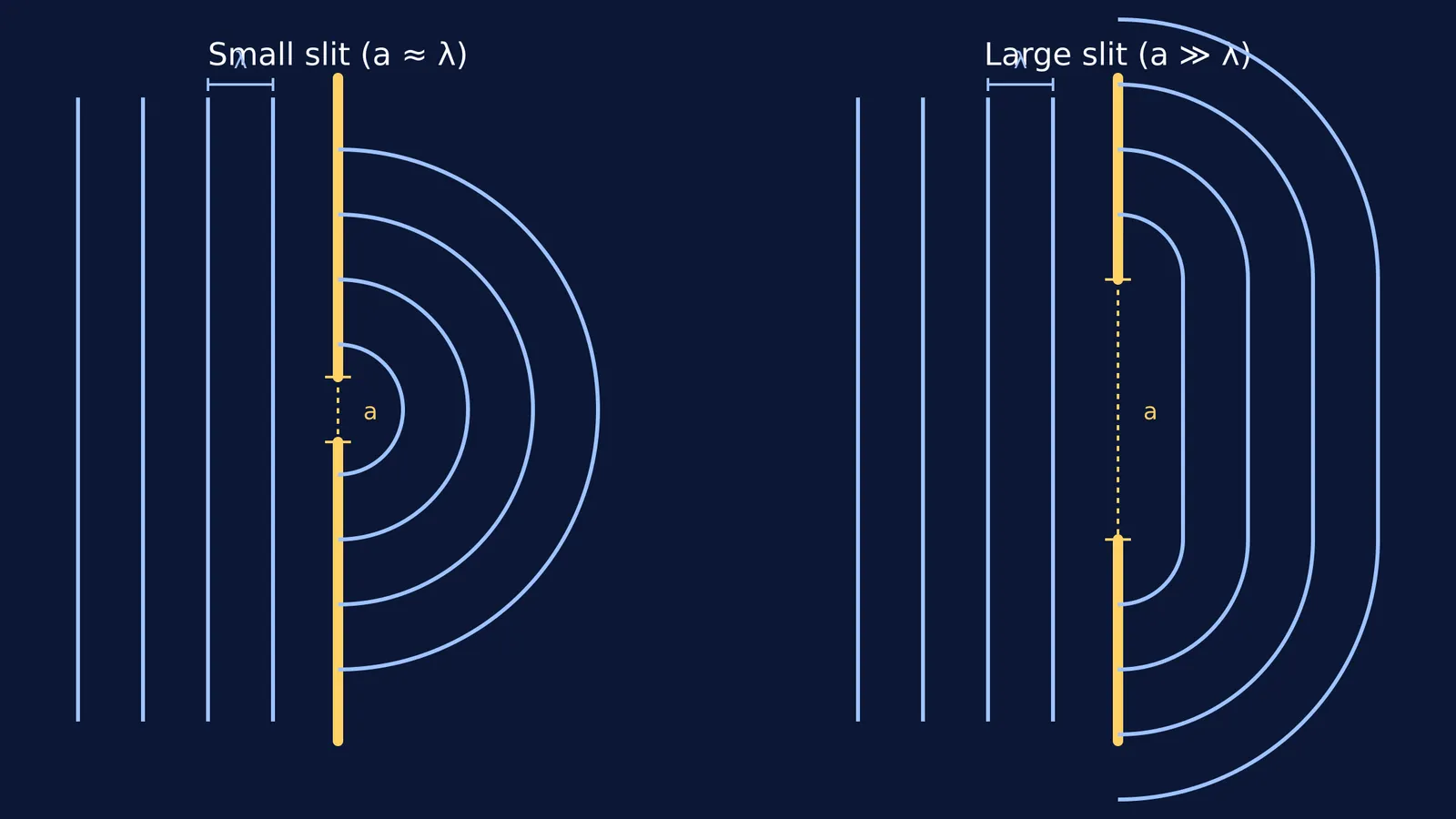
To understand this, we look at Huygens' principle, which states that every point on a wavefront acts as a source of secondary spherical wavelets. When a wave reaches a slit, the points within the gap create new wavelets that spread out. If the slit is wide, these wavelets interfere constructively mostly in the forward direction, preserving a straight path. If the slit is narrow—acting more like a single point source—the resulting wavelet spreads out in all directions, causing noticeable bending.
When a slit is much wider than the wavelength (*a* ≫ λ), the ratio is tiny. The wave travels through the gap almost entirely in a straight line, casting a sharp shadow with only a microscopic amount of bending at the edges.
When the slit is small enough to be comparable to the wavelength (*a* ≈ λ), the ratio becomes significant. The wave is forced to spread out into a wide arc. You can see this effect clearly in a ripple tank: water waves passing through a wide gap continue straight, while those passing through a narrow gap emerge as sweeping semicircles.
Why does sound bend round doors more than light?
The dramatic difference between hearing and seeing around corners is just a matter of scale.
Sound waves in air have relatively long wavelengths. At room temperature, a mid-range sound wave at 1,000 Hz has a wavelength of roughly 34 cm (HyperPhysics). A standard doorway is about 80 cm wide, which is comparable to the sound's wavelength. Because the gap size and the wavelength are on the same order of magnitude, the sound wave diffracts heavily, filling the room beyond.
Light waves, on the other hand, have incredibly short wavelengths. The visible light spectrum typically ranges from 400 to 700 nanometers (HyperPhysics). A doorway is millions of times wider than the wavelength of visible light. Therefore, light waves pass through the door in straight lines, leaving the rest of the room in a sharp shadow.
How can you master diffraction for exams?
If you are solving problems in wave optics or acoustics, knowing whether to treat a wave as a straight ray or a diffracting wavefront is key. The Fermi Concept Library contains every concept in physics, chemistry, biology, mathematics and computing, each with its own lesson and its place in the map. This helps you trace the connections between Huygens' principle, interference fringes, and single-slit diffraction.
To master the maths of diffraction patterns, including calculating angular width and locating minima, the Fermi Problem Library has worked problems with a step-by-step solver that explains the reasoning rather than printing an answer.


