On this page
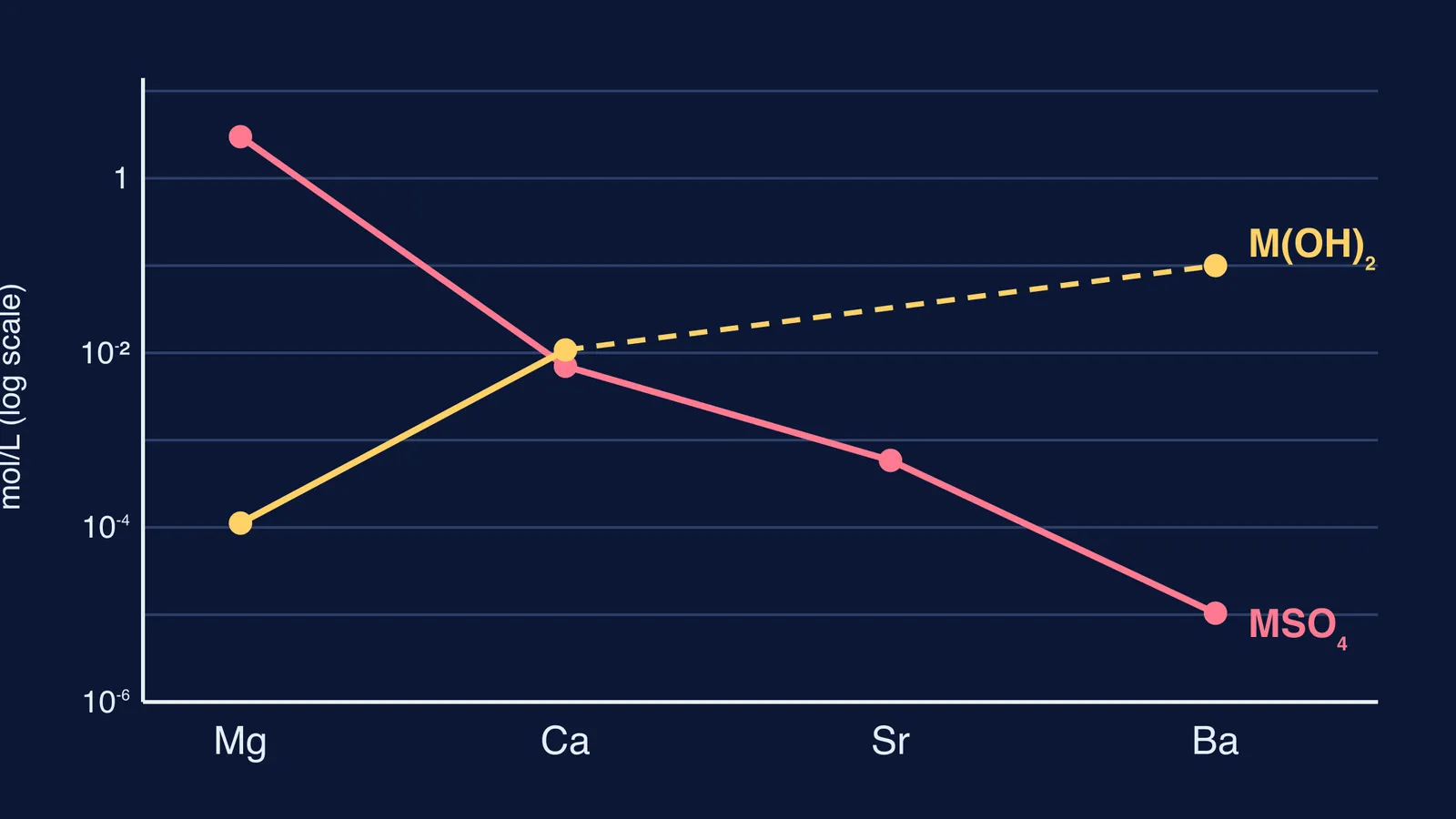
Go down Group 2 from magnesium to barium and two families of salts move in opposite directions. Magnesium sulphate dissolves easily and barium sulphate hardly at all. With hydroxides it is the reverse. Both trends come from the same two energy terms.
What are the solubility trends of Group 2 sulphates and hydroxides?
Group 2 hydroxides become more soluble going down the group, and the sulphates become less soluble, as the LibreTexts page on Group 2 hydroxides, sulphates and carbonates/Descriptive_Chemistry/Elements_Organized_by_Block/1_s-Block_Elements/Group__2_Elements%3A_The_Alkaline_Earth_Metals/1Group_2%3A_Chemical_Reactions_of_Alkali_Earth_Metals/The_Solubility_of_the_Hydroxides_Sulfates_and_Carbonates) states. The same page says about 1 g of calcium hydroxide (lime water) dissolves in a litre of water at room temperature, barium hydroxide reaches about 0.1 mol per litre, and only about 2 mg of barium sulphate dissolves per litre.
The solubility products in the LibreTexts table of Ksp values at 25 °C show the same pattern:
Sulphates: CaSO₄ 4.93 × 10⁻⁵, SrSO₄ 3.44 × 10⁻⁷, BaSO₄ 1.08 × 10⁻¹⁰.
Hydroxides: Mg(OH)₂ 5.61 × 10⁻¹², Ca(OH)₂ 5.02 × 10⁻⁶.
Magnesium sulphate is too soluble to have a useful Ksp: PubChem's record for magnesium sulphate quotes 360 g per litre of water at 20 °C.
Why does solubility of Group 2 sulphates decrease down the group?
Dissolving an ionic solid is a contest: you pay the lattice enthalpy to pull the ions apart and get back the hydration enthalpy when water surrounds them (refresher: why ionic compounds dissolve: lattice vs hydration enthalpy).
Both terms shrink down Group 2 as the cation grows; the question is which shrinks faster. Lattice enthalpy depends on the distance between the centres of the two ions, so it depends on the sum of both radii; see how ion charge and size decide the lattice energy. Hydration enthalpy of the cation depends on the cation alone.
The sulphate ion is large. As Chemguide's page on explaining Group 2 solubility puts it, with a big negative ion the inter-ionic distance is largely controlled by that ion's size, so a bigger positive ion changes the lattice enthalpy only a little. Meanwhile the hydration enthalpy of the cation falls faster from Mg²⁺ to Ba²⁺. You pay almost the same and get back less, so solubility falls.
Why does solubility of Group 2 hydroxides increase down the group?
The hydroxide ion is small, so a bigger cation makes a much larger percentage change to the distance between ions. When the cation grows from Mg²⁺ to Ba²⁺, the lattice enthalpy drops markedly: the LibreTexts Group 2 solubility page/Descriptive_Chemistry/Elements_Organized_by_Block/1_s-Block_Elements/Group__2_Elements%3A_The_Alkaline_Earth_Metals/1Group_2%3A_Chemical_Reactions_of_Alkali_Earth_Metals/The_Solubility_of_the_Hydroxides_Sulfates_and_Carbonates) lists hydroxide lattice energies falling from 2998 kJ/mol for magnesium to 2330 kJ/mol for barium. According to Chemguide, for small anions like hydroxide that fall is faster than the fall in the cation's hydration enthalpy, so dissolving becomes more favourable and solubility rises.
Worked example: turning Ksp into solubility
Use the Ksp values from the LibreTexts Ksp table.
For a sulphate MSO₄, Ksp = s², so s = √Ksp. For BaSO₄: s = √(1.08 × 10⁻¹⁰) ≈ 1.04 × 10⁻⁵ mol/L.
Convert to mass: 1.04 × 10⁻⁵ mol/L × 233.4 g/mol ≈ 2.4 mg per litre, matching the roughly 2 mg quoted earlier.
For a hydroxide M(OH)₂, Ksp = s × (2s)² = 4s³, so s = (Ksp/4)^(1/3). For Mg(OH)₂: s = (1.40 × 10⁻¹²)^(1/3) ≈ 1.1 × 10⁻⁴ mol/L.
For Ca(OH)₂: s = (1.26 × 10⁻⁶)^(1/3) ≈ 1.1 × 10⁻² mol/L, about 0.8 g/L, close to the 1 g per litre on the LibreTexts trends page/Descriptive_Chemistry/Elements_Organized_by_Block/1_s-Block_Elements/Group__2_Elements%3A_The_Alkaline_Earth_Metals/1Group_2%3A_Chemical_Reactions_of_Alkali_Earth_Metals/The_Solubility_of_the_Hydroxides_Sulfates_and_Carbonates).
So calcium hydroxide is about a hundred times more soluble in mol/L than magnesium hydroxide, while barium sulphate is about seven hundred times less soluble than calcium sulphate. Never compare Ksp values directly across the two formula types; convert to s first.
If the Ksp-to-solubility step trips you up, the Fermi Problem Library has worked problems with a step-by-step solver that explains the reasoning rather than printing an answer.
How should you write this in an exam?
Use this four-line answer and adapt the anion:
State the trend: hydroxides more soluble down the group, sulphates less soluble.
Name the two terms: solubility depends on the balance of lattice enthalpy and hydration enthalpy, and both decrease down the group.
Sulphate: the large anion means the inter-ionic distance changes little, so lattice enthalpy changes little while hydration enthalpy falls faster; solubility decreases.
Hydroxide: the small anion means lattice enthalpy falls faster than hydration enthalpy; solubility increases.
The low solubility of barium sulphate is also why it is the white precipitate in the barium chloride test for sulphate ions. To revise lattice enthalpy, hydration enthalpy and solubility as linked ideas, the Fermi Concept Library gives each concept its own lesson and its place in the map.