On this page
Clamp a metal rod at its centre, tap one end, and it rings with a high note. That note is a longitudinal standing wave: the particles move back and forth along the rod, not sideways.
What happens when a rod is clamped at the middle?
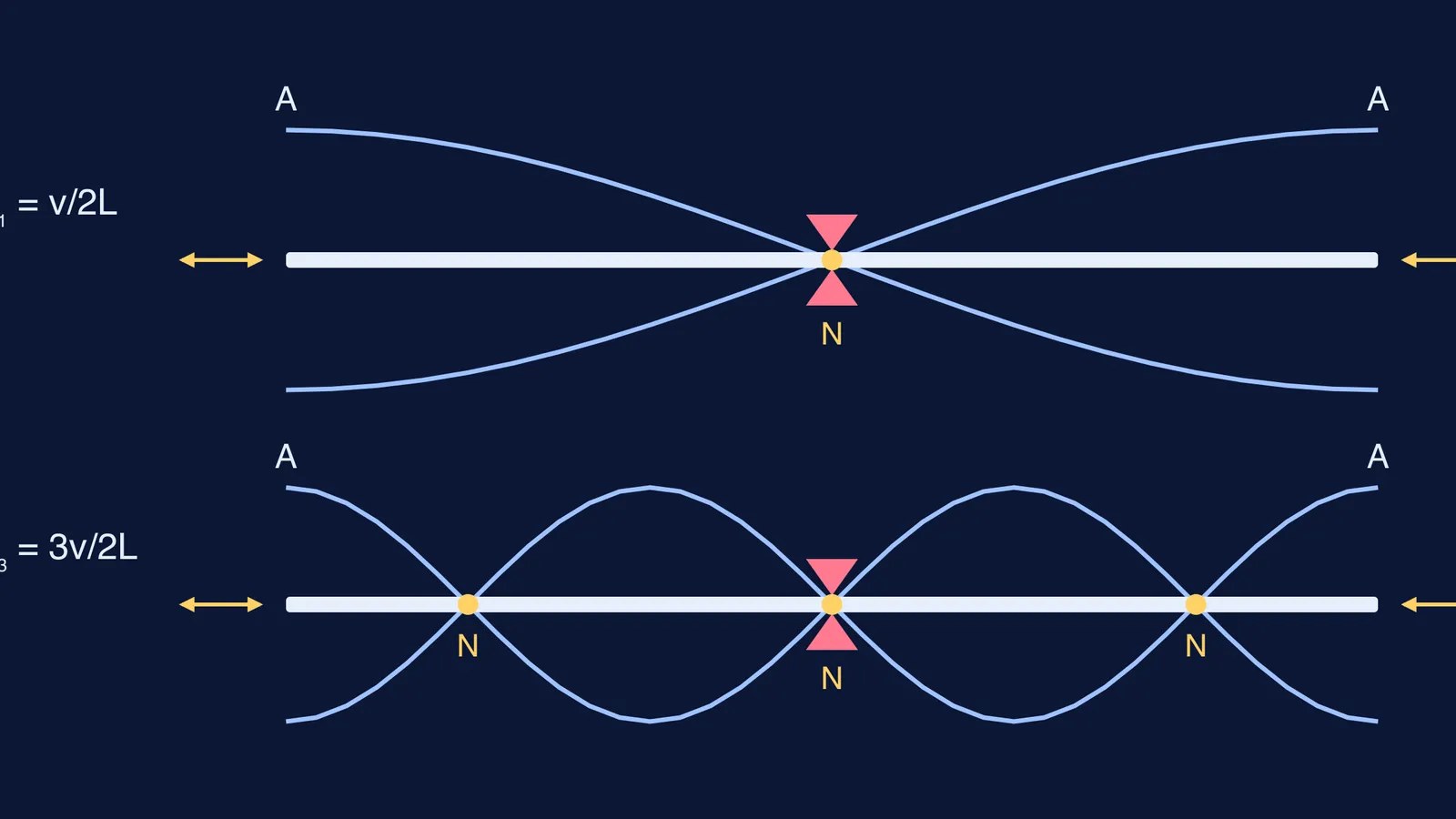
The clamp holds the centre still, so the centre is a displacement node. The two ends are free, so they move the most: they are displacement antinodes. Northwestern University's lecture demonstration notes describe a rod held at the centre ringing at the fundamental of a longitudinal wave bouncing from end to end, plus odd harmonics (3f, 5f) that have nodal points at the centre (Northwestern Physics Demos).
The distance from one antinode to the next is half a wavelength. In the fundamental mode the whole rod, end to end, is that half wavelength, so λ = 2L.
What is the frequency of a rod clamped at the middle?
Put λ = 2L into v = fλ (if that relation feels shaky, read how v = fλ works first).
Fundamental: f₁ = v/2L
Allowed modes: f = nv/2L with n = 1, 3, 5, 7...
Wave speed in a thin rod: v = √(Y/ρ), where Y is Young's modulus and ρ is the density
The thin-rod speed √(Y/ρ) (Wikipedia writes Young's modulus as E) applies when the rod's diameter is smaller than the wavelength, and it is always slightly less than the speed in a large block of the same material (Wikipedia, Speed of sound). The Engineering ToolBox table lists this rod (extensional) speed as 5180 m/s for 1% carbon steel and 5000 m/s for stainless steel, against about 5940 m/s for longitudinal waves in bulk carbon steel (Engineering ToolBox, speed of sound in solids). For a rod, use the rod value.
Why does a rod clamped at the centre give only odd harmonics?
Every mode of a free rod has antinodes at both ends. In the even modes (2f, 4f...) the centre is also an antinode, so a clamp there stops them. In the odd modes the centre is a node, so the clamp does not get in the way. It is the same logic as the missing harmonics in a string plucked at L/3.
Professor Steven Errede's Physics of Music notes at the University of Illinois show this in a real measurement (UIUC PHYS 406 notes). A 1.52 m aluminium rod held at its mid-point rang at f₁ = 1672 Hz, f₃ = 5012 Hz and f₅ = 8350 Hz, close to 1 : 3 : 5. More than 99% of the vibrational energy was in the fundamental. When the same rod was held at a quarter of its length instead, only the second harmonic appeared, at 3338 Hz.
You can check those numbers yourself: v = 2Lf₁ = 2 × 1.52 × 1672 ≈ 5080 m/s, which sits close to the 5000 m/s rod speed the Engineering ToolBox lists for rolled aluminium (Engineering ToolBox).
Worked example: a 1 m steel rod clamped at its middle
Take structural steel with Young's modulus Y = 200 GPa (Engineering ToolBox, Young's modulus) and density ρ = 7850 kg/m³ (Engineering ToolBox, metal densities). The rod is L = 1.0 m long and clamped at its centre.
Wave speed: v = √(Y/ρ) = √(2.0 × 10¹¹ / 7850) = √(2.55 × 10⁷) ≈ 5050 m/s.
Wavelength of the fundamental: λ₁ = 2L = 2.0 m.
Fundamental: f₁ = v/2L = 5050/2.0 ≈ 2520 Hz.
First overtone: f₃ = 3f₁ ≈ 7570 Hz.
Second overtone: f₅ = 5f₁ ≈ 12,600 Hz.
Sanity check: 5050 m/s is close to the 5180 m/s rod speed tabulated for carbon steel (Engineering ToolBox, speed of sound in solids). For why steel carries sound so much faster than air, see speed of sound in steel, water and air.
Now change one thing at a time. If the same rod is clamped at one end only, the clamp is a node and the free end an antinode, so L = λ/4 and f₁ = v/4L ≈ 1260 Hz, with odd harmonics. If both ends are clamped, both are nodes, so f₁ = v/2L again but every harmonic (2f, 3f...) is allowed.
Which mistakes cost marks on clamped-rod questions?
Using the bulk speed of sound for a thin rod instead of √(Y/ρ).
Writing f = v/4L because one point is clamped, without checking that both ends are free.
Listing 2f as the first overtone. With a centre clamp, it is 3f.
Forgetting to convert GPa to Pa or cm to m.
If a rod or pipe question keeps going wrong at the setup stage, the Fermi Problem Library has worked problems with a step-by-step solver that explains the reasoning rather than printing an answer. If the picture of a longitudinal standing wave is the hard part, the Fermi Simulation Lab has interactive simulations for ideas that are easier to see than to read.