On this page
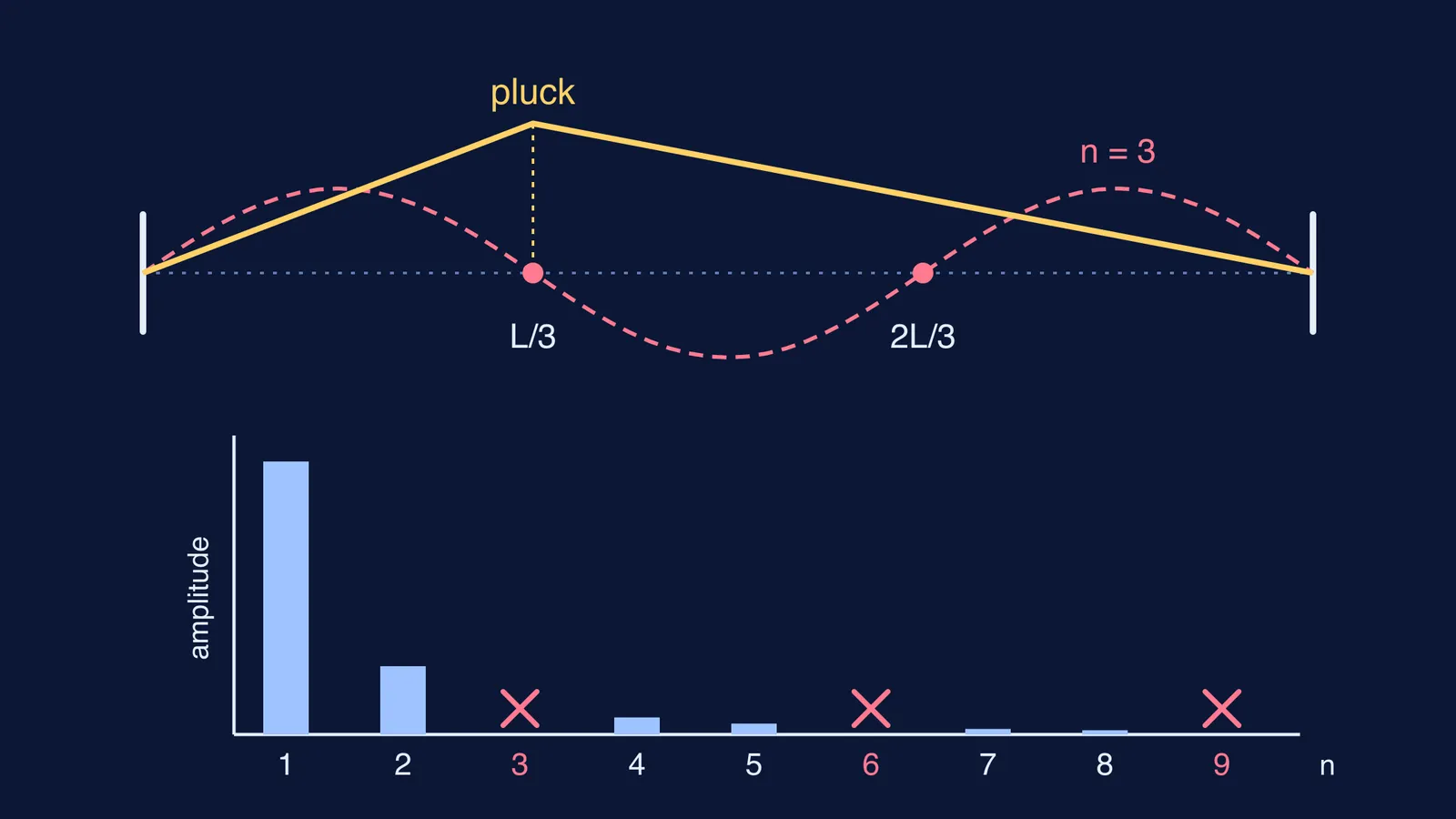
A stretched string is plucked at L/3 from one end: which harmonics are absent? The 3rd, 6th, 9th and so on. One idea explains it, and it works for any plucking point.
Why does the plucking point decide which harmonics you hear?
A string fixed at both ends can vibrate in a set of standing-wave modes. The nth mode has frequency f_n = nv/2L, where the wave speed is v = √(T/μ) for tension T and mass per unit length μ, as set out in the string vibration reference on Wikipedia. The nth mode has n − 1 nodes between the ends, spaced L/n apart.
When you pull the string aside at one point and let go, that point starts with the largest displacement of all. A mode with a node there would need that point to stay still, so the pluck cannot feed any energy into it. Cambridge engineer Jim Woodhouse puts it in one line in his online book Euphonics: "It is impossible to excite a mode of any system by driving at a nodal point."
The same page adds that a mid-point pluck excites only the odd harmonics, and a pluck at the 1/3 point misses every third harmonic.
Which harmonics are missing for each plucking point?
The exact answer comes from Fourier analysis. Daniel Russell of Penn State's Graduate Program in Acoustics shows on his plucked-string page that a string pulled aside by height h at distance d from one end has mode amplitudes A_n = (2h/n²π²) × (L²/d(L − d)) × sin(nπd/L). The same page notes that for d = L/3, the coefficients A_3, A_6, A_9, A_12 and so on are all zero.
The sine factor does the work: sin(nπd/L) is zero whenever nd/L is a whole number.
Plucked at L/2: missing 2nd, 4th, 6th (only odd harmonics remain)
Plucked at L/3 or 2L/3: missing 3rd, 6th, 9th
Plucked at L/4 or 3L/4: missing 4th, 8th, 12th
Plucked at 2L/5: missing 5th, 10th, 15th
Plucked at 3L/8: missing 8th, 16th
Reduce first: 2L/4 is really L/2, so the 2nd harmonic disappears, not just the 4th.
How do you solve a plucked-string question in an exam?
A wire 60 cm long is under tension 100 N and has mass per unit length 0.01 kg/m. It is plucked 20 cm from one end. Which frequencies are missing from the sound?
Find the wave speed: v = √(T/μ) = √(100/0.01) = 100 m/s.
Find the fundamental: f_1 = v/2L = 100/(2 × 0.6) ≈ 83.3 Hz.
Write the plucking point as a fraction: 20/60 = 1/3, so q = 3.
Missing harmonics are n = 3, 6, 9: that is 250 Hz, 500 Hz and 750 Hz.
Present harmonics include 83.3 Hz, 166.7 Hz, 333.3 Hz and 416.7 Hz.
Russell's formula also tells you how strong the survivors are. With d = L/3, sin(2π/3) has the same size as sin(π/3), so the 2nd harmonic has 1/2² = 1/4 of the fundamental's amplitude, the 4th has 1/16 and the 5th has 1/25. The diagram above plots these values.
If your answer keeps coming out wrong, the step-by-step solver in the Fermi Problem Library explains the reasoning rather than printing an answer, so you can see which step slipped.
Is plucking at L/3 the same as touching the string at L/3?
No. They do opposite things.
Plucking at L/3 makes that point move, so modes with a node there (3, 6, 9) are removed.
Touching lightly at L/3 holds that point still, so mainly the modes with a node there (3, 6, 9) sound. The UNSW Music Acoustics page on strings describes this: touching the string produces a node where you touch, so you mainly excite the mode that has a node there.
We cover the touching case in what happens when a string is touched at one-third of its length. If harmonics and overtones blur together, read overtones vs harmonics; for every node pattern, see standing waves in strings and pipes.
Can you hear the missing harmonics on a real instrument?
Yes. Euphonics notes that every guitarist knows the change in loudness and tone from plucking closer to the bridge. A pluck near the bridge makes q large, so no low harmonics are removed and the higher ones are relatively stronger, which sounds brighter. A pluck at the exact middle removes the even harmonics.
One caution: the formula assumes a sharp, point-like pluck on an ideal string. A finger has width, so on a real guitar read "missing" as "very weak".
If node positions for each mode still feel shaky, the Fermi Concept Library gives standing waves their own lesson and shows where they sit in the map of wave topics. Try the rule on L/5, 2L/7 and L/6 before your next mock test.