

On this page
When you pluck a guitar string or a sonometer wire, it vibrates in many modes at once. The lowest and loudest frequency is the fundamental, but higher frequencies called harmonics also ring in the background. If you gently rest your finger on the string at exactly one third of its length (L/3), the sound suddenly changes. The deep fundamental tone vanishes, replaced by a high, bell-like pitch.
This happens because your finger changes the boundary conditions of the vibrating string.
What happens when you force a node?
In a standing wave, a node is a point where the string does not move at all, while an antinode is a point of maximum displacement. A string fixed at both ends naturally has nodes at x = 0 and x = L.
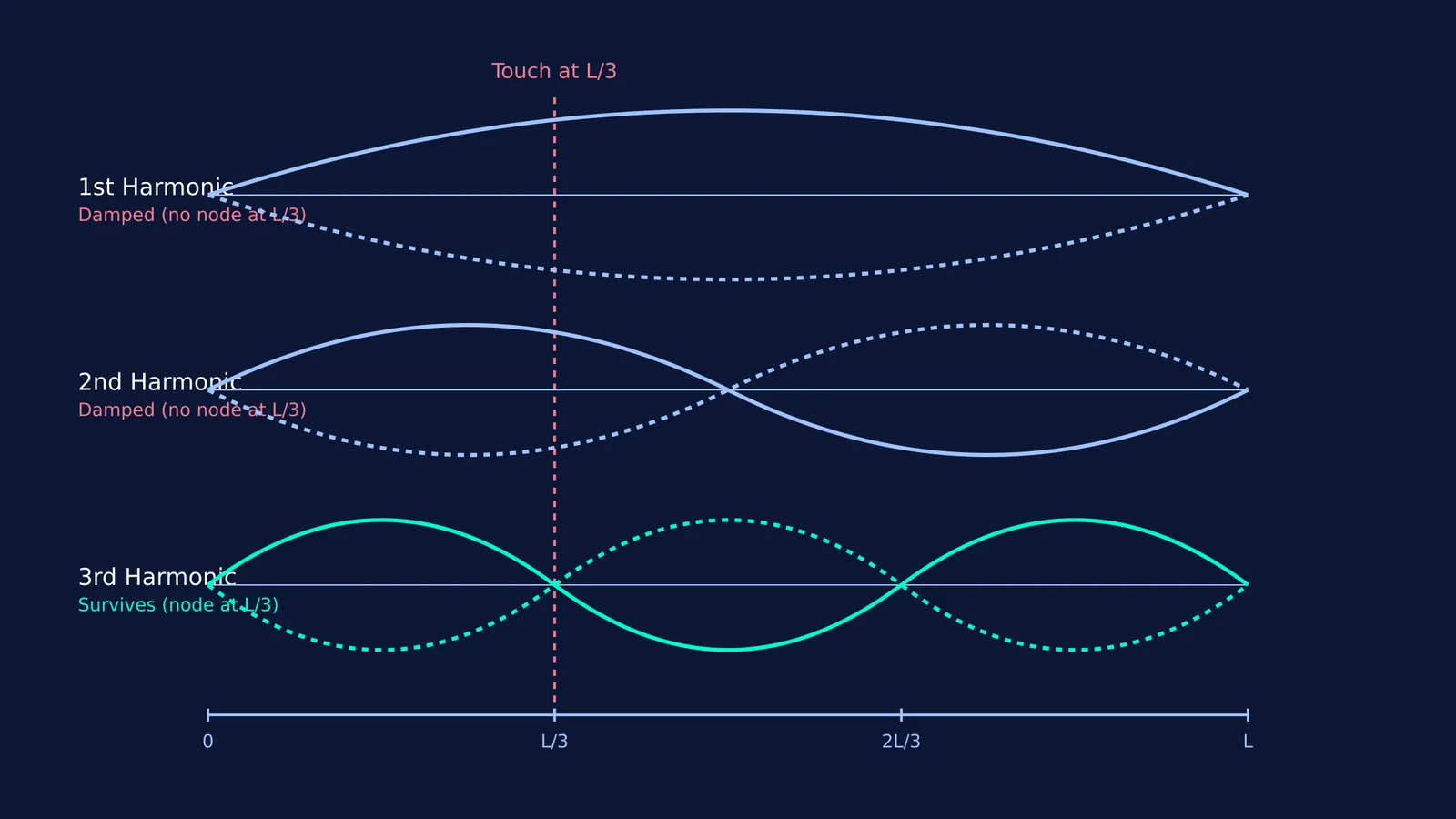
When you touch the string lightly at x = L/3, you physically prevent the string from moving at that exact spot 1. You have forced a new node. The string can now only sustain standing waves that naturally have a node at L/3. Any vibration mode that requires the string to move at the L/3 mark will transfer its energy into your finger and be damped out.
Mathematically, the displacement of a standing wave on a string of length L is described by a sine function, proportional to sin(nπx/L), where n is the harmonic number. For the nodes to exist, the sine term must be zero. The natural nodes occur at positions where nπx/L is an integer multiple of π. Therefore, the nodes for any given harmonic n are located at x = 0, L/n, 2L/n, and so on up to L. When you enforce a node at a specific position, only those harmonics whose natural node positions exactly match that spot can persist.
Which harmonics remain when a string is touched at one third?
Only harmonics that are multiples of 3 will remain. The 3rd harmonic is the lowest and most prominent of these surviving frequencies.
Here is why the other modes disappear:
The 1st harmonic (fundamental): This mode is a single half-wave across the entire string. It only has nodes at the two ends. At L/3, the string expects to be swinging widely. Your finger stops this motion, so the fundamental dies out instantly.
The 2nd harmonic: This mode has two half-waves and an extra node exactly in the middle (L/2). However, at L/3, the string is still moving. Therefore, the 2nd harmonic is also damped out.
The 3rd harmonic: This mode divides the string into three equal segments. It has natural nodes at L/3 and 2L/3. Because the string is already stationary at the L/3 mark, your finger does not interfere with it. The 3rd harmonic survives and continues to ring at three times the fundamental frequency 1.
Higher multiples like the 6th and 9th harmonics also share a node at L/3 and will remain, but they carry much less energy, so your ear primarily hears the 3rd harmonic.
How is this used in physics and music?
Musicians use this exact technique to play "natural harmonics". By lightly touching a string at specific fractions of its length—like L/2 for the octave, or L/3 for the twelfth—they can pick out high, pure tones without pressing the string down to the fretboard.
In a physics lab, you might test this yourself. When running The sonometer experiment: frequency, length and tension worked, you can slide a paper rider to the L/3 mark, strike the tuning fork, and watch how the wire resonates only when the conditions match. For a broader view of how these rules apply to open and closed tubes, you can compare the math in Standing waves in strings and pipes: harmonics and end corrections.
If you find it hard to picture how different boundary conditions create nodes and antinodes, the Fermi Concept Library maps out the mathematics of standing waves visually. You can also pluck and damp a virtual string in the Fermi Simulation Lab, watching in real time as the forbidden harmonics fade away and the allowed ones survive.


