

On this page
What is the difference between harmonics and overtones?
Every vibrating acoustic medium has natural frequencies known as normal modes. The lowest natural frequency is the fundamental frequency, f₁. Although the terms harmonic and overtone are often used interchangeably, they measure two distinct properties.
A harmonic is an integer multiple of the fundamental frequency (n × f₁, where n = 1, 2, 3...). The fundamental is the 1st harmonic (1 × f₁), while 2f₁ is the 2nd harmonic and 3f₁ is the 3rd harmonic. Harmonics form a mathematical sequence regardless of whether a given pipe physically produces that frequency.
An overtone is any physical resonance frequency produced by a system above its fundamental. The first resonant frequency heard above the fundamental is the 1st overtone, the next is the 2nd overtone, and so on. Overtones count physical resonance states rather than mathematical multiples.
In Hermann von Helmholtz's 1863 work, translated by Alexander J. Ellis in 1875, Helmholtz termed these higher modes upper partial tones. Ellis noted that calling them "overtones" caused confusion because the first overtone is the second partial. Research by Liang Zeng and colleagues (2014) on textbook treatments of pipe standing waves confirmed that relating physical boundary conditions to harmonic numbers remains a persistent stumbling block for physics students.
Why is the first overtone of an open pipe the second harmonic?
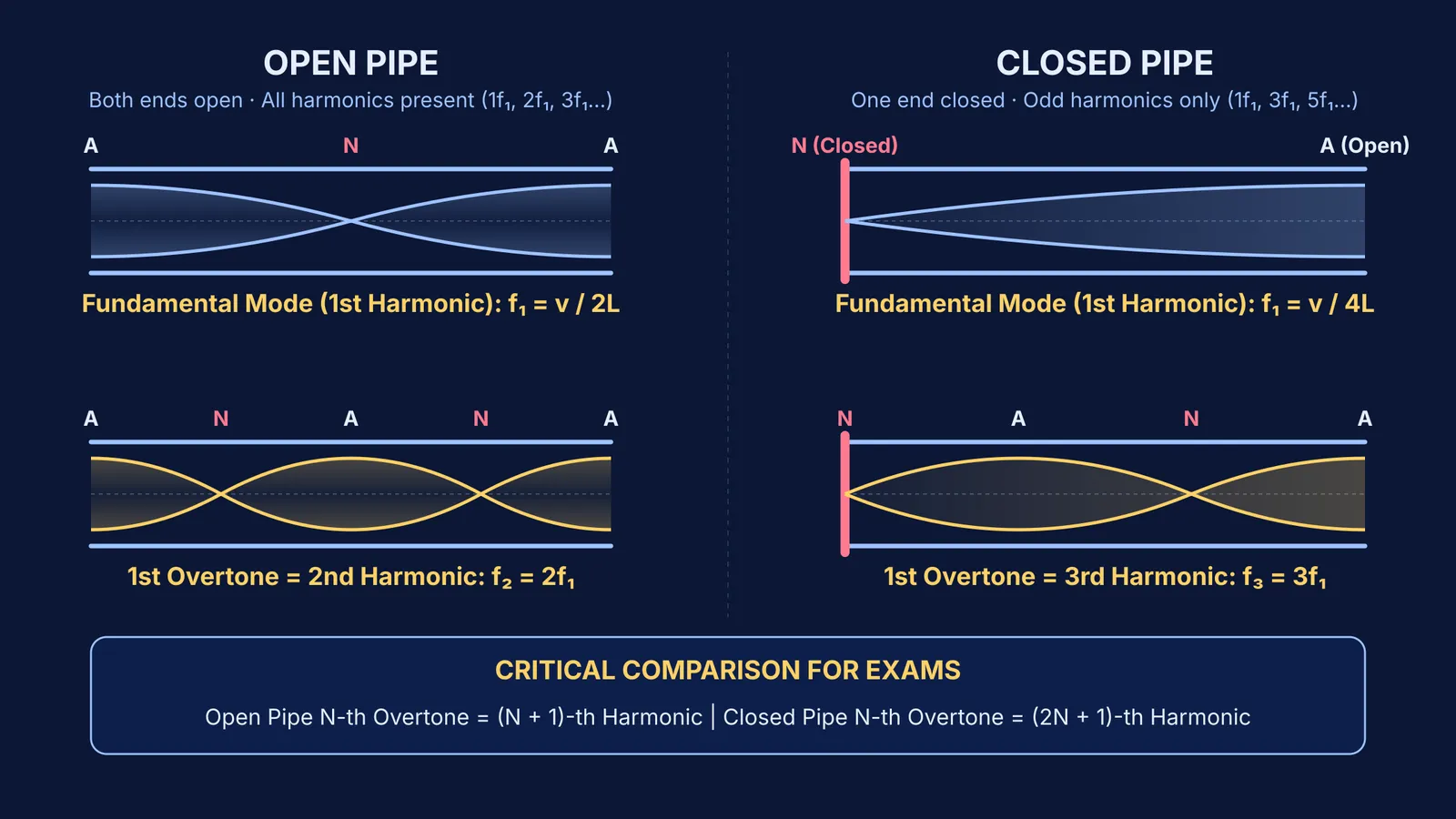
An open organ pipe is open to the air at both ends. Because air molecules move freely at an open boundary, each end forms a displacement antinode and a pressure node. For details on how pressure and displacement differ, see our guide to displacement and pressure waves in sound.
As explained in OpenStax University Physics, displacement antinodes at both ends require the pipe length L to contain an integer number of half-wavelengths: L = n(λ / 2), where n = 1, 2, 3... The allowed frequencies are:
fₙ = n × (v / 2L)
For n = 1, the fundamental frequency is f₁ = v / (2L), which is the 1st harmonic.
The next physical mode occurs at n = 2, where L = λ and the frequency is f₂ = 2 × (v / 2L) = 2f₁. Because this is the first physical resonance above the fundamental, it is the 1st overtone. Because its frequency is 2 times f₁, it is also the 2nd harmonic. In an open pipe, all integer harmonics exist: the 2nd overtone is the 3rd harmonic (3f₁), and the N-th overtone is the (N + 1)-th harmonic. For complete wave profiles, see our overview of standing waves in strings and pipes.
Why does a closed pipe skip even harmonics?
A closed pipe is sealed at one end and open at the other. The rigid closed boundary forces a displacement node, while the open end forms a displacement antinode.
Because boundary conditions are asymmetric, the pipe length L must accommodate an odd number of quarter-wavelengths: L = (2m − 1)(λ / 4), with m = 1, 2, 3... The resonant frequencies are:
f = (2m − 1) × (v / 4L)
For m = 1, the fundamental frequency is f₁ = v / (4L). As acoustic physicist Thomas Rossing (1986) noted, an ideal closed pipe sounds an octave lower (half the frequency) than an open pipe of the same length because its fundamental wavelength is twice as long (4L versus 2L).
The 2nd harmonic, 2f₁ = v / (2L), requires a half-wavelength (L = λ / 2). But a half-wavelength standing wave requires identical boundaries at both ends. Because a closed pipe has a node at one end and an antinode at the other, 2f₁ cannot form a standing wave.
The first physical resonance above the fundamental occurs at m = 2, where L = 3λ / 4:
f = 3 × (v / 4L) = 3f₁
This mode is the 1st overtone because it is the first frequency above the fundamental, but it is the 3rd harmonic because its frequency is 3 times f₁. Closed pipes produce only odd harmonics (1f₁, 3f₁, 5f₁...). The N-th overtone is the (2N + 1)-th harmonic. This odd-harmonic sequence is measured experimentally in the resonance tube speed of sound practical.
How do you convert between overtones and harmonics in exam numericals?
In competitive exams like JEE Main and NEET, questions frequently test conversions between pipe types based on standard resonance models, such as those presented in OpenStax University Physics. Use this direct translation:
Open pipe: N-th overtone = (N + 1)-th harmonic = (N + 1)f₁
Closed pipe: N-th overtone = (2N + 1)-th harmonic = (2N + 1)f₁
Consider a classic problem: an open pipe of length 60 cm resonates such that its 2nd overtone matches the frequency of the 3rd overtone of a closed pipe. What is the length of the closed pipe?
Open pipe: L_open = 0.60 m. Fundamental frequency f_open,1 = v / (2 × 0.60) = v / 1.20. The 2nd overtone is the 3rd harmonic (N + 1 = 3), giving f = 3 × (v / 1.20) = 2.50v.
Closed pipe: With length L_closed, f_closed,1 = v / (4L_closed). The 3rd overtone is the 7th harmonic (2N + 1 = 7), giving f = 7v / (4L_closed).
Equating frequencies: 2.50v = 7v / (4L_closed) yields 4L_closed = 7 / 2.50 = 2.80 m, so L_closed = 0.70 m = 70 cm.
Mistaking the 3rd overtone of the closed pipe for the 3rd harmonic yields 30 cm instead of 70 cm.
When practicing wave numericals, the Fermi Problem Library provides worked problems with a step-by-step solver that explains the reasoning rather than printing an answer. To review the underlying wave equations, the Fermi Concept Library catalogs every concept in physics, chemistry, biology, mathematics and computing, each with its own lesson and its place in the map. To observe displacement patterns animate across open and closed pipes, the Fermi Simulation Lab offers interactive simulations for ideas that are easier to see than to read.


