

On this page
In JEE and board exams, one of the most frequently tested inorganic reactions is how halogens react with alkalis. Chlorine's reaction with sodium hydroxide (NaOH) is a classic example of disproportionation—a chemical reaction where the same element is both oxidised and reduced simultaneously. The final products change entirely depending on the temperature and concentration of the alkali used.
Understanding this difference stops you from having to memorise equations blindly. Let us look at what happens in the beaker, why the temperature matters, and how to work out the exact products yourself using oxidation states.
What is the reaction of chlorine with cold dilute NaOH?
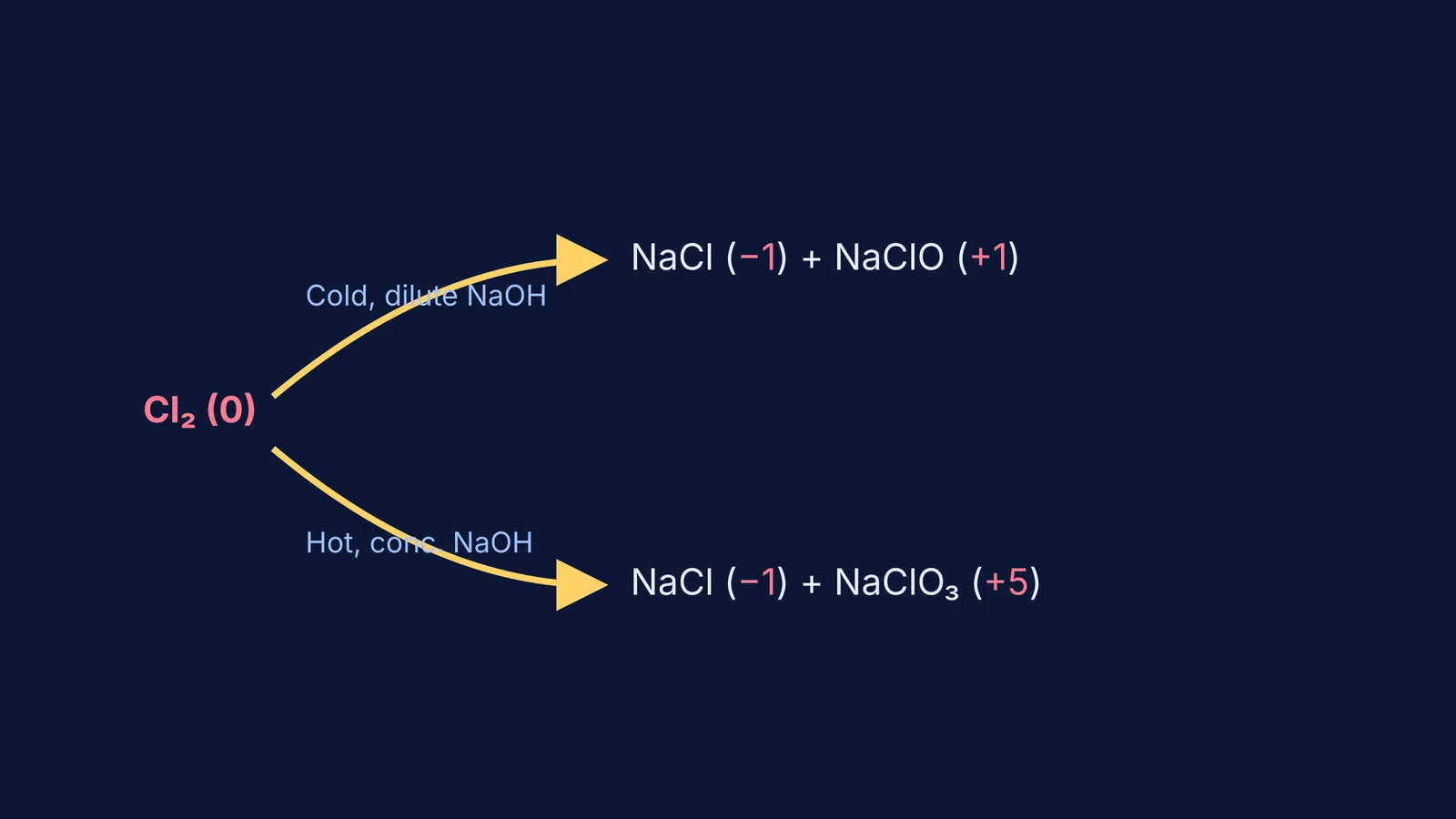
When chlorine gas is bubbled through a cold, dilute solution of sodium hydroxide (typically kept at room temperature or below), it forms a mixture of sodium chloride (NaCl) and sodium hypochlorite (NaClO), alongside liquid water.
The chemical equation is: Cl₂ + 2NaOH → NaCl + NaClO + H₂O
Here, the chlorine molecule, which starts with an oxidation state of 0, splits its fate. One chlorine atom is reduced to the chloride ion (Cl⁻) with an oxidation state of −1. The other chlorine atom is oxidised to the hypochlorite ion (ClO⁻), taking an oxidation state of +1. Because both reduction and oxidation happen to the exact same element, this is defined as a disproportionation reaction. The resulting solution is a mixture of salt and hypochlorite, which is commonly used as commercial household bleach Wikipedia.
What is the reaction of chlorine with hot concentrated NaOH?
If you heat the sodium hydroxide solution to around 70 °C, the reaction takes a different path Wikipedia. The hypochlorite ion (ClO⁻) formed initially is thermally unstable at higher temperatures. It disproportionates further to give a much more highly oxidised product.
The overall chemical equation is: 3Cl₂ + 6NaOH → 5NaCl + NaClO₃ + 3H₂O
In this hot and concentrated environment, a large portion of the chlorine still goes down to an oxidation state of −1 in sodium chloride. However, the oxidised product is now sodium chlorate (NaClO₃), where the chlorine atom reaches a much higher oxidation state of +5.
How do you balance the hot concentrated reaction?
Memorising the 3:6 ratio for the hot reaction often leads to mistakes under the pressure of an exam. Instead, you can balance it quickly using the oxidation state method. If you are ever stuck on a balancing problem or redox equation, the Fermi Problem Library has step-by-step solvers that walk you through redox reactions by explaining the reasoning rather than just printing the final coefficients.
Here is a simple worked example for balancing the hot concentrated reaction:
Write the skeleton disproportionation showing the ions: Cl₂ → Cl⁻ + ClO₃⁻
Split into oxidation and reduction half-reactions. The reduction half is Cl₂ → 2Cl⁻ (this requires 2 electrons). The oxidation half is Cl₂ → 2ClO₃⁻ (chlorine goes from 0 to +5, so each atom loses 5 electrons, meaning 10 electrons are lost in total).
Balance the electrons by multiplying the reduction half by 5, giving 5Cl₂ + 10e⁻ → 10Cl⁻.
Add the two half-reactions together to get 6Cl₂ → 10Cl⁻ + 2ClO₃⁻.
Simplify the coefficients by dividing everything by 2 to get 3Cl₂ → 5Cl⁻ + ClO₃⁻.
Add the spectator sodium ions (Na⁺) to both sides and balance the oxygen by adding 3H₂O on the right side, giving the final balanced equation: 3Cl₂ + 6NaOH → 5NaCl + NaClO₃ + 3H₂O.
This systematic method works every time and relies purely on understanding the underlying oxidation states rather than rote learning.
Is this pattern the same for other halogens?
This temperature-dependent behaviour is not unique to chlorine. Bromine and iodine follow the exact same reaction pattern with alkalis. They form hypobromite or hypoiodite in cold dilute conditions, and they form bromate or iodate in hot concentrated conditions.
Fluorine, however, is a notable exception. Because it is the most electronegative element in the periodic table, it cannot exhibit positive oxidation states and therefore does not undergo disproportionation in the same way. Instead, fluorine reacts with dilute NaOH to give oxygen difluoride (OF₂), and with concentrated NaOH to give oxygen gas (O₂) Wikipedia.
To explore these trends across Group 17 in more detail, you can find the complete halogen lessons in the Fermi Concept Library, which maps out every concept in inorganic chemistry and shows exactly how they connect.
For a broader look at industrial inorganic chemistry, review the Contact process for sulphuric acid. You can also see how halogens bond with each other in our guide to Interhalogen compounds: shapes of ClF3, BrF5 and IF7 for JEE, or learn how they substitute onto benzene rings in the Sandmeyer and Gattermann reactions: replacing the diazo group.


