On this page
When a question asks why CsCl has a coordination number of 8 while NaCl has 6, the answer starts with one division: cation radius over anion radius.
What is the radius ratio rule?
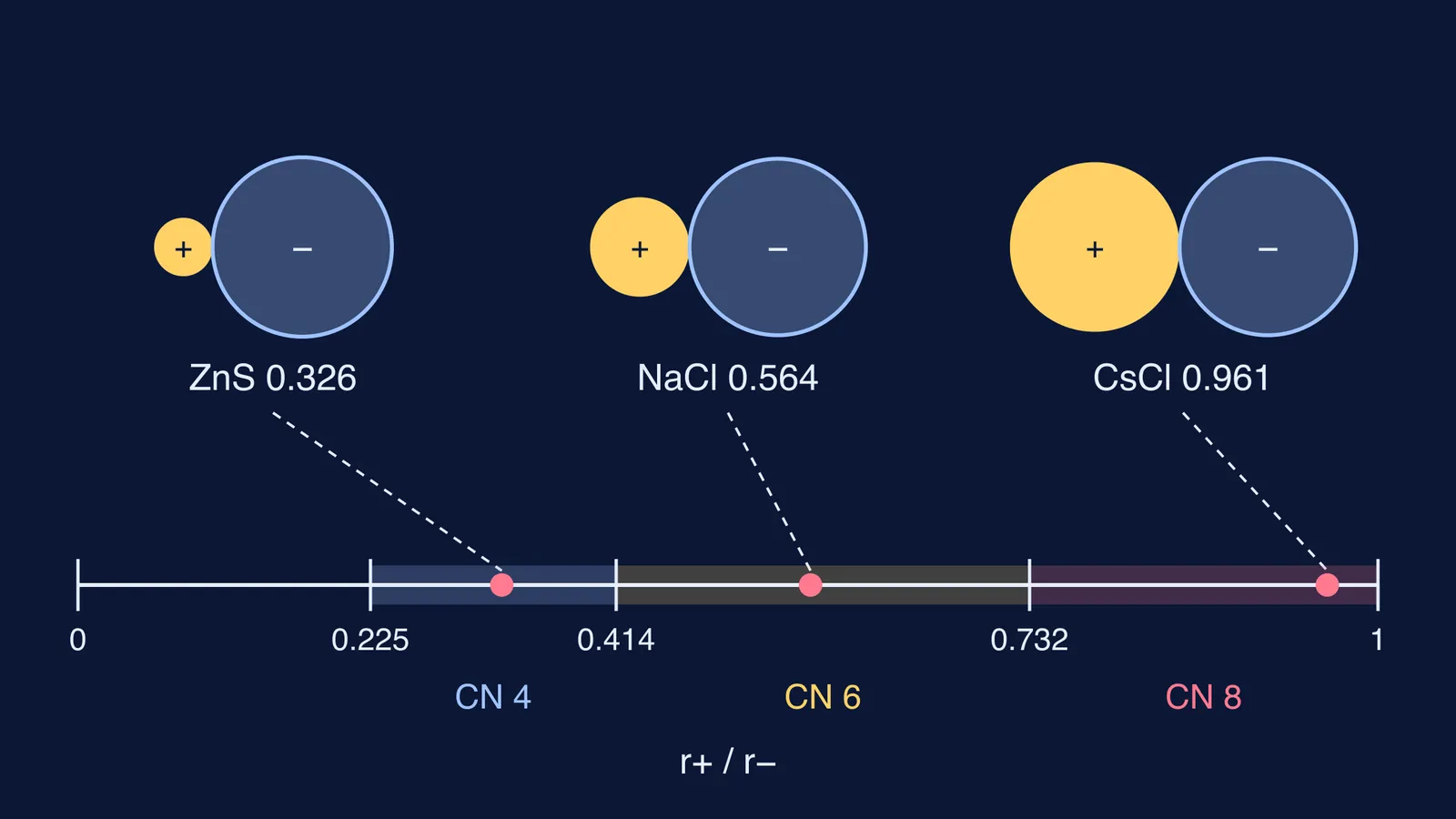
The radius ratio rule says that r+/r−, the cation radius divided by the anion radius, decides how many anions can pack around a cation. The LibreTexts inorganic chemistry text/09:_Ionic_and_Covalent_Solids_-_Energetics/9.01:_Ionic_Radii_and_Radius_Ratios) credits the first such rules to Linus Pauling, who considered how to pack oppositely charged spheres of different radii. If a cation is too small for a site, the anions bump into each other before they touch it, and a lower coordination number wins.
Its table gives:
0.225 to 0.414: coordination number 4, tetrahedral
0.414 to 0.732: coordination number 6, octahedral
0.732 to 1.0: coordination number 8, cubic
The Cambridge crystal models page on CsCl and NaCl gives the same 0.414 and 0.732 limits for the NaCl and CsCl structures.
Where do 0.225, 0.414 and 0.732 come from?
Each limit is the ratio at which the cation just touches every anion around it while the anions also just touch each other.
Octahedral (CN 6): four of the six anions sit in a square around the cation. Neighbouring anions touch, so the square's edge is 2r−. Across the diagonal, 2r+ + 2r− = √2 × 2r−, which gives r+/r− = √2 − 1 = 0.414.
Cubic (CN 8): the anions sit at the corners of a cube with edge 2r−. Along the body diagonal, 2r+ + 2r− = √3 × 2r−, which gives r+/r− = √3 − 1 = 0.732.
Tetrahedral (CN 4): the same idea inside a tetrahedron gives √(3/2) − 1 = 0.225.
Our post on edge length and atomic radius in simple cubic, bcc and fcc uses the same body diagonal.
How do you predict the structure of NaCl, CsCl and ZnS?
The usual radius table is R. D. Shannon's 1976 paper on revised effective ionic radii in Acta Crystallographica A, which gives a different radius for each coordination number. The six-coordinate values below are listed in the Wikipedia ionic radius table; the others come from the KnowledgeDoor Shannon-Prewitt listing and its zinc page.
The radii: Na+ is 102 pm and Cl− is 181 pm, both six-coordinate; Cs+ is 174 pm when eight-coordinate; Zn2+ is 60 pm when four-coordinate; S2− is 184 pm, its six-coordinate value.
NaCl: 102 ÷ 181 = 0.564. That sits between 0.414 and 0.732, so predict CN 6, the rock-salt structure.
CsCl: 174 ÷ 181 = 0.961. That is above 0.732, so predict CN 8, the caesium chloride structure.
ZnS: 60 ÷ 184 = 0.326. That sits between 0.225 and 0.414, so predict CN 4, the zinc blende structure.
All three predictions match the real crystals: the Wikipedia page on the cubic crystal system gives six octahedral neighbours in rock salt, a cube of eight in CsCl and four tetrahedral neighbours in zinc blende.
Does the prediction survive a different radius?
Radii change with coordination number, so test your answer. For CsCl, swap in the six-coordinate Cs+ radius of 167 pm from the KnowledgeDoor listing: 167 ÷ 181 = 0.923, still above 0.732, so CN 8 holds. For ZnS, swap in the six-coordinate Zn2+ radius of 74 pm from the zinc page: 74 ÷ 184 = 0.402, still below 0.414, so CN 4 holds. If the prediction stays put under both radii, trust it. If it flips, the salt is a borderline case.
Why does the radius ratio rule sometimes fail?
The rule treats ions as hard spheres held together only by charge, and neither is quite true. LibreTexts/09:_Ionic_and_Covalent_Solids_-_Energetics/9.01:_Ionic_Radii_and_Radius_Ratios) points out that the radii of individual ions are not known exactly and that atoms in crystals have a varying degree of covalency, and it says the rule predicts only about half of the alkali halide structures correctly. So use the ratio as a first prediction, not a law.
A five-step routine for exam questions
Write r+ and r− in the same unit, taken from the same table.
Divide cation by anion. If you get a number above 1, check you have not divided the wrong way round.
Place the ratio against 0.225, 0.414 and 0.732.
Name the result: CN 4 is the zinc blende type, CN 6 the rock-salt type, CN 8 the CsCl type.
If the ratio lands very close to a limit, say it is borderline rather than certain.
For the next step, holes in the lattice, see finding a formula from tetrahedral and octahedral voids. For which ion is bigger, see how to rank ionic radii of isoelectronic species.
If solid-state numericals keep going wrong at the same step, the Fermi Problem Library has worked problems with a step-by-step solver that explains the reasoning rather than printing an answer. For the packing geometry itself, the Fermi Concept Library gives each concept its own lesson and its place in the map.
Try the routine on KCl next, with radii from the same table, and check whether your answer survives the radius swap.