On this page
The question reads: "Atoms of B form ccp and atoms of A occupy 2/3 of the tetrahedral voids. What is the formula of the compound?" It is really a counting problem, and once you know two numbers it takes four lines.
This post gives you those two numbers, a four-step method, worked examples, and a way to check your answer against real crystals.
How many voids are there in ccp and hcp?
In both hexagonal close packing (hcp) and cubic close packing (ccp), there is one octahedral hole and two tetrahedral holes per packing atom, according to Chemistry LibreTexts on close packing and interstitial sites.
So for N atoms in the packing:
octahedral voids: N
tetrahedral voids: 2N
An atom in a tetrahedral void touches four packing atoms; an atom in an octahedral void touches six. You do not need to draw the unit cell to get the formula. You only need these two counts.
How do you find the formula from voids occupied?
Use the same four steps every time.
Take one atom of the element that forms the packing. Call its count 1.
Count the voids of the type the question names: 1 octahedral or 2 tetrahedral per packing atom.
Multiply by the fraction occupied. That is the number of atoms of the other element per packing atom.
Write the ratio and clear the fractions with the smallest whole number.
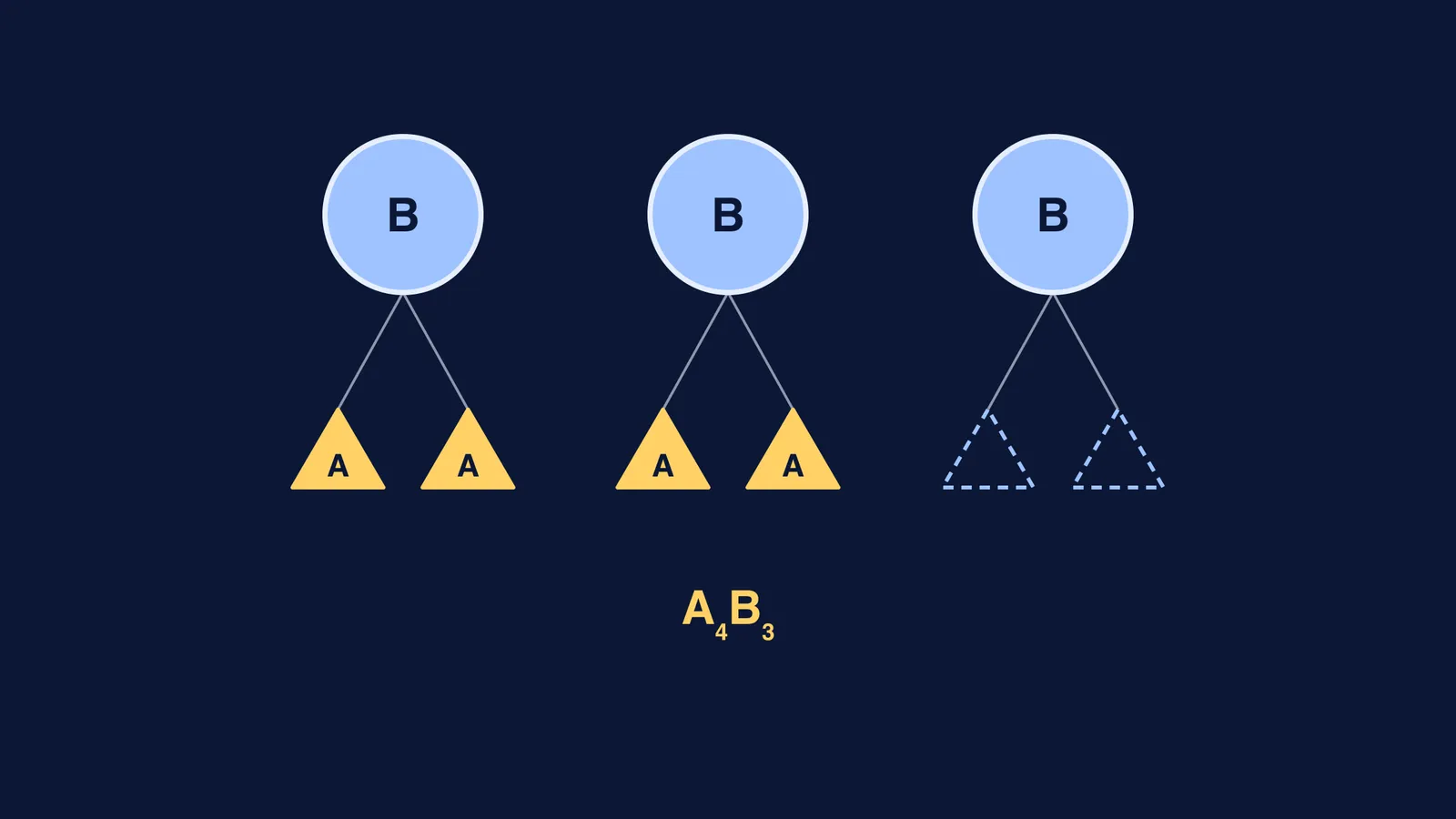
What is the formula if B forms ccp and A occupies 2/3 of tetrahedral voids?
Work it through:
B = 1.
Tetrahedral voids = 2 × 1 = 2.
A = 2 × 2/3 = 4/3.
A : B = 4/3 : 1. Multiply both by 3 to get 4 : 3.
The formula is A₄B₃. If the question said hcp instead of ccp, the answer would not change, because both packings have the same number of voids per atom.
If you prefer unit cells, you get the same result. A ccp (FCC) unit cell holds 4 atoms, so it has 4 octahedral and 8 tetrahedral voids; in fluorite, 8 fluoride ions fill all the tetrahedral sites of a cell of 4 calcium ions. Here A = 8 × 2/3 = 16/3 against 4 atoms of B, which again simplifies to 4 : 3.
If a void question goes wrong in a mock, try a similar one in the Fermi Problem Library, where a step-by-step solver explains the reasoning rather than printing an answer, so you can see which of the four steps slipped.
How do you check your answer against real compounds?
The Chemistry LibreTexts chapter on lattice structures in ionic solids describes these three, and each one passes the four-step test:
Corundum, Al₂O₃: aluminium ions sit in two-thirds of the octahedral holes of close-packed oxide ions. Per O: Al = 1 × 2/3, so Al : O = 2 : 3.
Fluorite, CaF₂: fluoride ions occupy all the tetrahedral sites of the array of calcium ions. Per Ca: F = 2 × 1 = 2, so CaF₂.
Zinc blende, ZnS: Zn²⁺ ions sit in half of the tetrahedral holes. Per S: Zn = 2 × 1/2 = 1, so ZnS.
Notice that in fluorite the cation forms the packing, not the anion. Always read which element forms the lattice before you start counting.
What if two elements fill different voids?
Here is the harder version: oxide ions form ccp, A occupies 1/8 of the tetrahedral voids and B occupies 1/2 of the octahedral voids.
O = 1.
Tetrahedral voids = 2; octahedral voids = 1.
A = 2 × 1/8 = 1/4; B = 1 × 1/2 = 1/2.
A : B : O = 1/4 : 1/2 : 1. Multiply by 4 to get 1 : 2 : 4.
The formula is AB₂O₄. Now check the charge. If A is +2 and B is +3, the positive charge is 2 + 2 × 3 = 8, and four oxide ions carry 4 × 2 = 8 negative. It balances. Whenever a question gives charges, run this check: a wrong fraction often gives a formula whose charges do not balance.
If close packing itself still feels hazy, the Fermi Concept Library covers every concept in chemistry, each with its own lesson and its place in the map.
Is this topic still in the syllabus?
In the current NCERT Class 12 chemistry book, Unit 1 is Solutions, not The Solid State (NCERT, reprint 2026-27). Syllabuses differ by exam and board and change from year to year, so check the current official syllabus for your exam before deciding how much time to give void problems. The counting method is the same wherever they appear.
Next time you meet one, write "1 O, 2 T" in the margin before you read the fractions.