On this page
Count every living thing in a grassland, level by level, and you get the textbook pyramid. In the NCERT Class 12 Biology chapter on ecosystems, a grassland count runs from 5,842,000 producers to 708,000 primary consumers, 354,000 secondary consumers and just 3 tertiary consumers. Count the life on one big tree instead and the bottom of the pyramid shrinks to a single individual. Here is why, and why energy never flips.
Why is the pyramid of numbers inverted in a tree?
A pyramid of numbers counts individuals at each trophic level and ignores how big each one is. The same NCERT ecosystem chapter asks you to count the insects on a big tree, then the small birds that eat them, then the larger birds that eat those, and draw the shape.
Try it with a mango or neem tree near your home:
Producer: one tree.
Primary consumers: caterpillars, aphids and other leaf-eating insects. Far more than one.
Secondary consumers: small birds that eat the insects. Fewer.
Tertiary consumers: a larger bird that hunts the small ones. Fewer still.
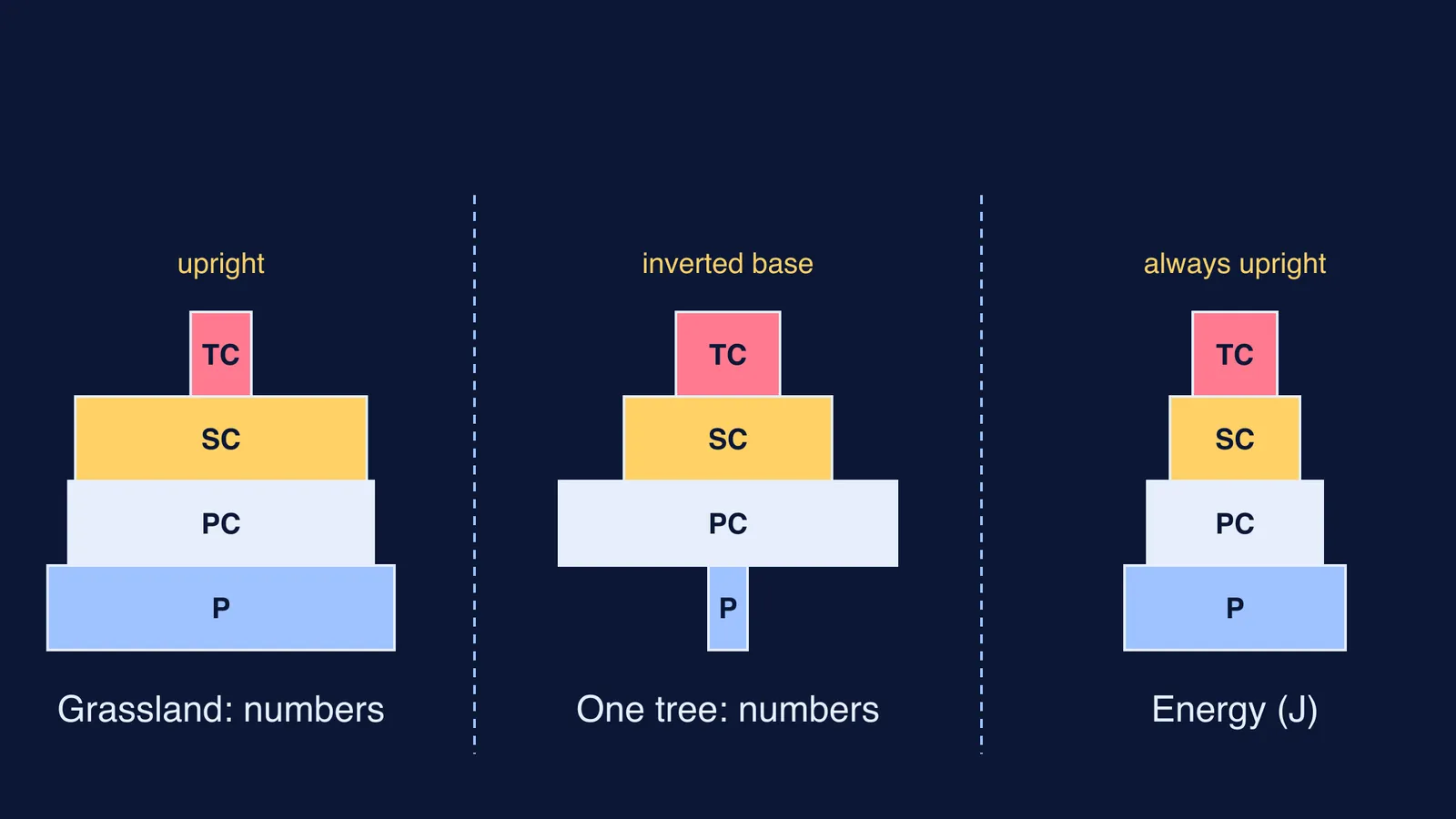
The base is narrower than the level above it, so the pyramid of numbers is inverted. Strictly, the top narrows again, which is why some books call it a spindle; either way, the producer bar is the smallest. NCERT's end-of-chapter exercise tests exactly this, as a fill-in-the-blank: "In an ecosystem dominated by trees, the pyramid (of numbers) is ___ type." The expected answer is inverted.
The puzzle disappears once you weigh the tree: one tree holds far more living mass than the insects on it.
Grassland vs a single tree: what changes and what does not?
Producers: many small grass plants versus one large tree.
Pyramid of numbers: upright in the grassland, inverted on the tree.
Pyramid of biomass: upright in both, because the grass or the tree outweighs what eats it.
Pyramid of energy: upright in both, and in every other ecosystem.
Biomass has its own exception in the sea, explained in why the pyramid of biomass is inverted in the sea. For the links in a grassland food chain, see our guide to the grassland ecosystem and its food web.
Why can the pyramid of energy never be inverted?
NCERT states it plainly: "Pyramid of energy is always upright, can never be inverted, because when energy flows from a particular trophic level to the next trophic level, some energy is always lost as heat at each step" (NCERT Class 12 Biology, Chapter 12).
The same chapter explains why:
Energy flows one way, from the sun to producers to consumers.
Under the 10 per cent law, only about 10 per cent of the energy at one trophic level is transferred to the next.
Plants capture only 2 to 10 per cent of photosynthetically active radiation, which is itself less than 50 per cent of incoming sunlight.
NCERT's ideal energy pyramid runs from 1,000,000 J of sunlight to 10,000 J in producers, then 1,000 J, 100 J and 10 J up the chain.
Energy is a flow: NCERT notes each bar shows energy "in a given time or annually per unit area". For a level to receive more energy than the level feeding it, energy would have to appear from nowhere, which the first law of thermodynamics rules out.
Worked example: the same tree, two pyramids
Suppose (an illustrative figure, not a measurement) one neem tree stores 40,000 kJ in a year. Apply the NCERT 10 per cent law:
Tree: 1 individual, 40,000 kJ
Leaf-eating insects: thousands of individuals, about 4,000 kJ
Small birds: a few dozen, about 400 kJ
One hawk: 1 individual, about 40 kJ
The count column is inverted at the base; the energy column, each bar a tenth of the one below, is upright. Same tree, different question. For more practice, try our 10 per cent law numericals, worked backwards.
How do you write this in a board or NEET-UG answer?
Use this four-step check on any pyramid question:
Ask what is being measured: number, biomass or energy.
Look at the producer. One large tree can flip the number pyramid; phytoplankton can flip the biomass pyramid.
Energy has one answer: always upright, because heat is lost at every transfer.
Write the reason, not just the shape.
A model answer: "In a tree ecosystem, a single large producer supports a large number of herbivorous insects, so the pyramid of numbers is inverted. The pyramid of energy stays upright because energy is lost as heat at each transfer."
If you keep mixing up count, stock and flow, the Fermi Concept Library covers every concept in biology, alongside physics, chemistry, mathematics and computing, each with its own lesson and its place in the map.
Next time you pass a big tree, count what lives on it. You will have drawn the exception yourself.