

On this page
Energy flow numericals look different every time, but almost all of them are one idea used forwards or backwards.
What is the 10 percent law of energy flow?
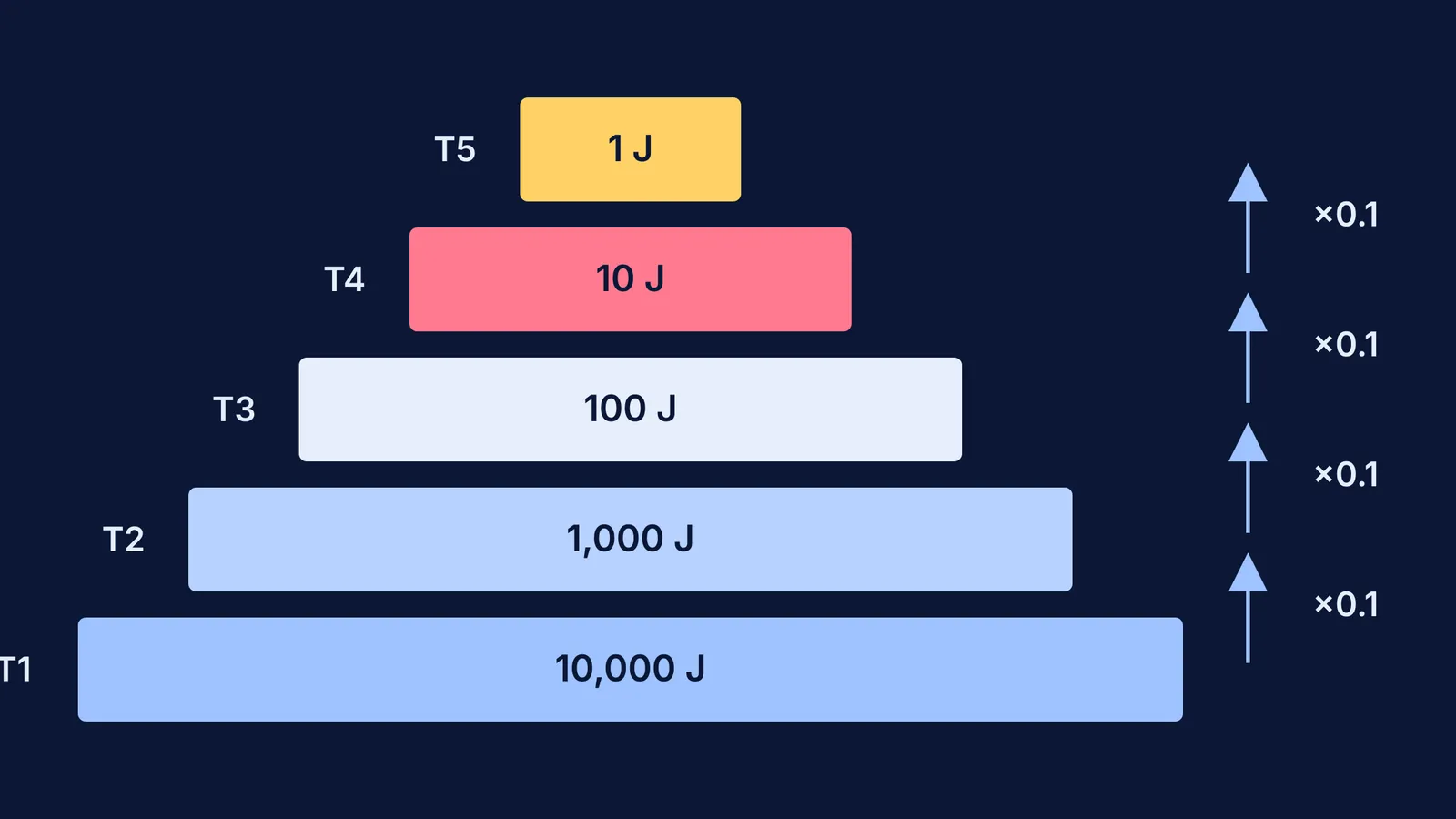
The 10 percent law states that only about 10% of the energy at one trophic level is transferred to the next (National Geographic Education). A large share of the rest escapes as heat during respiration, and much of the remainder ends up with decomposers, where most of it is also lost as heat.
Textbooks trace the idea to Raymond Lindeman, who measured the energy budget of a lake in The Trophic-Dynamic Aspect of Ecology, published in Ecology in 1942. We tell the story of that work in Raymond Lindeman and the energy budget of a lake.
The 10% figure is a rule of thumb, not a constant. The efficiency of transfer between two levels is called the trophic level transfer efficiency, and in the Silver Springs ecosystem in Florida it was about 14.48% between the first two levels (OpenStax Biology 2e). In school and exam questions, use 10% unless the question gives you a different figure.
How do you calculate energy at each trophic level?
Number the levels: producers are T1, primary consumers (herbivores) T2, secondary consumers T3, tertiary consumers T4. With a 10% transfer at each step (National Geographic Education), the energy at level n is:
E(n) = E(1) × (0.1)^(n − 1)
The exponent is n − 1 because there is one transfer fewer than the number of levels. The most common slip: four organisms make only three arrows.
Worked example: grass fixes 20,000 J in the chain grass → grasshopper → frog → snake → hawk.
Grasshopper (T2): 20,000 × 0.1 = 2,000 J
Frog (T3): 2,000 × 0.1 = 200 J
Snake (T4): 200 × 0.1 = 20 J
Hawk (T5): 20 × 0.1 = 2 J
Check with the formula: 20,000 × (0.1)^4 = 2 J.
How do you work back from the top consumer?
Questions often give a top consumer's energy and ask what the producers fixed. Flip the operation: going down one level means multiplying by 10, because the level below must hold ten times as much for 10% of it to reach the one above (National Geographic Education).
E(1) = E(n) × 10^(n − 1)
Worked example: a tertiary consumer (T4) receives 15 J. How much energy did the producers fix?
Count the steps: T4 to T1 is three transfers.
Multiply by 10 for each: 15 × 10 × 10 × 10 = 15,000 J.
Sense check: the answer must be larger than every level above it.
If the question gives a different efficiency, divide by it instead of multiplying by 10. At 20% efficiency, each step down is ÷ 0.2, so the same 15 J at T4 needs 15 ÷ (0.2)^3 = 1,875 J at T1.
The same logic explains why pyramids of energy are always upright (OpenStax Biology 2e): each level must hold more energy than the one it feeds.
Why are food chains so short?
The low efficiency of energy transfer is usually the major factor limiting the length of food chains, and after four to six transfers there is not enough energy left to support another trophic level (OpenStax Biology 2e). National Geographic gives five as the maximum number of trophic levels most ecosystems can support (National Geographic Education).
Run the numbers from our first example. At 10% per step, T5 gets 0.01% of the producer energy, and a T6 predator would get 0.001%. That is why few ecosystems support more than five levels.
How animals use their food matters too. OpenStax notes that the net production efficiency of ectotherms is generally about ten times that of endotherms, with a caterpillar eating leaves measured at 18% and a squirrel eating acorns as low as 1.6% (OpenStax Biology 2e). Net production efficiency is not the same as transfer efficiency, but it shows why real transfers stray from 10%.
For how productivity at the base sets the whole budget, see our notes on ecosystem productivity and decomposition.
What should you check before writing the answer?
Did you count transfers (arrows), not organisms?
Are you going up (× 0.1) or down (× 10)?
Did the question give an efficiency other than 10%? Use it.
Did it start from sunlight? Convert to producer energy first.
Is the unit the same throughout (J, kJ or kcal)?
Does each lower level have more energy than the one above?
If a question mixes efficiencies or levels and you get stuck, the Fermi Problem Library has worked problems with a step-by-step solver that explains the reasoning rather than printing an answer. For the ideas underneath, such as trophic levels, productivity and ecological pyramids, each concept has its own lesson in the Fermi Concept Library.
Try it now: if a hawk at T5 receives 3 J, how much did the grass fix? (Answer: 3 × 10^4 = 30,000 J.)


