

On this page
Grassland questions look easy until the exam asks what happens if one species disappears. Then you need to see how energy moves and which links hold the system together. Here is the structure, a worked energy example, and a method for removal questions.
What are the components of a grassland ecosystem?
NCERT's Class 12 chapter Ecosystem splits every ecosystem into abiotic and biotic components and names grassland as a terrestrial ecosystem. For a grassland, that gives you:
Abiotic: sunlight, soil and its minerals, water, temperature and day length.
Producers: grasses and other herbs, which fix the Sun's energy by photosynthesis.
Primary consumers (herbivores): grasshoppers, cows, deer, rabbits and other grazers.
Secondary and tertiary consumers: frogs, birds, snakes, wolves and hawks.
Decomposers: fungi and bacteria that break dead matter into simple inorganic substances.
Decomposers are heterotrophic organisms, mainly fungi and bacteria, that get their energy and nutrients by breaking down dead organic matter, according to NCERT. The same chapter says plants capture only 2-10 per cent of the photosynthetically active radiation, and that small amount sustains the entire living world.
What is the food chain in a grassland ecosystem?
NCERT's own example of a grazing food chain is grass to goat to man (NCERT, section 12.4). A longer chain you can draw for a grassland is grass to grasshopper to frog to snake to hawk, with five trophic levels.
Energy shrinks at every step. NCERT states the 10 per cent law: only about 10 per cent of the energy at one trophic level is transferred to the next (NCERT). Here is a worked example if the grass fixes 10,000 kJ:
Grass (producer): 10,000 kJ
Grasshopper (primary consumer): 1,000 kJ
Frog (secondary consumer): 100 kJ
Snake (tertiary consumer): 10 kJ
Hawk (top carnivore): 1 kJ
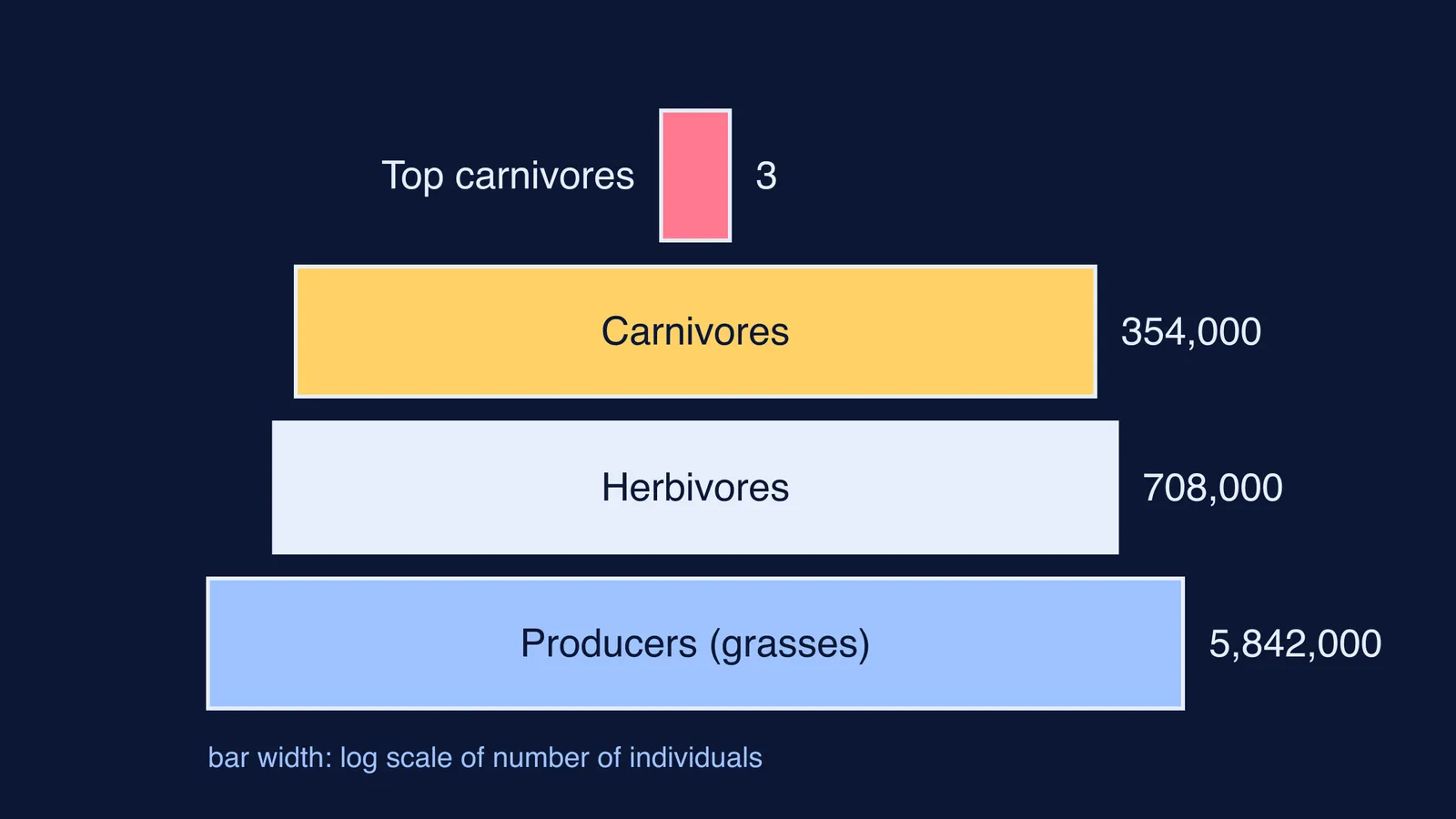
That is why grassland chains rarely go beyond four or five levels. The NCERT pyramid of numbers for a grassland shows 5,842,000 producers supporting 708,000 primary consumers, 354,000 secondary consumers and only 3 top carnivores (NCERT, Figure 12.4a). For more practice with these sums, see our guide to ten per cent law energy flow calculations.
How does a grassland food chain become a food web?
Real grasslands are not single lines. Frogs and birds both eat grasshoppers; a hawk eats snakes and rats. When chains cross like this, you get a food web.
NCERT notes that in a terrestrial ecosystem a much larger fraction of energy flows through the detritus food chain than through the grazing food chain (NCERT). Dead grass, dung and carcasses feed earthworms, fungi and bacteria, which return nutrients to the soil for the next season of grass. Our explainer on detritus vs grazing food chains covers the difference in detail.
What happens when grazers are removed from a grassland?
Two well-studied grasslands show that the grass does not simply thrive; the whole system changes shape.
In North American tallgrass prairie, Alan Knapp and colleagues reviewed research on bison at Konza Prairie in Kansas (Knapp et al., BioScience, 1999). Bison eat mostly grass; forbs (broad-leaved flowering plants) and woody plants usually make up less than 10 per cent of their diet. In frequently burned prairie without grazing, a small group of grasses such as big bluestem accounts for most of the biomass, and species richness is low. Where bison graze, the forbs get room to grow, and the authors report significant increases in plant species diversity.
The Serengeti in East Africa shows the same logic in reverse. A cattle disease, rinderpest, kept wildebeest numbers low until it was eradicated in the 1960s. After that the population increased about six-fold in roughly 15 years, according to UBC Reports on zoologist Anthony Sinclair's research. A 2009 model by Ricardo Holdo, Sinclair and colleagues found that this rise in grazers led to a widespread fall in fire and an ongoing recovery of trees (Holdo et al., PLoS Biology, 2009). So when grazers were scarce, uneaten grass built up, fuelled fires and held trees back.
How do you answer a 'what if grazers are removed' question?
Work in four steps. Here they are, applied to removing all grazers from a grassland:
Draw the web first. Grass, grazers, their predators, decomposers.
Look up the web. Predators such as wolves or hawks lose food and decline, or switch to other prey.
Look down the web. Grass is no longer eaten, so it builds up; a few dominant grasses can crowd out other plants.
Look sideways. More dead grass means more fuel for fire and more litter for decomposers, which changes trees and soil.
A full answer names at least one effect up, down and sideways. To test your answers by removing species yourself, try our food web removal simulation. If terms like trophic level or standing crop still feel shaky, each has its own lesson in the Fermi Concept Library, so you can fix the gap before your next test.


