

On this page
Every ecosystem needs a continuous flow of energy to survive. This energy travels through a series of organisms in what we call a food chain. However, not all food chains start with a green leaf and a hungry herbivore.
Depending on where you look—a deep ocean or a forest floor—the ecosystem relies on two entirely different pathways to move its energy: the grazing food chain (GFC) and the detritus food chain (DFC). Understanding how they divide the work is a key concept in ecology and a frequent topic in biology exams.
What is the difference between a grazing and a detritus food chain?
The core difference between the two chains lies in their starting point and primary energy source (NCERT Class 12 Biology).
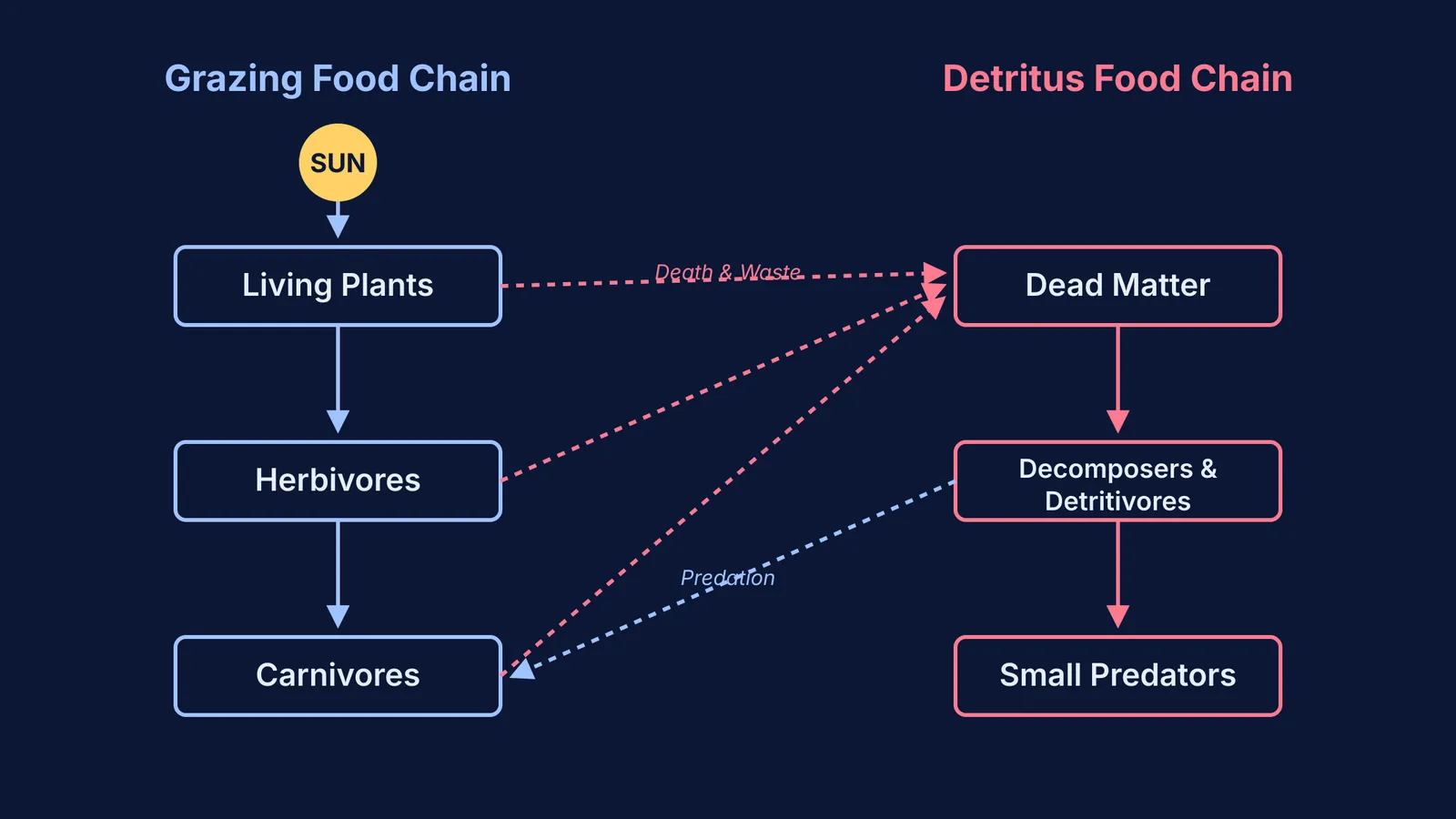
The Grazing Food Chain (GFC) begins with living green plants (producers). It relies on sunlight as its primary energy source. Energy flows from these plants to herbivores, and then on to carnivores.
*Example:* Grass → Rabbit → Fox.
The Detritus Food Chain (DFC) begins with dead organic matter (detritus), such as fallen leaves, animal remains, and waste. Instead of sunlight, its primary energy source is the chemical energy trapped in this decaying matter. Energy flows to decomposers (bacteria and fungi) and detritivores (like earthworms), which are then eaten by small predators.
*Example:* Fallen leaves → Earthworm → Frog → Snake.
If you are mapping out these relationships for your revision and find the connections hard to picture, you can step through the whole ecosystem map in the Fermi Concept Library, where you can find every concept in physics, chemistry, biology, mathematics and computing, each with its own lesson and its place in the map.
Why is the grazing food chain the major conduit in aquatic ecosystems?
In aquatic environments like oceans, lakes, and ponds, the grazing food chain is the primary pathway for energy flow.
This happens because aquatic primary producers—mostly microscopic phytoplankton—are easily digestible and lack the tough structural tissues like wood or bark found in land plants. Consequently, herbivores (zooplankton) consume almost the entirety of this living biomass very quickly. Because energy is transferred rapidly from producers to consumers before the organisms die and settle, the grazing chain dominates the energy flow.
How does energy flow in terrestrial ecosystems?
On land, the story is completely inverted. In a terrestrial ecosystem, a much larger fraction of energy flows through the detritus food chain than through the grazing food chain.
According to research on carbon flow published in *The American Naturalist* (Cebrian, 1999), plant palatability is a primary limiting factor for herbivores. In forests and grasslands, communities lose far less production to herbivores because much of the plant mass is indigestible wood and stems. This means up to 90% of the net primary production eventually dies and drops to the soil as litter.
This decaying matter is broken down by fungi and bacteria—organisms that, alongside viruses, viroids and lichens, sit outside the standard plant and animal classifications. Because such a massive volume of energy bypasses herbivores entirely, the detritus food chain is the undisputed engine of terrestrial ecosystems. It breaks down complex molecules to fuel respiration as an amphibolic pathway, recycling inorganic nutrients back into the soil for plants to reuse.
How do the two chains connect in a food web?
In nature, these two food chains are never entirely isolated. They intersect at multiple points to form a complex food web.
The most obvious connection is that every organism in the grazing food chain—whether plant, herbivore, or carnivore—eventually dies or produces waste, funnelling straight into the detritus food chain. Conversely, detritus-feeding organisms are frequently preyed upon by animals from the grazing chain; for instance, a bird (a GFC consumer) pulling an earthworm (a DFC detritivore) out of the soil. These cross-links ensure that no energy is ever permanently lost until it is completely dissipated as heat.


