On this page
Textbook food webs look fixed. Real ones change all the time, and a good way to understand a web is to break it on purpose: take one species out, predict what happens to every other population, then check your guess. Here is a method, a practice web and two real experiments that show why some species matter far more than their numbers suggest.
What happens to a food web if one species disappears?
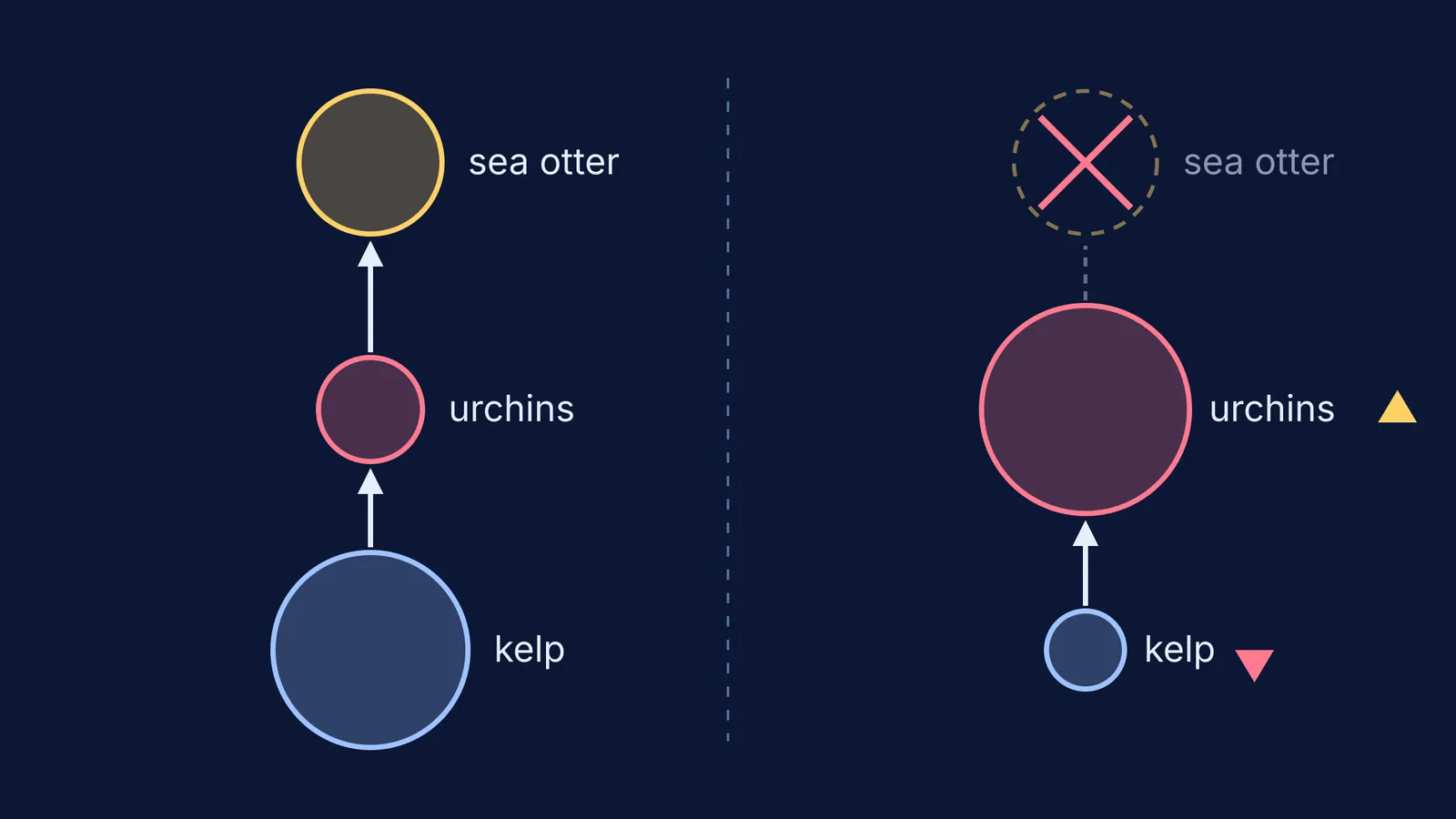
Three things happen, roughly in this order. Its predators lose a food source. Its prey lose a predator, so they can increase. Then those changes spread to species that never ate, or were eaten by, the missing one. When these indirect effects run down from a predator through the levels below it, ecologists call the chain a trophic cascade.
To predict it, use a three-direction check on each species touching the one you removed:
Up: who ate the missing species? They lose food. Do they have other food, or do they crash?
Down: what did it eat? That population is released and may grow.
Sideways: who competes with the released species, and which predators will switch to new prey?
Then repeat the check one ring further out. A common mistake is stopping after step one.
What did Paine's starfish experiment show?
The ecologist Robert Paine kept removing the predatory starfish Pisaster from rocky shore at Mukkaw Bay, Washington, leaving a neighbouring area as a control. He published the first results as Food web complexity and species diversity in The American Naturalist in 1966.
After three years without starfish, the 15 species originally present in the pools declined to eight, as Quanta Magazine reports. After 10 years, a mussel monoculture dominated the shore. The starfish had been eating mussels, a dominant competitor for space; without it, mussels crowded other species off the rock.
That is the surprise worth remembering: removing a predator lowered diversity. Paine named Pisaster a keystone species in a 1969 follow-up paper, after the wedge-shaped stone at the top of an arch. We tell the full story in our post on Robert Paine and the starfish that defined keystone species.
Why can losing a predator destroy plants?
A keystone species is an organism that has a major influence on the way its ecosystem works, in National Geographic's definition.
In 1974, James Estes and John Palmisano compared western Aleutian islands with and without sea otters. Their Science paper found that sea otters control herbivorous invertebrates, and that removing otters causes increased herbivory and ultimately destroys the kelp and other large seaweeds. The otters never touch the kelp, yet the kelp depends on them.
A later review, Trophic downgrading of planet Earth by Estes and 23 co-authors, describes research showing extensive cascading effects from the loss of apex consumers, the animals at the top of food webs, in marine, land and freshwater ecosystems.
Try it: remove one species from this food web
Here is a practice web. Grass is eaten by grasshoppers and rabbits. Frogs eat grasshoppers. Snakes eat frogs and rabbits. Hawks eat rabbits and snakes. Cover the answers and predict each removal first.
Remove the hawks (top predator). Up: nothing eats hawks. Down: rabbits and snakes are released. Sideways: more snakes eat more frogs, and more rabbits eat more grass, so grasshoppers face competition. Frogs get squeezed from both sides. The honest answer for frogs is uncertain, and saying so is good reasoning.
Remove the grasshoppers (herbivore). Up: frogs lose their only food and crash. Then snakes lose frogs and switch to rabbits, so rabbits fall, which leaves hawks with less food. Down: grass may increase.
Remove the grass (producer). Every animal here depends on it directly or indirectly, so the whole web collapses from the bottom up.
Drawn on paper, a web is frozen. Watching populations rise and fall over time makes the delays and overshoots easier to see; our post on when simulations beat static diagrams covers what studies found. The Fermi Simulation Lab has interactive simulations for ideas that are easier to see than to read, so you can make a prediction, run it and compare.
Is every important species a keystone?
No. The label has been stretched: over 200 species have been marked as keystones, Quanta reports, and some ecologists fear the word has lost its meaning. Keystones are not always predators either. National Geographic notes that mangrove trees play a keystone role on many coastlines by firming up shorelines and reducing erosion.
For NEET and board exams, pair this with food chains, pyramids and population questions in our ecology guide for NEET. Then pick any food web in your NCERT book, remove one species, and write your three-direction prediction before you read the answer.