

On this page
When you water a plant, you might assume its roots are hard at work actively pumping the liquid up into the stem. But in plant physiology, the roots actually do very little of the mechanical work most of the time.
In 1949, plant physiologist Paul Kramer formally distinguished two mechanisms for how plants take in water: active and passive absorption (Major Differences). Understanding these mechanisms is just as foundational to botany as knowing the roles of apical, intercalary and lateral meristems in growth. The primary difference lies in where the driving force originates, and whether the plant has to spend its own metabolic energy to move the water.
How does passive absorption of water work?
Passive absorption is the primary way plants drink, doing the heavy lifting during daylight hours. In this process, the driving force is generated at the very top of the plant, in the leaves.
As sunlight warms the leaves, water evaporates through tiny pores called stomata in a process known as transpiration. This evaporation creates a negative pressure, or tension, in the plant's xylem (the main water-transporting tissue). Because water molecules naturally stick to each other (cohesion) and to the xylem walls (adhesion), this tension pulls the entire continuous column of water upwards, much like sucking liquid through a straw.
During passive absorption, the root cells do not expend any metabolic energy (ATP). They act merely as a physical conduit for the water, which mostly travels through the non-living cell walls and intercellular spaces (the apoplast pathway).
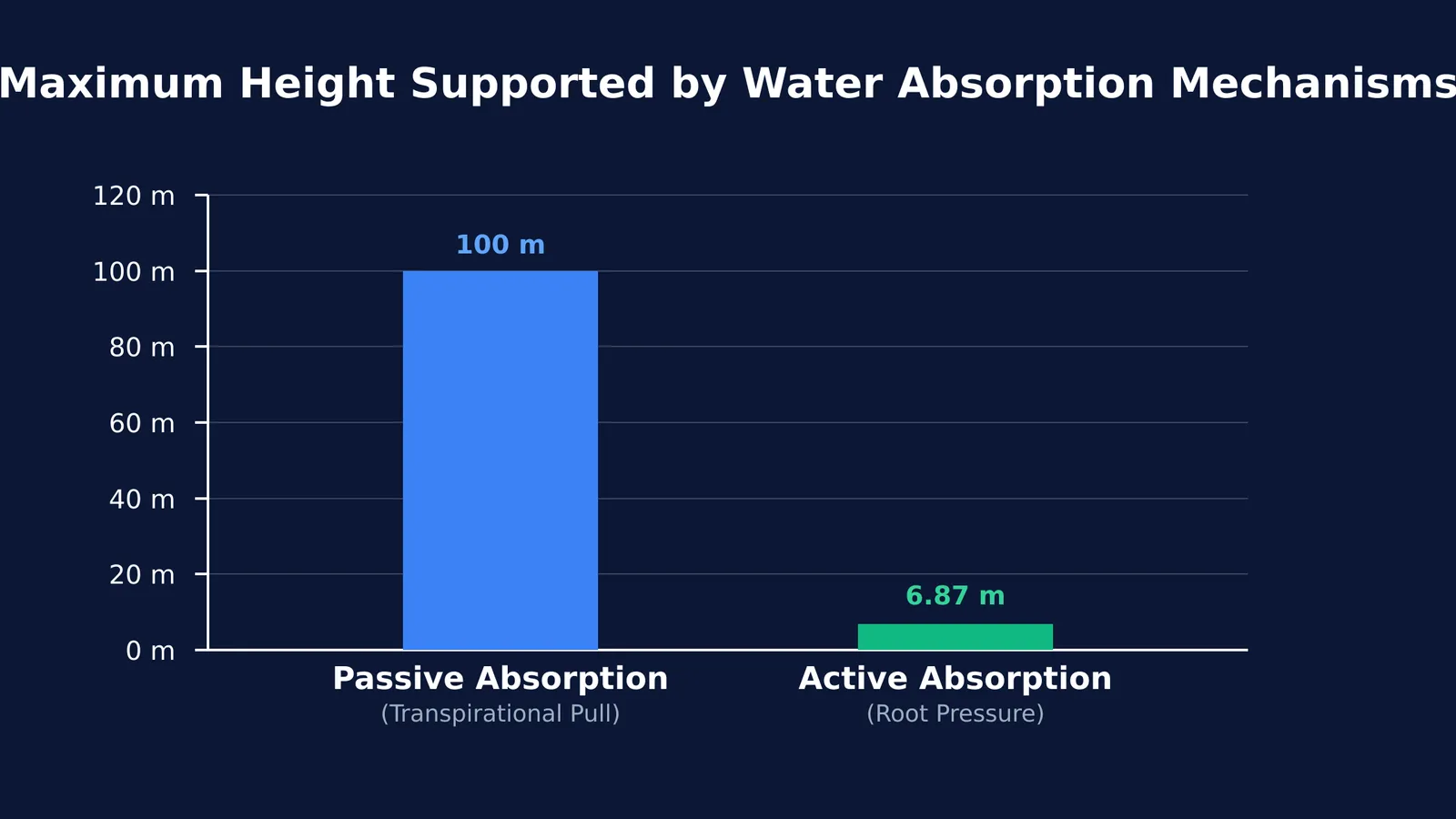
The sheer power of this transpirational pull is enormous. Passive transpirational pull can support trees over 100 metres tall (Wikipedia). It is also incredibly high-volume: approximately 97% to 99.5% of the water taken up by roots is eventually lost through transpiration and guttation (Wikipedia).
What is active absorption of water by roots?
Active absorption, on the other hand, is driven entirely by the roots themselves. It becomes the dominant method of water uptake at night, or on very humid days when the air is too saturated for transpiration to occur.
To absorb water actively, the root cells expend metabolic energy (ATP) to pump mineral ions from the soil into the root xylem against a concentration gradient. This accumulation of minerals lowers the water potential inside the root. As a result, water from the soil naturally flows into the root via osmosis to balance the concentration.
This process creates a positive pressure from below, known as root pressure, which physically pushes water up the stem. The water in this case moves straight through the living cytoplasm of the cells (the symplast pathway).
While active absorption ensures the plant still takes in vital nutrients when transpiration stops, it is a relatively weak physical force. The maximum root pressure measured can only raise water to about 6.87 metres (Wikipedia).
Active vs passive absorption of water: Key differences?
If you are revising for biology exams, keeping these differences straight is crucial—just as it is when studying Blackman's law of limiting factors or photorespiration.
Origin of force: Passive absorption is pulled from above by transpiration in the shoot. Active absorption is pushed from below by osmotic root pressure.
Energy usage: Passive absorption uses no ATP; it is driven entirely by the Sun's energy evaporating water. Active absorption requires ATP from root cell respiration to actively pump ions.
Volume and rate: Passive absorption accounts for the vast majority of water uptake and happens rapidly. Active absorption is slow and accounts for a tiny fraction of the total volume.
Primary pathway: Passive water movement mostly uses the apoplast pathway (through cell walls). Active water movement relies on the symplast pathway (through the cytoplasm).
Time of day: Passive absorption dominates during the day when stomata are open. Active absorption takes over at night when stomata close and transpiration halts.
Getting the concepts straight
Plant physiology can sometimes feel like a blur of pathways, pressures, and potentials. But instead of memorising facts in isolation, focus on the physical principles. Once you understand that passive absorption is just a continuous string of water being pulled by evaporation, the apoplast pathway and the lack of ATP make perfect logical sense.
If you struggle with visualising these invisible processes, the Fermi Concept Library holds a lesson for every concept in biology. Instead of just giving you a textbook definition, Fermi's AI tutor works out what you already know and teaches through the material—checking your understanding as you trace the journey of a water molecule from the soil to the sky.


