On this page
The sodium-potassium pump turns up twice in NCERT Class 11 Biology: as the example of active transport, and again in the neuron chapter. The key fact to remember is 3 Na+ out, 2 K+ in, one ATP used. Here is why that ratio matters and how to write it in an exam.
What does the sodium-potassium pump do in one cycle?
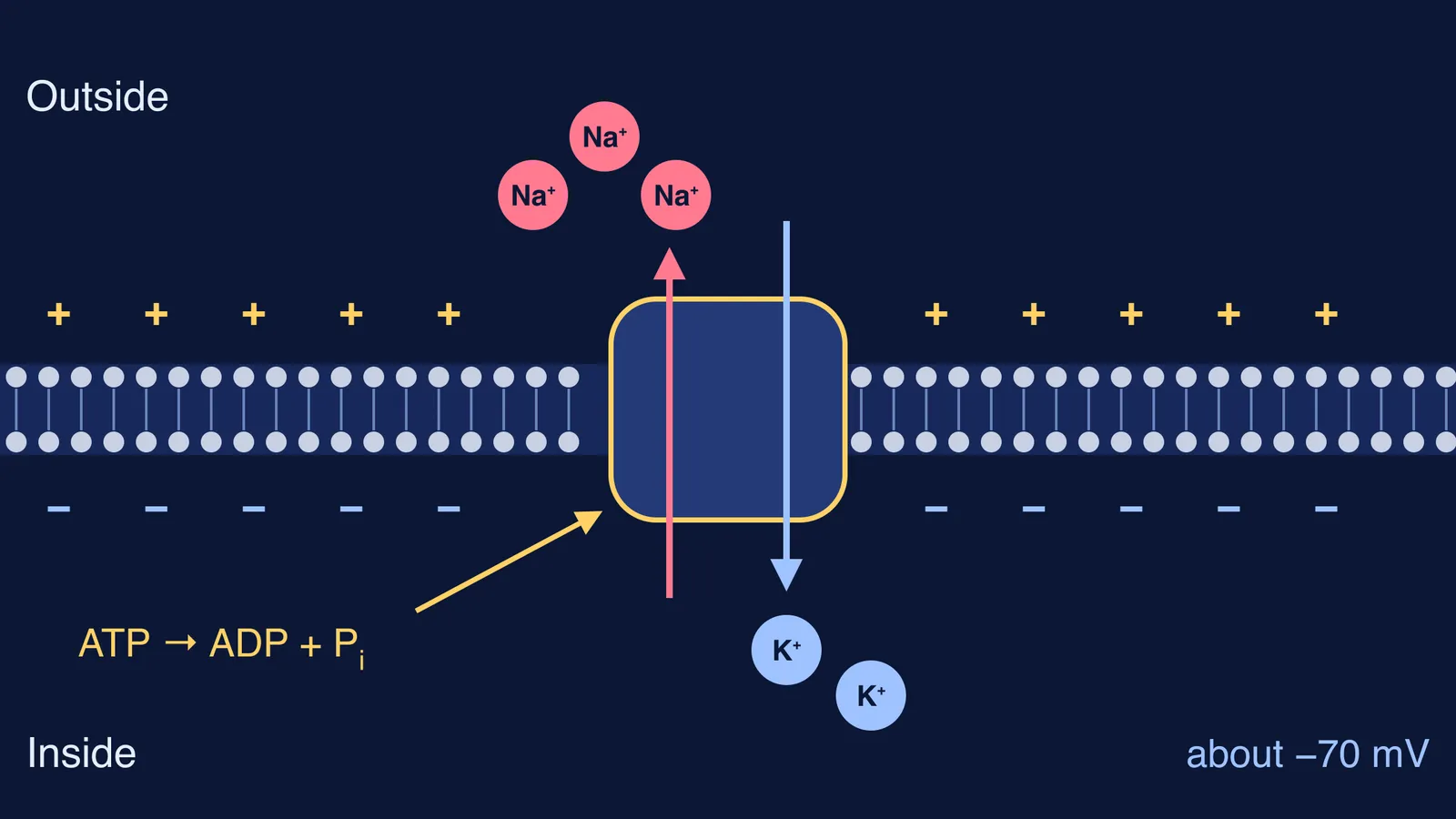
The pump is a protein that sits across the plasma membrane. A 2023 review in Biophysical Reviews describes it as moving three sodium ions and two potassium ions against their electrochemical gradients for each ATP molecule hydrolysed. The review dates the first measurement of this 3:2 ratio to 1957.
Step by step: sodium binds on the inside, ATP is split, the protein changes shape and releases sodium outside, then potassium binds and is carried in, as the OpenStax Biology 2e chapter on active transport walks through.
Why does it move 3 Na+ out but only 2 K+ in?
Count the charges. Three positive charges leave the cell and two come back, so each cycle sends one net positive charge out. The Biophysical Reviews authors put it in exactly those terms: one net positive charge leaves the cell per ATP hydrolysed. A pump that separates charge like this is called electrogenic. OpenStax defines an electrogenic pump as one that creates a charge imbalance across the membrane.
A one-for-one swap would build gradients but move no net charge; the unequal count is what lets the pump itself nudge the inside negative.
How does the pump keep the inside negative?
Many short answers skip this: the pump's own net charge does only part of the work. The 2023 review notes that in most cells, which are highly permeable to potassium, the pump's direct electrical contribution is small.
The bigger effect is indirect. The NCERT Class 11 neuron chapter (section 18.3.1) explains that a resting axon membrane is more permeable to K+ and nearly impermeable to Na+, and that the pump keeps K+ high inside and Na+ high outside. Potassium leaks out down its gradient, carrying positive charge, while negatively charged proteins stay inside. So the outer surface ends up positive and the inner surface negative.
The OpenStax Anatomy and Physiology chapter on the action potential gives the numbers: the resting membrane potential is about −70 mV, and Na+ is 10 times more concentrated outside the cell than inside. Leak channels let Na+ drift in and K+ drift out, and the pump restores them, so it works less like a battery and more like someone refilling a leaking tank.
Why does NCERT call it active transport?
In the chapter Cell: The Unit of Life, NCERT section 8.5.1 defines active transport as moving ions or molecules against their concentration gradient, from lower to higher concentration, in an energy-dependent process that uses ATP. The example it gives is the Na+/K+ pump.
The pump meets both conditions:
Against the gradient: Na+ is already higher outside, and the pump pushes more out. K+ is already higher inside, and the pump pulls more in.
Uses energy directly: each cycle splits one ATP. OpenStax calls this primary active transport, as opposed to secondary active transport, which rides on a gradient that a primary pump has already built.
For diffusion, osmosis and carriers side by side, see our guide to how substances cross the cell membrane, or read about the scientist who discovered the sodium-potassium pump and how the idea of a resting potential began.
Worked example: count the charges yourself
Run the pump through 1,000 cycles:
ATP used: 1,000
Na+ moved out: 3 × 1,000 = 3,000
K+ moved in: 2 × 1,000 = 2,000
Net positive charge moved out: 3,000 − 2,000 = 1,000
Now the examiner's twist: if ATP runs out, the pump stops. The leaks keep going, so Na+ creeps in, K+ creeps out, the gradients run down and the resting potential shrinks. That chain answers any "pump is blocked" question.
How to write it in a 3-mark answer
Use this order:
Name it: the sodium-potassium pump (Na+/K+ ATPase) in the plasma membrane.
State the ratio: 3 Na+ out and 2 K+ in for each ATP hydrolysed.
Say why it is active: it moves both ions against their concentration gradients using ATP.
Link to the resting potential: it keeps K+ high inside and Na+ high outside; the membrane is more permeable to K+, so the inside stays negative and the outside positive.
Common slips to avoid: swapping the directions (sodium goes out), calling the pump diffusion or facilitated diffusion, and claiming the 3:2 ratio alone creates the full −70 mV resting potential.
If the link from pump to resting potential still feels shaky, the Fermi Concept Library has a lesson for each idea and shows where it sits in the map of biology. For practice, theFermi Problem Library has worked problems with a step-by-step solver that explains the reasoning rather than printing an answer.