On this page
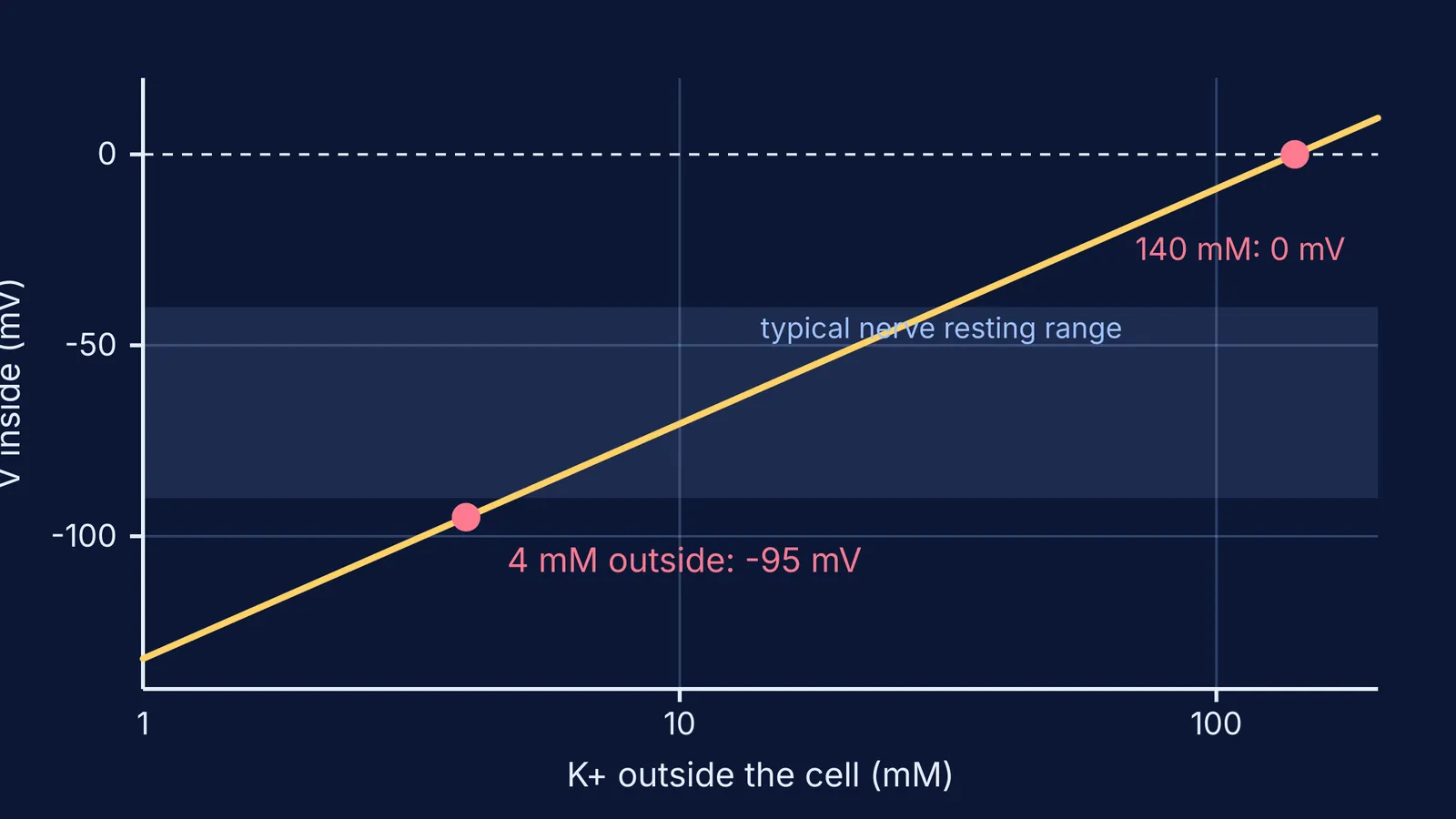
Every nerve cell in your body holds a small voltage across its membrane, with the inside negative compared with the outside. In nerve cells this resting potential is somewhere between about -40 mV and -90 mV, according to the Neurosim tutorial from the University of St Andrews. The first plausible physical and chemical explanation for it came from Julius Bernstein (1839-1917), professor of physiology at the University of Halle in Germany.
In 1902 Bernstein published Untersuchungen zur Thermodynamik der bioelektrischen Ströme in Pflügers Archiv. In a 2006 profile of Bernstein, Ernst-August Seyfarth calls it the first plausible physico-chemical model of bioelectric events and says its fundamental concepts remain valid today. Bernstein had already made his name in 1868 with the first accurate description of the action potential, using an instrument he developed called a differential rheotome.
What did Julius Bernstein propose in 1902?
Alan Hodgkin summarised the idea in his 1963 Nobel lecture: the resting membrane "is selectively permeable to potassium ions" and the potential across it "arises from the tendency of these ions to move outward from the more concentrated solution inside a nerve or muscle fibre."
This is the membrane theory: the resting potential is a potassium diffusion potential across a membrane that lets potassium through.
Why does potassium leaking out make the inside negative?
Inside the cell potassium is concentrated. Outside it is dilute.
Potassium ions drift outward, down their concentration gradient.
Each K+ that leaves carries a positive charge out. The large negative ions inside, such as proteins, cannot follow.
The inside becomes negative, and that negative charge starts pulling K+ back in.
The outward push of the concentration gradient and the inward pull of the voltage balance out. The voltage stops changing. That balance point is the resting potential.
How do you calculate the resting potential from potassium?
The balance point is given by the Nernst equation. Hodgkin wrote it as V(K) = (RT/F) ln([K]out/[K]in), where V(K) is the inside potential minus the outside potential (Hodgkin, Nobel lecture). In Hodgkin's example, a membrane permeable only to potassium, with 400 mM inside and 20 mM outside, makes the inside 75 mV negative to the outside.
Now try it yourself for a mammalian cell. The St Andrews tutorial uses about 140 mM potassium inside and 4 mM outside.
Constants: R = 8.314 J/(mol K) (NIST), F = 96,485 C/mol (NIST), T = 310 K (37 °C).
RT/F = (8.314 x 310) / 96,485 = 0.0267 V, or 26.7 mV.
Ratio: [K]out/[K]in = 4/140 = 1/35. ln(1/35) = -3.56.
V(K) = 26.7 mV x (-3.56) = about -95 mV.
Real neurons usually rest less negative than this because the membrane is not perfectly selective. Hodgkin noted that if sodium permeability were 1/12 of potassium's, an isolated squid axon in sea water would be predicted to rest at about 50 mV inside-negative instead (Nobel lecture). For the chemistry version, see where the 0.059 in the Nernst equation comes from.
What did Bernstein get wrong?
Bernstein also explained the nerve impulse. He said the membrane briefly breaks down and stops being selective. On that view, Hodgkin explained, "the action potential should not exceed the resting potential".
In 1939 Hodgkin and Andrew Huxley pushed a fine electrode inside a squid giant axon and published Action Potentials Recorded from Inside a Nerve Fibre. One recording in the Nobel lecture shows an action potential of 86 mV on a resting potential of 45 mV, so the inside briefly turned positive. A breakdown cannot do that. The lecture also reports Curtis and Cole's result that at high external potassium the membrane "behaved like a potassium electrode, as predicted by Bernstein's theory."
The fix was the sodium hypothesis. In the 1949 paper by Hodgkin and Bernard Katz, replacing the sodium outside the axon reduced the action potential but not the resting potential. So the resting potential did not depend on outside sodium, which fits Bernstein's potassium idea. A brief, selective rise in sodium permeability drives the spike. For more on the impulse, try our action potential simulation guide and the story of Edgar Adrian and the all-or-none nerve impulse.
How should you revise the membrane theory?
Try this self-test:
Explain in two sentences, using the words gradient and balance, why K+ leaving makes the inside negative.
Calculate V(K) for 150 mM inside and 5 mM outside at 37 °C. You should get about -91 mV.
Name one prediction of Bernstein's that held (resting potential tracks external potassium) and one that failed (no overshoot).
If the ion movement is hard to picture, the Fermi Simulation Lab has interactive simulations for ideas that are easier to see than read. For related topics such as diffusion or electrochemical cells, the Fermi Concept Library gives each concept its own lesson.