

On this page
What is the all-or-none law of nerve impulses?
When a nerve cell fires, it does not whisper or shout. It either speaks at full volume or stays completely silent. If a stimulus depolarises the axon membrane past its critical threshold, the neuron fires an action potential of a fixed, maximum amplitude. Any stimulus below that threshold produces nothing at all, while any stimulus above it produces an electrical impulse of the exact same height.
The idea originally began in the study of muscles. In 1909, Cambridge physiologist Keith Lucas demonstrated that individual skeletal muscle fibres contract on an absolute all-or-none basis (Journal of Physiology). His student, Edgar Douglas Adrian, then extended this hypothesis to nerve fibres in 1914 (Journal of Physiology).
By passing impulses through an alcohol-vapour block that temporarily depressed the nerve's ability to conduct, Adrian showed that an impulse emerging from the block recovered to its full, original height. This proved that the nerve was not just a passive wire leaking an electrical signal. Instead, it was an active transmission line, drawing energy from its own membrane to continually regenerate the signal. Adrian eventually shared the 1932 Nobel Prize in Physiology or Medicine with Charles Sherrington for mapping how these fundamental neural units communicate.
How did Edgar Adrian record a single nerve fibre?
For decades, physiologists struggled to verify the all-or-none law in sensory nerves. The problem was that whole nerve trunks contain thousands of tightly bundled axons. Stimulating a nerve trunk with stronger electric shocks produced a larger overall electrical deflection on a galvanometer. This misled early researchers into thinking that individual nerve impulses grew in size. In reality, the stronger shocks were merely recruiting a larger number of individual fibres to fire simultaneously.
Adrian realised he had to isolate a single fibre to see its true behaviour. In 1926, working alongside Yngve Zotterman, he meticulously dissected the sternocutaneous muscle of a frog until only a single sensory nerve fibre remained intact (Journal of Physiology).
To record the tiny voltages produced by this single fibre, Adrian adapted the newly invented three-valve amplifier—a piece of technology originally developed for radio communications. He connected it to a capillary electrometer, an instrument which used a microscope to photograph the microscopic movement of a mercury meniscus onto rapidly moving photographic film (Journal of Physiology). This innovative apparatus allowed them to visualize electrical spikes lasting just thousandths of a second.
How does the brain decode stimulus intensity?
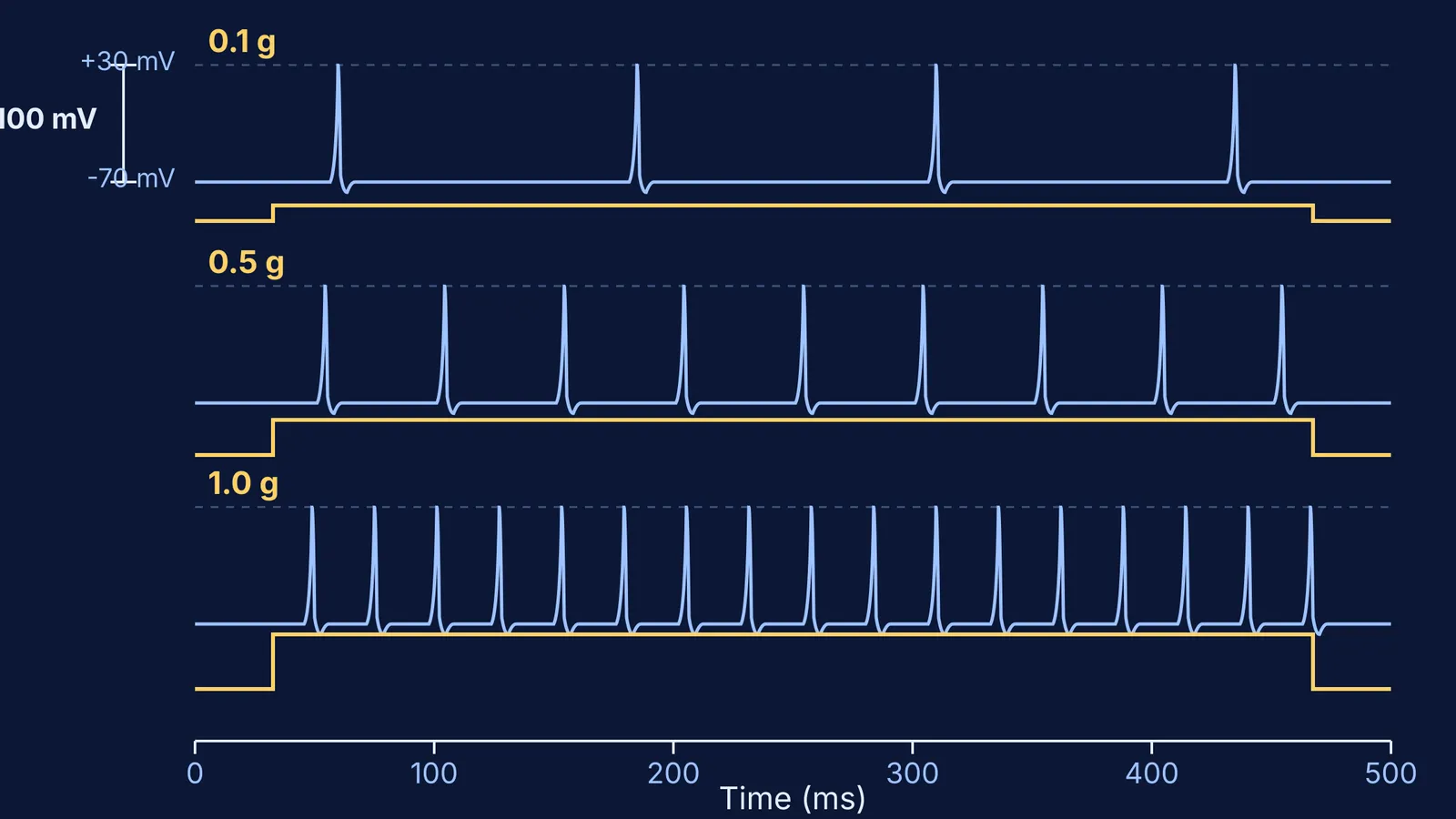
When Adrian and Zotterman applied increasing weights to stretch the frog muscle, they made a critical observation that fundamentally changed our understanding of the nervous system. A heavier weight did not produce taller voltage spikes. Instead, it produced the exact same spikes, but they occurred much closer together in time.
As Adrian explained in his 1932 Nobel lecture, the nerve fibre "can only transmit a succession of brief explosive waves, and the message can only be varied by changes in the frequency and in the total number of these waves" (NobelPrize.org).
This discovery established the principle of rate coding. Because action potentials are all-or-none events, the nervous system cannot encode a strong sensation by sending a larger impulse. It must send more impulses per second. This fundamental property of neural control and coordination dictates everything from how bright a light seems to how strongly a muscle contracts.
How do you apply rate coding to physics problems?
The relationship between stimulus intensity and firing frequency is a core concept in physiology, often tested alongside the mechanics of Alan Hodgkin and Andrew Huxley. When analysing data from sensory nerves, you must decouple the amplitude of the signal from the frequency of the signal.
Consider a sensory stretch receptor that is firing at a steady baseline rate. If the stimulus applied to the receptor increases in magnitude, the new impulse amplitude remains exactly the same. By the all-or-none law, the spike height is entirely independent of the stimulus magnitude.
However, the inter-spike interval—the time delay between one action potential and the next—shortens. The brain decodes the heavier weight or the brighter light from these identical electrical impulses arriving more frequently. Understanding how time and frequency encode information is just as important in electronics as it is in biology.
If you are looking for physics problems that apply rate coding and electrical signalling in biological systems, check the Problem Library. You can also explore how action potentials propagate using interactive models in the Simulation Lab.


