On this page
NCERT tells you that when a neuron is stimulated, the membrane becomes freely permeable to Na+, Na+ rushes in, the inside turns positive, and then K+ flows out to restore the resting state. That account is less than a century old, and two Cambridge physiologists worked it out, largely using nerve fibres from squid. This post explains what they measured, how one equation connects your chemistry and biology books, and how to avoid the most common action-potential mistakes.
Who were Hodgkin and Huxley?
Alan Hodgkin's Nobel biography records that he was born in Banbury in 1914 and studied at Trinity College, Cambridge. A teacher advised him to learn as much mathematics and physics as he could, "good, if painful, advice". In 1937-38 he spent weeks at Woods Hole with K. S. Cole and learnt to dissect squid axons. Back in Cambridge in 1938, he began working with Andrew Huxley, whom he had taught.
Huxley's Nobel biography says he was born in London in 1917, a grandson of Thomas Huxley, and went to Cambridge expecting a career in the physical sciences. He took up physiology partly because the rules required a third science. In August 1939 he joined Hodgkin at the Marine Biological Association laboratory in Plymouth, where, the biography says, "they succeeded in recording electrically from the inside of the squid giant axon."
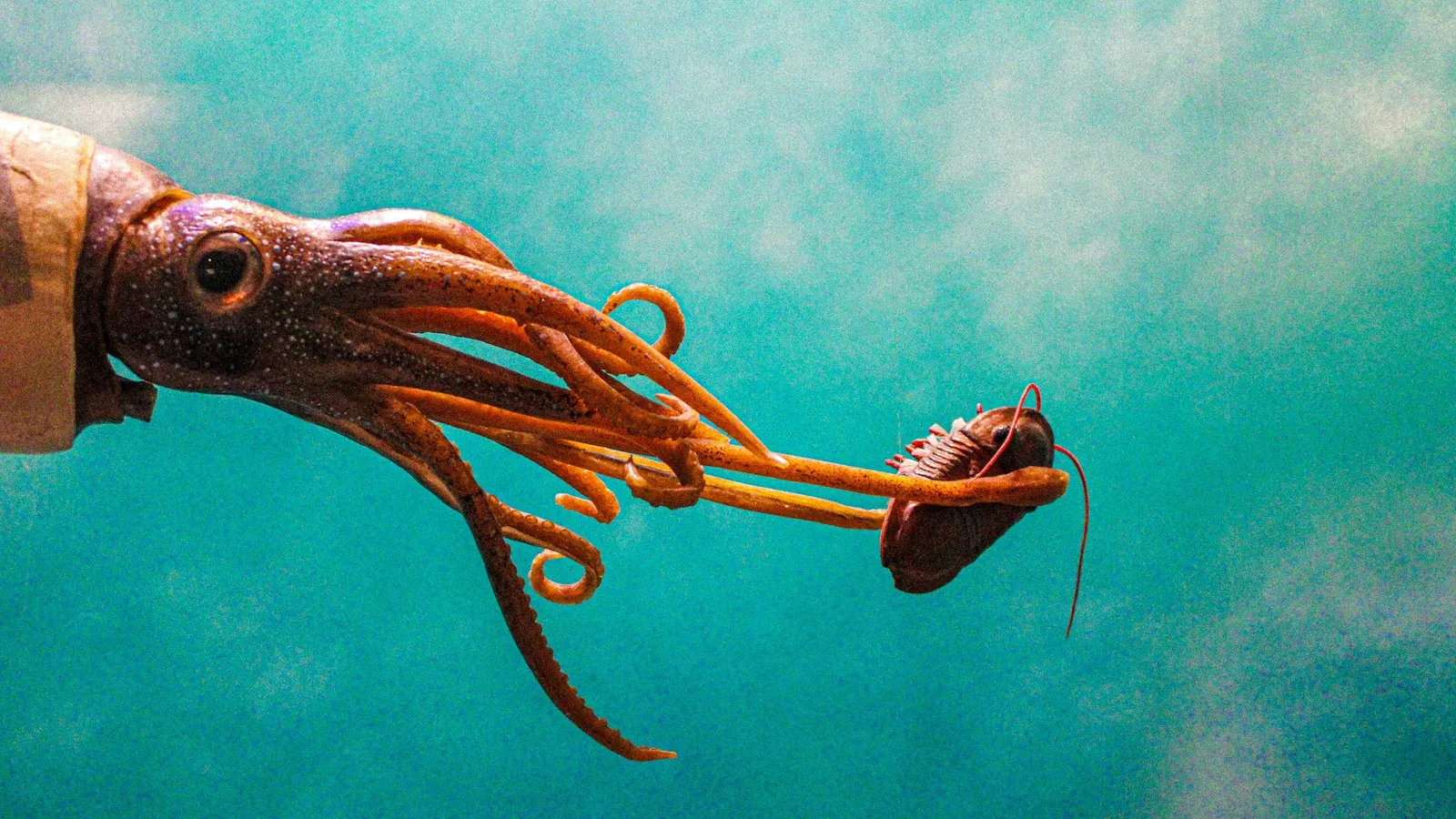
Why use a squid?
In his Nobel lecture, Hodgkin explains that crab nerve fibres he had used were at most 1/30 mm across, inconveniently small. The giant nerve fibres of squid of the genus Loligo, discovered by J. Z. Young, can be as much as a millimetre in diameter. They run in the body wall to the muscles that squirt water out for jet propulsion. A fibre that wide could take a fine glass tube inside it.
Their first result, published in Nature in 1939, was a surprise. The theory of the time said that during an impulse the membrane simply broke down, so the potential should fall to about zero. Instead it overshot. Hodgkin's lecture shows one of these records: an action potential of 86 mV and a resting potential of 45 mV. The inside briefly became positive. Something more than a breakdown was happening. Then the Second World War interrupted the work.
What is the sodium hypothesis?
After the war, Hodgkin, Huxley and Bernard Katz proposed that the resting membrane is mainly permeable to potassium, but that during an impulse it becomes briefly and selectively permeable to sodium. To test it, they changed the sodium outside the fibre. With less external sodium, the overshoot shrank; with extra sodium, it grew, as the lecture describes.
To measure the currents directly, they used a feedback method called the voltage clamp. Huxley's Nobel lecture explains that two wires run along the inside of the fibre, one to measure the membrane potential and one to pass whatever current is needed to hold it steady. Records taken in 1949 were analysed over the next two years. The results, with a set of equations describing the sodium and potassium conductances, appeared in 1952, including A quantitative description of membrane current (Journal of Physiology).
Huxley's lecture notes that the computations were done by hand: a membrane action potential "took a matter of days to compute, and a propagated action potential took a matter of weeks." The calculated impulses agreed well with the real squid axon.
The 1963 Nobel Prize in Physiology or Medicine went to John Eccles, Hodgkin and Huxley "for their discoveries concerning the ionic mechanisms involved in excitation and inhibition in the peripheral and central portions of the nerve cell membrane".
Worked example: the Nernst equation in Hodgkin's lecture
In Class 12 chemistry you meet the Nernst equation for electrode potentials. The same physics sets the membrane voltage at which an ion stops flowing. At about room temperature it is roughly:
E = 58 mV × log10([ion outside] / [ion inside]) for an ion with charge +1.
Hodgkin's lecture uses the numbers below.
Potassium: about 400 mM inside the axon and 20 mM outside. The ratio outside/inside is 20/400 = 0.05. log10(0.05) = −1.30. So E(K) = 58 × (−1.30) ≈ −75 mV. His lecture gives the same: the inside "should be 75 mV negative".
Sodium: about ten times more concentrated outside than inside. log10(10) = 1, so E(Na) ≈ +58 mV. The lecture calls this the limiting value, and it explains why the overshoot can make the inside positive.
So: when the membrane is mostly permeable to K+, the potential sits near −75 mV; when Na+ permeability shoots up, the potential swings towards +58 mV. The measured values lie between, because both ions leak a little.
Common mistakes:
Saying the sodium-potassium pump makes the action potential. The pump maintains the gradients; the impulse comes from ions flowing down them.
Mixing the order. Na+ flows in first (depolarisation), then K+ flows out (repolarisation).
Using 58 mV without the log. A tenfold ratio gives 58 mV; a hundredfold ratio gives 116 mV.
Our guide to neural control and coordination covers the NCERT side, and Class 11 Biology Chapter 18 has the textbook diagram.
What can a student take from Hodgkin and Huxley's way of working?
Pick the system that makes measurement possible. The squid's giant axon turned an impossible experiment into a practical one.
Learn the maths early. Hodgkin's teacher told him to learn physics and mathematics. The equations they built still describe nerve impulses.
Take the anomaly seriously. The overshoot that did not fit the old theory was where the discovery lay.
If the shape of the action potential still feels abstract, the Fermi Simulation Lab has interactive simulations for ideas that are easier to see than read.
Next step: compute the potassium equilibrium potential for 140 mM inside and 5 mM outside using the 58 mV rule, then check your answer with a calculator.