On this page
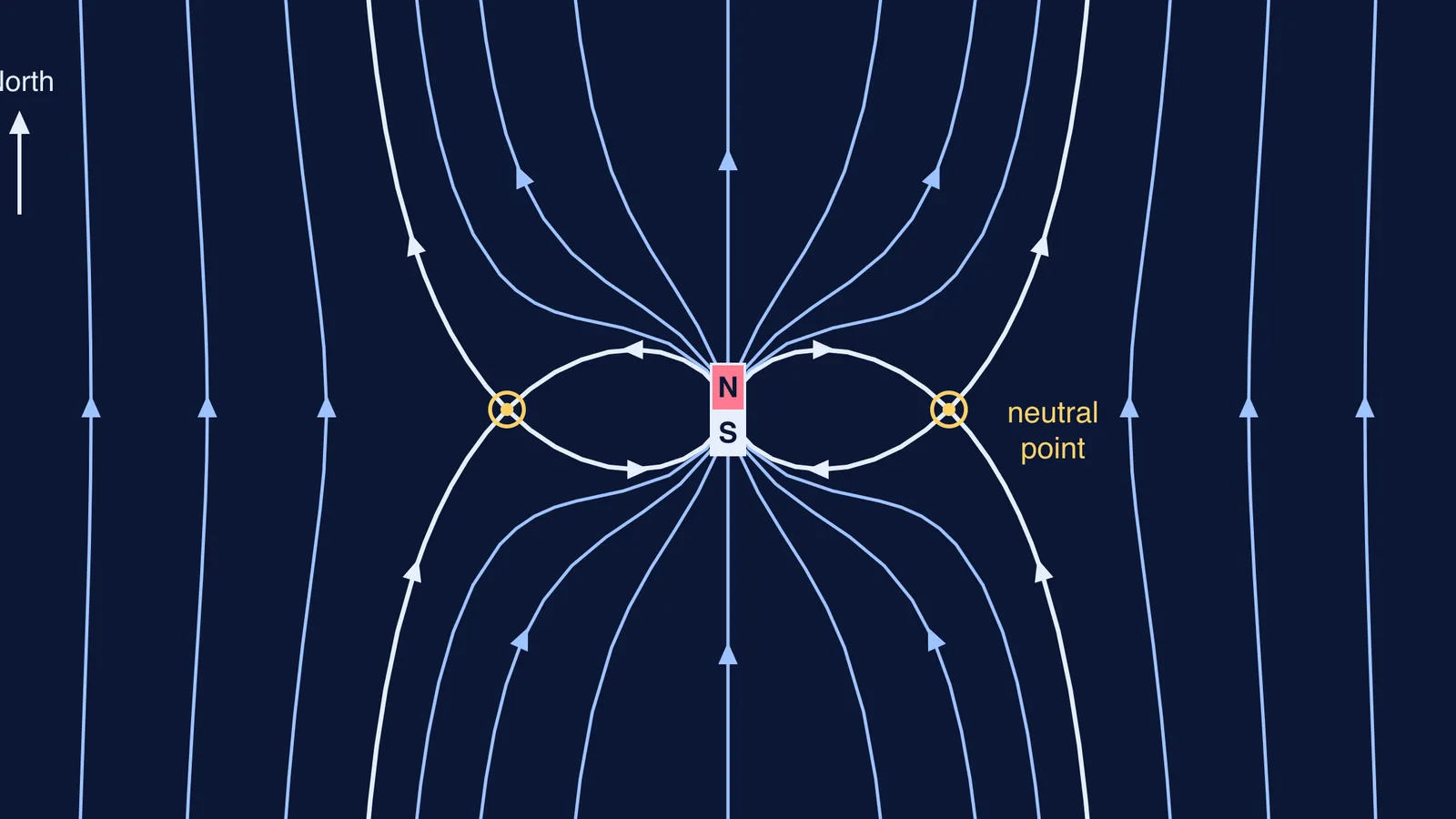
A neutral point is a place near a magnet where the magnet's field exactly cancels the horizontal component of Earth's field, so the net horizontal field there is zero. A compass needle placed at that spot feels no torque, because the torque on a magnet is τ = m × B and B is zero there (NCERT Class 12 Physics, Chapter 5, Eq. 5.2). Finding them comes down to one question: on which line does the magnet's own field point south?
Where are the neutral points when the north pole faces north?
NCERT describes Earth's field as pointing roughly from geographic south to north (NCERT, Section 5.1). The magnetic moment m points from a magnet's S end to its N end, so with the north pole facing north, m points north.
The two short-magnet formulas hold at distances r much larger than the magnet (NCERT, Eqs. 5.4 and 5.5):
On the axis: B = (μ0/4π)(2m/r³), pointing along m.
On the equatorial line (the normal bisector): B = (μ0/4π)(m/r³), pointing opposite to m.
With m pointing north, the axial field adds to Earth's field, while the equatorial field points south, against Earth's northward horizontal field B_H. So the neutral points lie on the equatorial line, east and west of the centre, where (μ0/4π)(m/r³) = B_H. That gives r = (μ0m / 4πB_H)^(1/3).
What changes if the south pole faces north?
Turn the magnet round and m points south. Now the axial field points south and cancels B_H, so the neutral points move onto the axis, north and south of the magnet. The condition becomes (μ0/4π)(2m/r³) = B_H (NCERT, Eq. 5.5), and r = (2μ0m / 4πB_H)^(1/3). Because of the cube root, the axial neutral points sit 2^(1/3), or about 1.26, times farther out than the equatorial ones for the same magnet.
For where the two formulas come from, see our explainer on the magnetic field of a bar magnet on its axial and equatorial lines.
Worked numerical: how far from the magnet is the neutral point?
Take the short bar magnet from NCERT Exercise 5.7, which has magnetic moment m = 0.48 J/T (NCERT, Chapter 5 exercises). Lay it on a table in New Delhi with its north pole facing north.
For B_H, use the International Geomagnetic Reference Field. The British Geological Survey's IGRF-14 web service gives a horizontal intensity of 34,223 nT, or 3.42 × 10⁻⁵ T, at New Delhi (28.61° N, 77.21° E) on 3 November 2026 (BGS IGRF-14 result for New Delhi). For the constant, NIST lists μ0 = 1.25663706127 × 10⁻⁶ N A⁻², so μ0/4π is 1.00 × 10⁻⁷ T m/A to three significant figures (NIST CODATA value of μ0).
The neutral points are on the equatorial line, so set (μ0/4π)(m/r³) = B_H.
Rearrange: r³ = (1.00 × 10⁻⁷ × 0.48) / (3.42 × 10⁻⁵) = 1.40 × 10⁻³ m³.
Take the cube root: r = 0.112 m, so the neutral points are about 11.2 cm east and 11.2 cm west of the magnet's centre.
Check: (1.00 × 10⁻⁷ × 0.48) / (0.112)³ = 3.42 × 10⁻⁵ T, equal to B_H.
On the axis, at the same 11.2 cm, the magnet's field is twice as large and points north, so the total there is 3B_H, about 1.03 × 10⁻⁴ T.
Turn the magnet so its south pole faces north and the neutral points move to the axis: r³ = 2.81 × 10⁻³ m³, so r = 14.1 cm north and south of the centre.
Location matters too. The same BGS web service gives 40,466 nT for Bengaluru (12.97° N, 77.59° E) on that date (BGS IGRF-14 result for Bengaluru), which pulls the neutral points in to about 10.6 cm (equatorial) and 13.3 cm (axial).
These formulas assume r is much larger than the magnet. If the magnet's length is comparable to your answer, the short-magnet result is only approximate.
Which mistakes cost marks on neutral point questions?
Putting the points on the wrong line. Apply the rule in the box above before writing any formula.
Using Earth's total field instead of its horizontal component. For New Delhi, the same IGRF-14 result gives a total field of 48,818 nT against a horizontal 34,223 nT (BGS IGRF-14 result for New Delhi). Our post on angle of dip, declination and the horizontal component shows how the two are linked.
Dropping the factor of 2 on the axis, or the cube root.
Leaving B_H in nanotesla. Convert to tesla first.
Reporting one neutral point. There are always two, symmetric about the magnet.
In a lab, ignoring nearby iron, which bends the field; see why a compass points wrong near iron.
If you keep landing on the wrong line, the Fermi Problem Library has worked problems with a step-by-step solver that explains the reasoning rather than printing an answer. If the cancellation is hard to picture, the Fermi Simulation Lab has interactive simulations for ideas that are easier to see than to read.
Next time, sketch the magnet, mark which way its field points on each line, and the neutral points follow in two steps.