On this page
It is one of the most common doubts in optics: light slows down in glass, so does each photon lose some energy? The short answer is no, and once you see why, a whole family of exam questions becomes easy. Below we explain the rule, then work it through with real numbers for 600 nm orange light entering a real optical glass.
Does the energy of a photon change when light enters glass?
No. The energy of a single photon depends only on its frequency: E = hf, as set out in OpenStax College Physics 2e, section 29.3.
When light goes from vacuum into a medium, "its speed and wavelength change, but its frequency f remains the same," according to OpenStax College Physics 2e, section 27.1.
Put those two facts together and the photon's energy cannot change. The same OpenStax section notes that colours do not change from one medium to another, because colour is associated with frequency.
What does change is the speed and the wavelength. The refractive index is defined as n = c/v, where c is the speed of light in vacuum and v its speed in the material (OpenStax, section 25.3). The wavelength in the medium is λn = λ/n (OpenStax, section 27.1).
Why does the frequency stay the same at the boundary?
Think of crests arriving at the surface of the glass. If 500 crests hit the surface every tick of a clock, then 500 crests must leave it into the glass in the same tick. If fewer left, crests would pile up at the surface; if more left, they would appear from nowhere. Neither happens, so the rate of crests, the frequency, is fixed by the source and carries straight across.
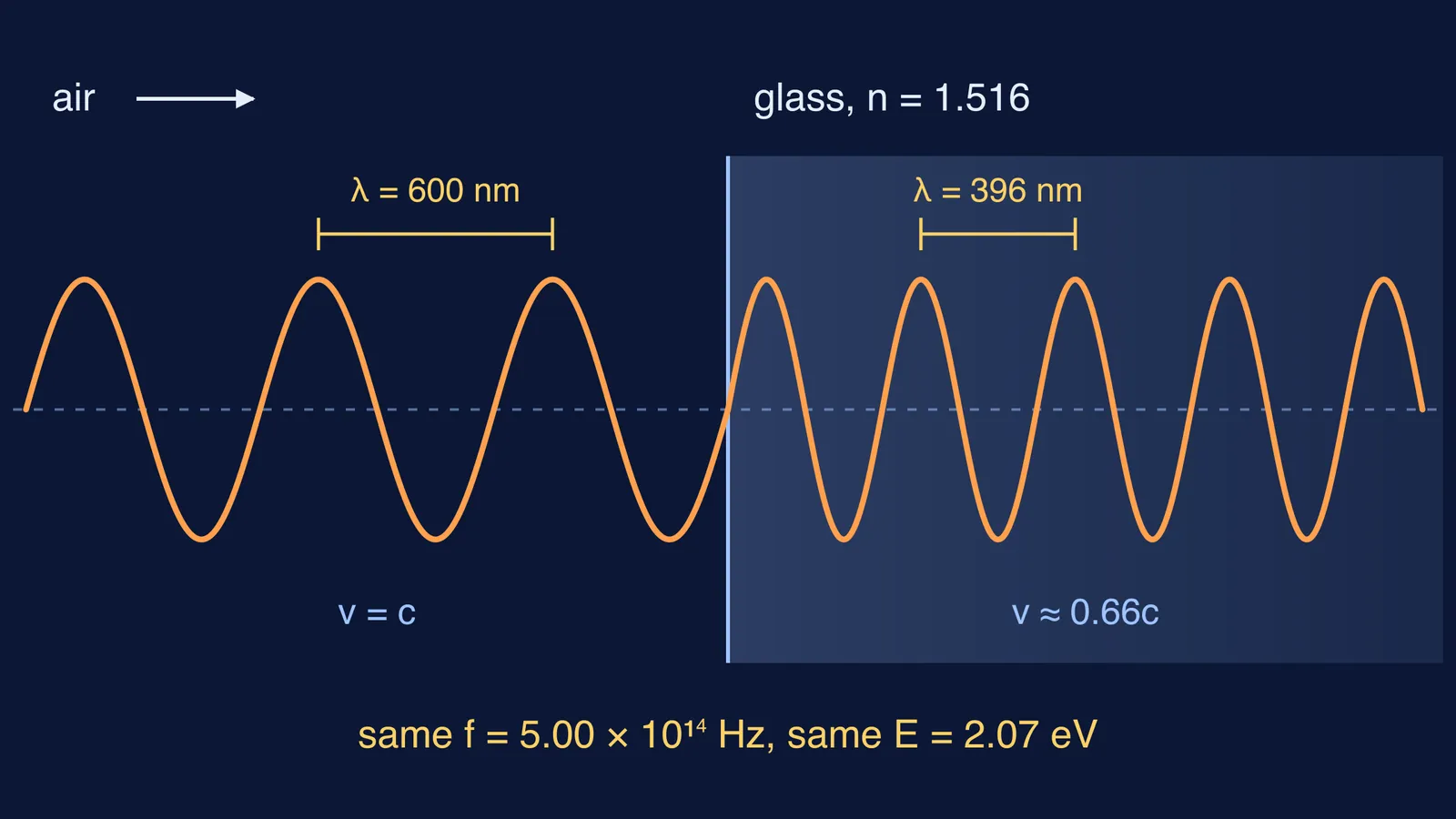
The crests do move more slowly inside the glass. Same number per second, lower speed, so they bunch closer together: the wavelength shrinks. That is the whole story in one line: v = fλ, with f fixed, so λ falls exactly as v falls.
Worked example: 600 nm light entering glass
We use N-BK7, an optical glass made by SCHOTT. Its refractive index comes from the Sellmeier formula published on RefractiveIndex.INFO, from the SCHOTT catalogue. The constants are the exact SI values from NIST: c = 299 792 458 m/s, h = 6.626 070 15 × 10⁻³⁴ J s and e = 1.602 176 634 × 10⁻¹⁹ C.
Frequency in air: f = c/λ = 299 792 458 / (600 × 10⁻⁹) ≈ 5.00 × 10¹⁴ Hz.
Photon energy: E = hf ≈ 3.31 × 10⁻¹⁹ J. Divide by e to get about 2.07 eV. The shortcut hc ≈ 1240 eV nm from OpenStax section 29.3 gives 1240/600 ≈ 2.07 eV too.
Refractive index: putting λ = 0.6 µm into the N-BK7 Sellmeier formula gives n ≈ 1.516.
Speed in glass: v = c/n ≈ 1.98 × 10⁸ m/s, about 0.66c.
Wavelength in glass: λn = 600/1.516 ≈ 396 nm.
Check: v/λn = (1.98 × 10⁸)/(396 × 10⁻⁹) ≈ 5.00 × 10¹⁴ Hz, the same frequency as in air. So the energy in glass is still about 2.07 eV.
Notice that 396 nm in vacuum would sit at the violet end of the visible spectrum. Inside the glass, the 600 nm light has that short wavelength but its colour has not changed, because its frequency has not moved.
If a step here felt shaky, the idea behind it (refraction, n = c/v, or E = hf) has its own lesson in the Fermi Concept Library, which covers every concept in physics, chemistry, biology, mathematics and computing.
If the energy is the same, why does light look dimmer after glass?
Because brightness is about how many photons arrive each second, not how much energy each one carries. At each surface some light is reflected back, and a thick or tinted piece of glass absorbs some as well. Both remove photons from the beam. The photons that get through each carry the same energy as before. Fewer photons, not weaker photons.
How do you check your answer in an exam?
Run through this short checklist whenever a question puts light into a new medium:
Frequency: same as the source. If your f changed, something is wrong.
Photon energy: same, because E = hf.
Colour: same, because colour follows frequency.
Speed: divide by n.
Wavelength: divide by n.
Any formula with hc/λ: use the vacuum wavelength only.
A quick sanity test is that both speed and wavelength must shrink by the same factor, so their ratio, the frequency, stays put.
If you keep reaching for the wrong method on problems like this, the Fermi Problem Library has worked problems with a step-by-step solver that explains the reasoning rather than printing an answer. Try the 600 nm example above with a different glass or with water, and see whether your frequency survives the trip.