On this page
Why do chrysanthemums and poinsettias flower when nights grow long, while spinach and peas flower when nights are short? The response is called photoperiodism, and the usual shorthand, that plants measure day length, is slightly wrong. Here is what they really measure, and where.
The idea dates to 1920, when W. W. Garner and H. A. Allard published work arguing that the length of daylight was critical; later work showed that the length of the night was the controlling factor. We tell the story of their tobacco plants in how Garner and Allard discovered photoperiodism in a dark shed.
What are short-day and long-day plants?
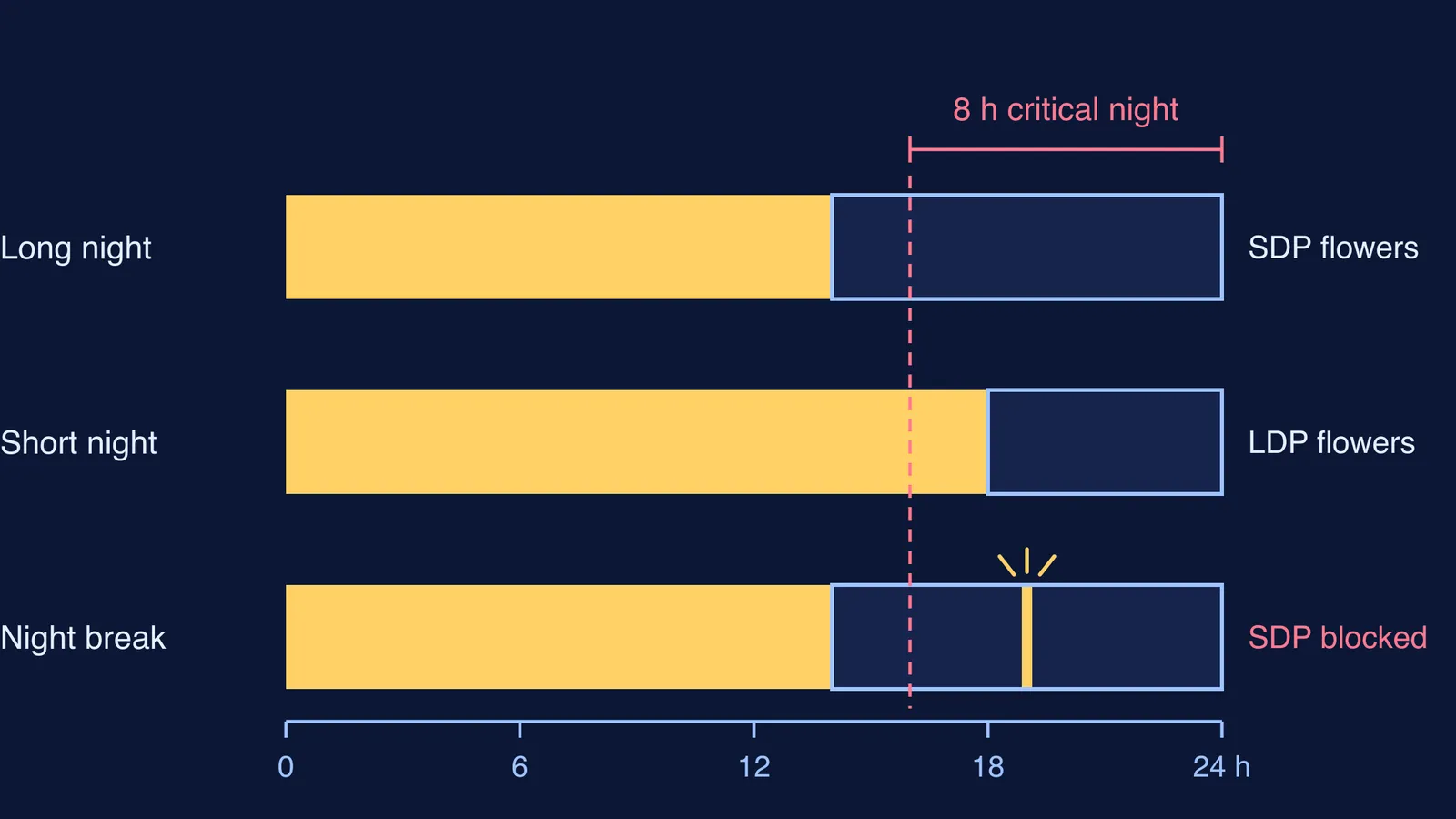
A short-day plant flowers when day length is less than its critical photoperiod, and a long-day plant flowers when day length exceeds it, as NPTEL lecture notes on plant growth factors define them. The same notes also say short-day plants respond to long nights, and long-day plants to short nights.
Short-day plants: chrysanthemum, poinsettia and coffee, from the NPTEL list above.
Long-day plants: onion, spinach, carnation and pea, from the same list.
Day-neutral plants: tomato, cucumber and rose, which flower according to their stage of growth rather than day length, as the Wikipedia overview of photoperiodism summarises.
The names describe a direction, not a number. Short-day does not mean a day under 12 hours. In the experiments of Karl Hamner and James Bonner, published in Botanical Gazette in 1938, cocklebur (Xanthium), a short-day plant, flowered under photoperiods shorter than 15 hours with dark periods longer than 8 hours. So a 14-hour day, which sounds long, still counts as short for cocklebur.
Why is it really night length that matters?
Hamner and Bonner put it directly: "The response of Xanthium to photoperiod is primarily a response to length of dark period rather than to duration of photoperiod" (Hamner and Bonner, 1938). The critical day length you see in textbooks is really a stand-in for a critical night length.
The clearest evidence is the night break. A short-day plant will not flower if it is lit for a few minutes in the middle of its long night, while a long-day plant given light during its dark period can flower, as the Wikipedia overview notes. In cocklebur, red light given in the middle of the inductive dark period inhibits flowering, a treatment Frank Salisbury's 1981 paper in Plant Physiology used for comparison.
The sensor is the pigment phytochrome. At dawn the phytochrome in a leaf converts to its active Pfr form, and in darkness Pfr slowly reverts to Pr over hours, which lets the plant gauge how long the night was (OpenStax Biology 2e). The lettuce-seed experiments that revealed this pigment are in how Borthwick and Hendricks found phytochrome.
Where is the photoperiodic stimulus perceived?
In the leaves. Hamner and Bonner exposed different parts of the same plant to different photoperiods and showed that leaves perceive the stimulus and make substances that are carried to where flowers form; the flowering substances could even pass from one plant to another (Hamner and Bonner, 1938).
That mobile signal was long called florigen. In 2007, a team led by George Coupland reported in Science that in Arabidopsis, day length is perceived in leaves and FT protein made in the leaf phloem moves to the shoot apex, where it induces flowering (Corbesier and colleagues, 2007).
Worked example: will this plant flower?
Take cocklebur, a short-day plant that flowered with dark periods longer than 8 hours in Hamner and Bonner's experiments. Predict, then check.
14 hours light, 10 hours dark. The night is longer than 8 hours, so it flowers.
18 hours light, 6 hours dark. The night is too short, so no flowers. A typical long-day plant would flower here.
14 hours light, 10 hours dark, with a brief flash of light 5 hours into the night. The plant gets two 5-hour nights, neither long enough, so no flowers.
Leaves given long nights, shoot tip given short nights. The leaves are the sensors, so expect flowering.
All leaves removed, plant given long nights. Nothing is left to perceive the night, so do not expect flowering.
For any photoperiod question, run three checks in order:
Which side of the plant's own critical night is the dark period on?
Was the dark period unbroken?
Did the leaves receive the treatment?
If the Pr and Pfr switch or the leaf-to-apex signal still feels abstract, the Fermi Concept Library gives every biology concept its own lesson and its place in the map, which helps you link photoperiodism to the topics around it. If you got a prediction wrong and are not sure why, Fermi's AI tutor works out what you already know and builds a plan for the session.
Cold is the other calendar some plants keep; read how weeks of cold make winter wheat flower next.