On this page
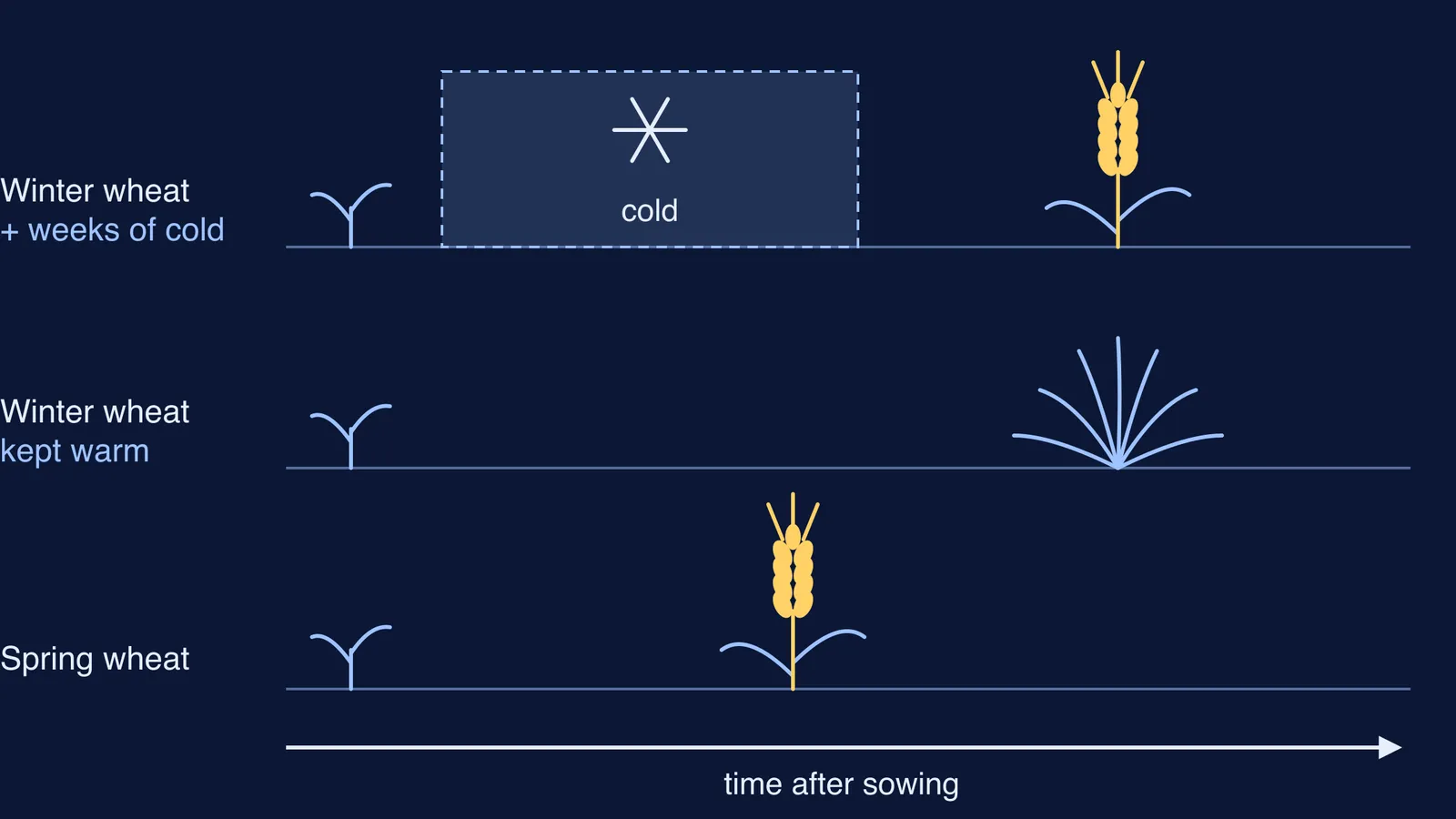
Sow a winter wheat in warm weather and it keeps making leaves while its neighbours come into ear. Give the same seedlings several weeks of cold first and they flower on schedule. That response to cold has a name, vernalisation, and it explains why some crops are sown before winter and others after it.
What is vernalisation in plants?
Vernalisation is the process by which flowering is promoted when a plant senses a long exposure to winter cold, as defined in a 2009 review by Kim, Doyle, Sung and Amasino. The same review explains why plants evolved it: a cold requirement stops a plant from flowering before winter and lets it flower in the better conditions of spring.
Three classic examples:
Winter wheat. Winter wheats need several weeks at low temperature to flower, a response controlled mainly by the VRN1 gene (Yan et al., PNAS 2003).
Biennials such as sugar beet. A biennial grows vegetatively in its first season and flowers only after a winter. In one study, sugar beet plants were vernalised at 4 °C for three months, and bolting (sending up a flowering stem) was timed from the end of the cold (Vogt et al., Frontiers in Plant Science 2014).
Winter-annual Arabidopsis. Two genes, FRIGIDA and FLOWERING LOCUS C (FLC), act together to block flowering until the plant has been through a cold spell (Amasino, The Plant Cell 2004).
How does cold make a plant flower?
The cold does not switch flowering on directly. It switches off the brakes. In Arabidopsis and cereals, vernalisation suppresses genes that repress flowering (Kim et al. 2009).
In Arabidopsis the brake is FLC, which encodes a MADS-domain protein that acts as a potent repressor of flowering (Amasino 2004). Prolonged cold silences FLC epigenetically, through histone modifications rather than changes to the DNA sequence (Kim et al. 2009).
In wheat the brake is VRN2, a dominant repressor of flowering that cold turns down (Yan et al., Science 2004). In winter wheat, AP1, the likely VRN1 gene, was transcribed only after vernalisation, starting after just 2 weeks in the cold room, and many winter wheat varieties need a minimum of 2 weeks of vernalisation (Yan et al. 2003).
Two more facts matter for exams, both from Amasino 2004:
The shoot apex senses the cold. In most species, a vernalised shoot tip grafted onto an unvernalised plant flowers, but an unvernalised tip on a vernalised plant does not.
The plant remembers. Vernalisation sets up a cellular memory that stays stable through mitotic cell divisions.
The memory can be fragile right after the cold. In the sugar beet study, the researchers raised the temperature in steps over 6 weeks after vernalisation to avoid devernalisation, the loss of the cold effect (Vogt et al. 2014).
Why don't spring wheat varieties need cold?
Because their brakes are already broken. When VRN2 is lost, through natural mutations or deletions, the result is spring lines that do not need vernalisation; when researchers lowered VRN2 in winter wheat by RNA interference, the plants flowered more than a month earlier (Yan et al. 2004). In plants carrying a dominant Vrn1 allele, AP1 transcription starts with no cold at all (Yan et al. 2003).
Spring wheat is grown in India too. One study tested 4,680 advanced spring bread wheat breeding lines sown in November at Jabalpur, Ludhiana and Pusa (Samastipur), and notes that unlike winter types, spring wheats need little or no environmental cue to flower (Bhati et al., Frontiers in Plant Science 2022).
What should NEET students remember about vernalisation?
The current NCERT Class 11 Biology chapter 13, Plant Growth and Development (2026-27 reprint), lists four sections: growth; differentiation, dedifferentiation and redifferentiation; development; and plant growth regulators (NCERT chapter PDF). It has no vernalisation section, so check the current NEET-UG syllabus on the National Medical Commission website before giving it time. Topics such as how plant growth is measured and what each plant hormone is used for in farming are core either way.
Then test yourself: true or false?
"A few hours of cold vernalise winter wheat." False: it takes weeks.
"The leaves sense the cold." False: the shoot apex does.
"Spring wheat must be vernalised to flower." False: its VRN alleles let it flower without cold.
"Flowering begins the moment the cold ends." False: vernalisation gives competence; day length can still set the timing.
"Cold switches off FLC, a gene that blocks flowering." True, in Arabidopsis.
"Vernalisation and photoperiodism are the same thing." False: one responds to a long cold spell, the other to day length (see how Garner and Allard discovered photoperiodism).
If a wrong answer showed a gap, say in what a MADS-box gene or a histone modification is, look it up in the Fermi Concept Library, which gives each concept in biology, chemistry, physics, mathematics and computing its own lesson.