On this page
Plant growth regulators are one of those topics where the marks sit in the examples. NCERT Class 11 Biology, chapter 13, groups them into five families: auxins, gibberellins, cytokinins, abscisic acid and ethylene, and then lists what farmers and gardeners do with them (NCERT, Plant Growth and Development).
An AI chatbot can draft that table in a minute. The catch: a table with one swapped crop looks exactly like a correct one. So let the AI draft, then check every row against NCERT before it goes into your notes.
How do you ask AI for a plant hormone uses table?
Ask for a narrow table, tied to NCERT, with permission to say "not sure". You can copy this prompt:
"Make a table of the five plant growth regulator groups in NCERT Class 11 Biology, chapter Plant Growth and Development. Columns: hormone, farming or horticulture use, crop or plant named. Only include examples that appear in that NCERT chapter. If you are not sure an example is in NCERT, write 'not sure' instead of guessing. Do not give page numbers."
The last line matters. Chatbots can produce page numbers that look precise and are wrong, which we explain in why AI tutors invent fake NCERT page numbers.
What does NCERT actually say each hormone is used for?
This is your answer key, taken from section 13.4.3 of the NCERT chapter.
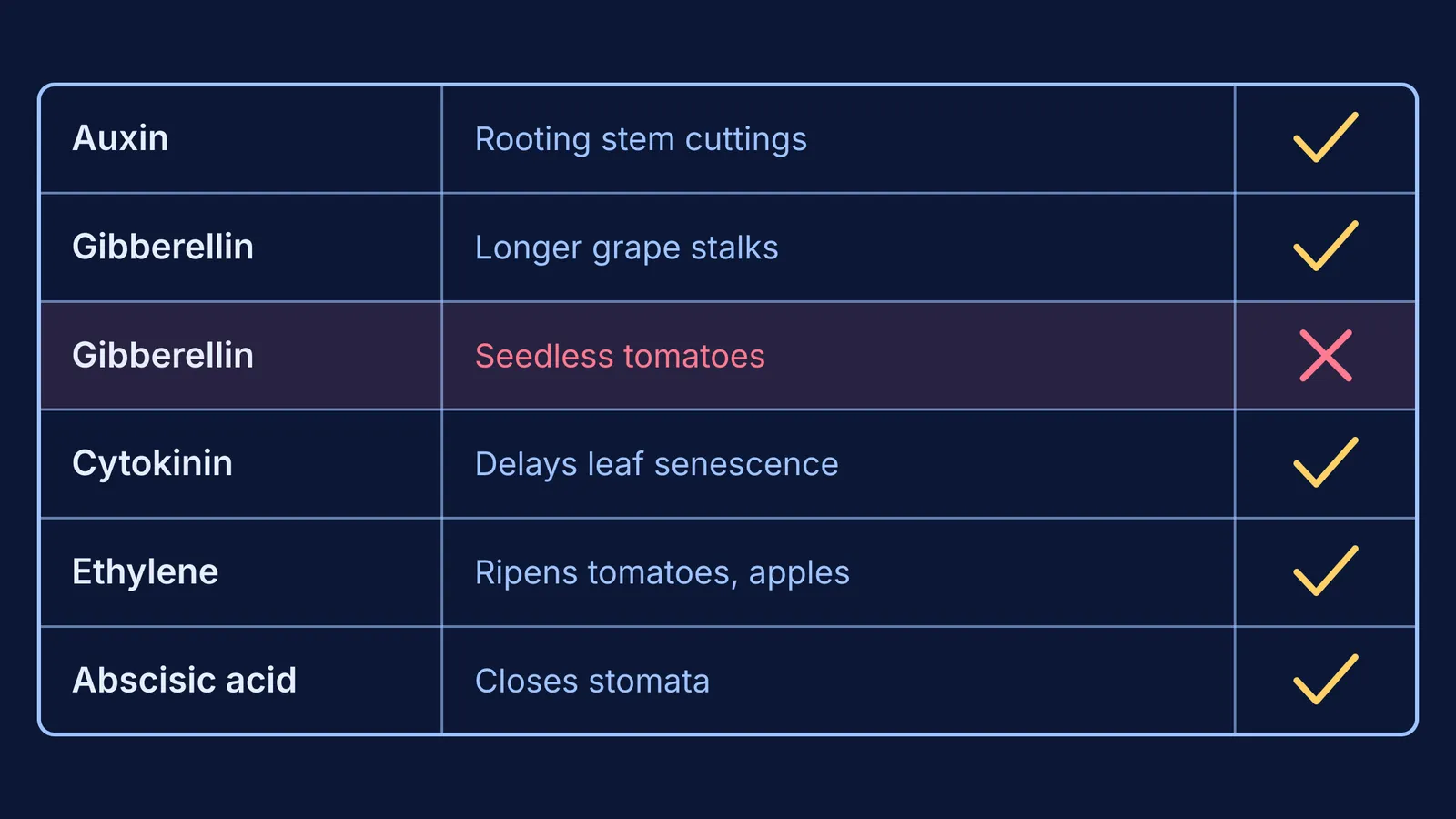
Auxins: start rooting in stem cuttings; promote flowering in pineapples; prevent early fruit and leaf drop; induce parthenocarpy in tomatoes; 2,4-D kills dicotyledonous weeds but not mature monocots, so gardeners use it for weed-free lawns. Removing shoot tips to break apical dominance is used in tea plantations and hedge-making.
Gibberellins: lengthen grape stalks; elongate apples and improve their shape; delay senescence so fruit can stay on the tree longer; GA3 speeds up malting in brewing; sprayed on sugarcane, they lengthen the stem and raise yield by as much as 20 tonnes per acre; they hasten seed production in juvenile conifers and cause bolting in beet and cabbages.
Cytokinins: NCERT gives effects rather than a named crop practice: new leaves, chloroplasts, lateral shoot growth, adventitious shoots, overcoming apical dominance and delaying leaf senescence.
Ethylene: ethephon, the most widely used source, hastens ripening in tomatoes and apples, thins flowers and fruits in cotton, cherry and walnut, and promotes female flowers in cucumbers. Ethylene also starts flowering and synchronises fruit-set in pineapples, and induces flowering in mango.
Abscisic acid: closes stomata, raises stress tolerance and maintains seed dormancy; NCERT calls it the stress hormone and says that in most situations it acts as an antagonist to gibberellins.
More detail: gibberellins in bolting, sugarcane and grape stalks and ethylene, ripening and ethephon.
How do you check each row against NCERT?
Go row by row with the chapter open. A row passes only if all five checks pass.
Sentence: find the NCERT sentence that says it. No sentence, no tick.
Hormone: the same regulator, not a cousin from the same paragraph.
Crop: the same plant, not a neighbour from the next sentence.
Verb: promote versus prevent, flowering versus fruit-set, ripening versus abscission.
Number and unit: copy them exactly, including "per acre".
Mark each row with a tick, a cross, or "not in NCERT".
If a row fails because you are unsure what the hormone does in the first place, the Fermi Concept Library has a lesson for every concept in biology, with its place in the map, so you can fix the idea before you memorise the use.
Which rows in an AI hormone table are easiest to get wrong?
A worked example: four flawed rows we wrote to show the check, each judged against the NCERT chapter.
"Gibberellins make seedless tomatoes." Cross: NCERT says auxins induce parthenocarpy in tomatoes.
"Pineapple flowering: auxin." Incomplete: NCERT names auxins for pineapple flowering and ethylene for initiating flowering and synchronising fruit-set.
"Gibberellins raise sugarcane yield by 20 tonnes per hectare." Cross: the unit in NCERT is per acre.
"2,4-D clears grasses from lawns." Cross: it is reversed. 2,4-D kills dicot weeds and spares mature monocots, which is why the lawn survives.
The pattern: the hormone, crop or unit drifts while the sentence still sounds right.
How do you know you have memorised the right table?
Close your notes and answer exercise 8 from the chapter. Which regulator would you use to:
induce rooting in a twig (auxin)
quickly ripen a fruit (ethylene)
delay leaf senescence (cytokinin)
induce growth in axillary buds (cytokinin, which overcomes apical dominance)
bolt a rosette plant (gibberellin)
induce immediate stomatal closure (abscisic acid)
Answer all six, plus one crop per hormone, without looking, and your table is ready. If you would rather work through the gaps with help, Fermi's AI tutor works out what you already know, builds a plan for the session and checks understanding as it goes.