

On this page
Plant growth relies on specialized regions of dividing cells, such as apical, intercalary and lateral meristems. Once those cells are produced, hormones take over to guide their development. Similar to how auxins control phototropism, geotropism and other tropic movements, gibberellins are a large family of plant hormones that control growth, specifically by commanding stems to stretch.
The history of gibberellins starts in Japan with the "bakanae" or "foolish seedling" disease in rice, as detailed in the NCERT Class 11 Biology textbook. Farmers noticed that some rice seedlings grew exceptionally tall and thin, eventually falling over and dying before they could yield grain. Scientists discovered this was caused by a fungus called *Gibberella fujikuroi*. When the active substance was isolated, it was named gibberellic acid.
Today, there are over 100 known gibberellins reported from fungi and higher plants, all of which are acidic. The most intensively studied of these is gibberellic acid (GA3).
If you are preparing for NEET-UG or your school biology exams, the practical agricultural applications of these hormones are high-yield topics. Here is how they are used to change how plants grow and when they flower.
How do gibberellins increase sugarcane yield?
Sugarcane is a unique crop because it stores its carbohydrates as sugar directly in its stems, rather than in its fruits or roots. Therefore, to get a higher sugar yield, a farmer essentially needs taller and thicker stems.
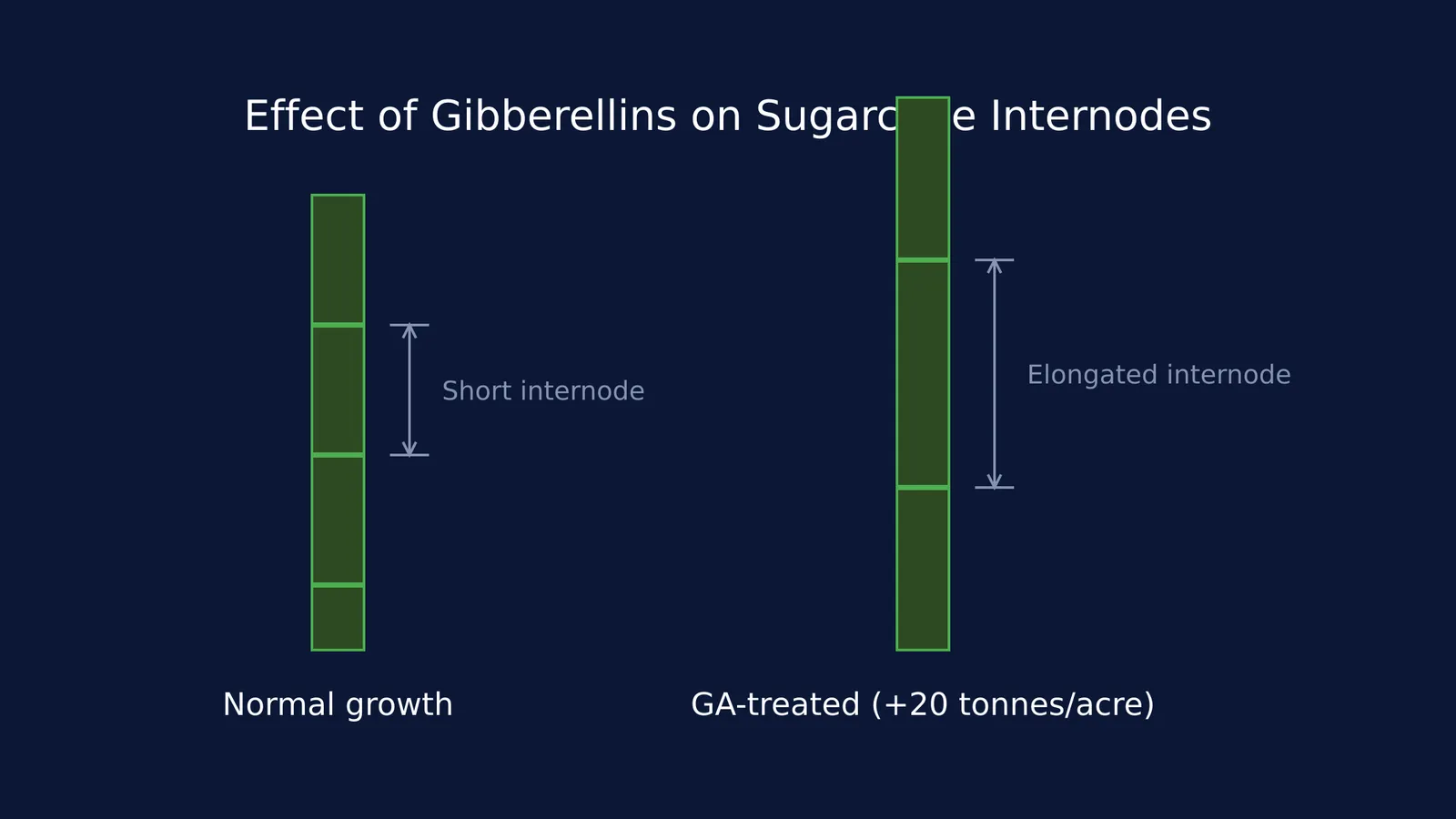
Spraying a sugarcane crop with gibberellins triggers rapid internode elongation. The internodes—the sections of the stem between the joints—stretch out, making the entire plant grow significantly taller. This simple hormonal spray can increase the overall sugarcane yield by as much as 20 tonnes per acre, according to the NCERT textbook. For large-scale farming, this is a large increase in productivity driven by a single biological mechanism.
Why are gibberellins used on grapes?
Gibberellins have the specific ability to cause a direct increase in the length of a plant's axis.
In viticulture (grape farming), spraying the vines increases the length of the grape stalks (the pedicels). Longer stalks create more physical space between individual grapes on the bunch. This extra room allows the grapes to grow much larger without crushing each other, and it improves air circulation, which significantly reduces the risk of fungal infections and rot.
Farmers also use gibberellins to cause fruits like apples to elongate and improve their final shape, making them more appealing for the market. By delaying senescence (the natural aging process), these hormones allow fruits to be left on the tree longer. This extends the harvesting window and the period they can be sold fresh in the market.
What is bolting in rosette plants?
Some plants, like beet and cabbages, naturally have a "rosette" habit. This means they grow a circular arrangement of leaves that sit very close to the ground, with extremely short internodes packed tightly together.
Gibberellins promote a process called bolting. Bolting is defined as the sudden elongation of internodes just prior to flowering. When triggered, the plant rapidly shoots up a tall flowering stalk from the center of the rosette. By applying gibberellins artificially, farmers or plant breeders can force these rosette plants to bolt, flower, and produce seeds much earlier than they naturally would under normal environmental conditions.
How do they speed up maturity and malting?
Beyond stems and stalks, gibberellins have two other major commercial uses that frequently appear in exams:
Brewing: GA3 is widely used to speed up the malting process in the brewing industry.
Conifers: Spraying juvenile conifers with gibberellins hastens their maturity period. This leads to early seed production, saving years of waiting for the trees to reach reproductive age.
When you have to memorize multiple plant hormones, it is easy to mix up their functions. The Fermi Concept Library contains every concept in biology, each with its own lesson and its place in the map, helping you trace exactly how hormones trigger plant development rather than just memorizing a list.
A checklist for gibberellin exam questions
When reviewing past papers, look for these specific keywords paired with gibberellins:
Stem elongation: Sugarcane (20 tonnes per acre).
Axis length: Grape stalks.
Fruit shape: Apples.
Bolting: Beet, cabbages, rosette plants.
Malting: Brewing industry.
Early seed production: Juvenile conifers.


