

On this page
If you prepare for JEE Main or NEET-UG, you might ask an AI where a concept is found in the NCERT textbook. The AI replies confidently that the reaction is on Page 314, Figure 11.2. You check the book and find it is completely wrong.
This is common. Invented page numbers and false citations are among the most confusing errors when students use standard AI tools for exam preparation.
Why does AI give wrong NCERT page numbers?
The fundamental reason is that a large language model (LLM) is not a database. When you search for a file on your computer, the system looks up an exact record. When you ask a general-purpose AI a question, it predicts the most mathematically likely sequence of words to follow your prompt.
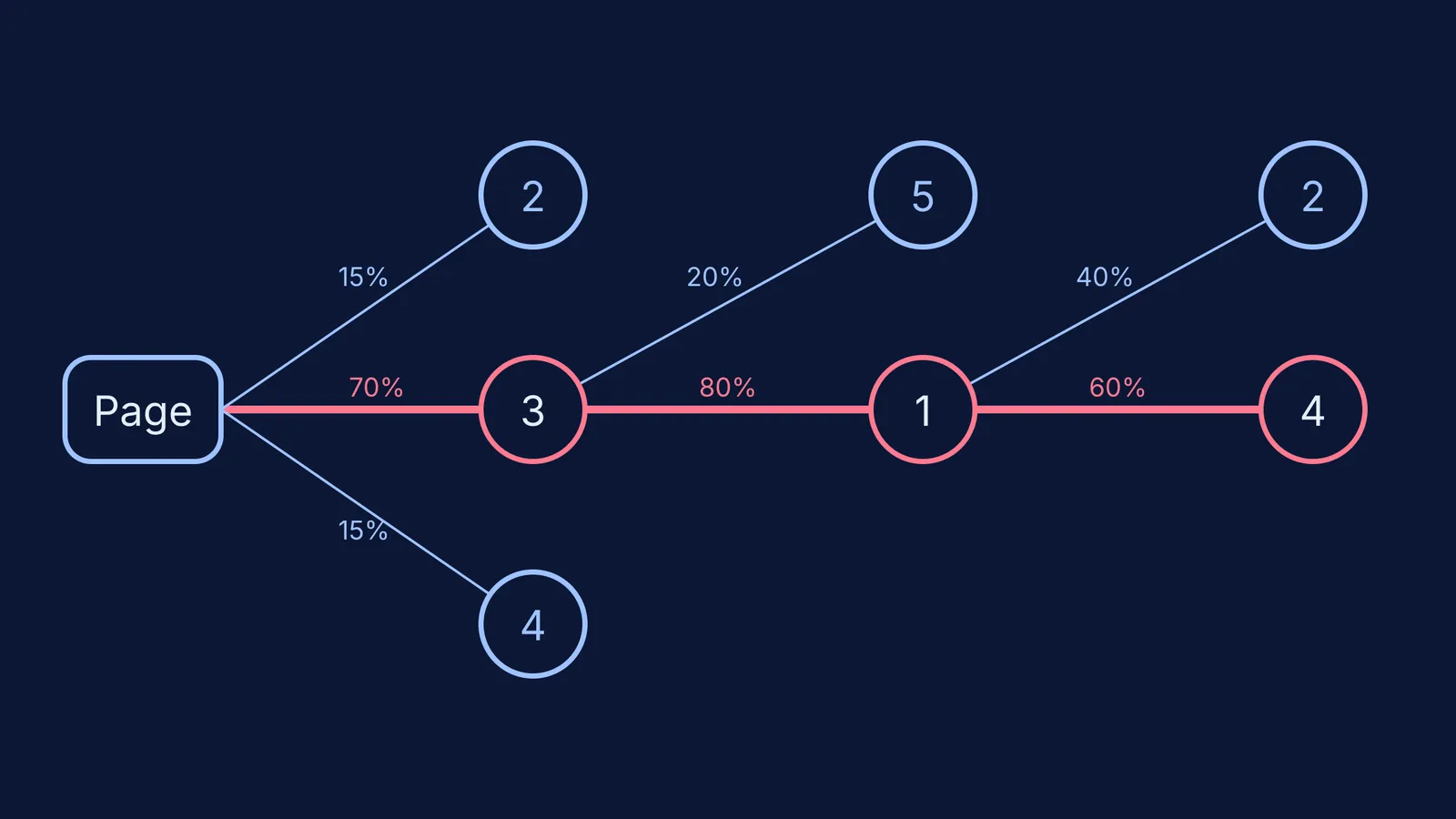
To understand why this happens, it helps to look at how these models generate text. When you type a prompt, the AI does not search through a verified index of NCERT books. Instead, it breaks your sentence down into tokens—chunks of words or letters. It then uses complex statistics to predict the token that should logically come next.
Because standard LLMs are trained on vast amounts of text rather than searchable databases, they learn what a citation looks like, not what it points to. To the model, a page number is just a statistically probable string of digits. It knows an aldehydes chapter typically has page numbers in the 300s, so it generates 314 because it is plausible, not because it checked the book. This tendency to invent plausible but incorrect facts is called a hallucination.
A 2024 study by Stanford researchers in the *Journal of Legal Analysis* found that standard AI models hallucinated citations and facts at least 58% of the time. The models struggled to predict their own errors and often presented false information with high confidence. While this study looked at law, the mechanism is the same for chemistry: when forced to recall specific numbers, AI relies on guesswork.
NCERT textbooks present an extra challenge for AI models. The books are updated frequently, and the PDFs available online do not always have text that maps neatly to the printed page numbers. A model might mix up the page number from an older edition with a figure number from a newer edition, creating a Franken-citation that does not exist in any physical book.
How do you verify if a figure or example number is real?
If you are using an AI chatbot to help you study, you need a systematic way to check its claims. Do not rely on the AI's confident tone or its willingness to apologise when challenged. Instead, use these steps to verify its output:
Search for the text, not the number. Ignore the page number the AI gave you entirely. Instead, take a unique phrase, the exact name of the reaction, or the specific biological term and search for it directly in your physical book's index or by using the search function in the official NCERT PDF. If the concept is real, you will find it by name much faster than by hunting for a ghost page.
Ask for an explanation instead of a citation. Instead of asking what page the Cannizzaro reaction is on, ask the AI to explain the mechanism and its conditions. You can then match the steps of the explanation against the chemical reactions listed in your textbook. Evaluating the logic is safer than trusting a naked citation.
Use the official syllabus as your map. Exam boards publish exact, binding syllabuses for competitive tests. Keep the official document open on your desk. Use it as your ultimate guide for what to study next, rather than asking a chatbot what topics are included in a specific chapter.
How can you stop AI from hallucinating your study material?
General chatbots invent facts because they are built to answer any question, even without the required data. Educational AI tools solve this by strictly restricting where the AI pulls its information from.
When a platform connects an AI to a verified library, it grounds the AI in reality. This is how Fermi's AI tutor works. Instead of guessing facts, the Fermi Concept Library holds every concept in physics, chemistry, biology, mathematics and computing, each with its own lesson and its place in the map. The AI teaches from this verified map.
If you get stuck on a numerical problem, a standard chatbot might invent an equation or skip a step. The Fermi Problem Library avoids this by offering worked problems with a step-by-step solver that explains the reasoning rather than printing an answer. You spend your time learning the physics, without having to double-check every line for errors.
Read more about AI in education:


