

On this page
In August 1952, a team at the US Department of Agriculture's Beltsville laboratories in Maryland published a short paper with a long reach. Harry Borthwick, Sterling Hendricks, Marion Parker, Eben Toole and Vivian Toole showed that a flash of red light made lettuce seeds germinate and a flash of far-red light right after cancelled it. Their paper, A Reversible Photoreaction Controlling Seed Germination, appeared in the Proceedings of the National Academy of Sciences. The pigment behind that on-off switch was later named phytochrome.
How was phytochrome discovered using lettuce seeds?
The lettuce work grew out of a puzzle about flowering. From 1936, Borthwick, a botanist, and Parker, a plant physiologist, were studying photoperiodism: how the length of day controls when plants flower. That is the effect Garner and Allard had found in 1920, told in our post on how a dark shed revealed photoperiodism. According to Hendricks' memoir of Borthwick for the National Academy of Sciences, the two sought out Hendricks, a chemist, for help measuring action spectra, which show which colours of light cause a response.
The memoir says the most basic finding "came from close at hand in an unexpected way." Eben and Vivian Toole studied seeds in a lab next door to the room where the spectra were measured. They suggested testing lettuce seeds, because many seeds were known to need light to germinate. The NAS memoir of Warren Butler calls lettuce germination the "more rapid" system. The memoir of Borthwick notes that the effect of red light took a day to show.
What did the 1952 experiment show?
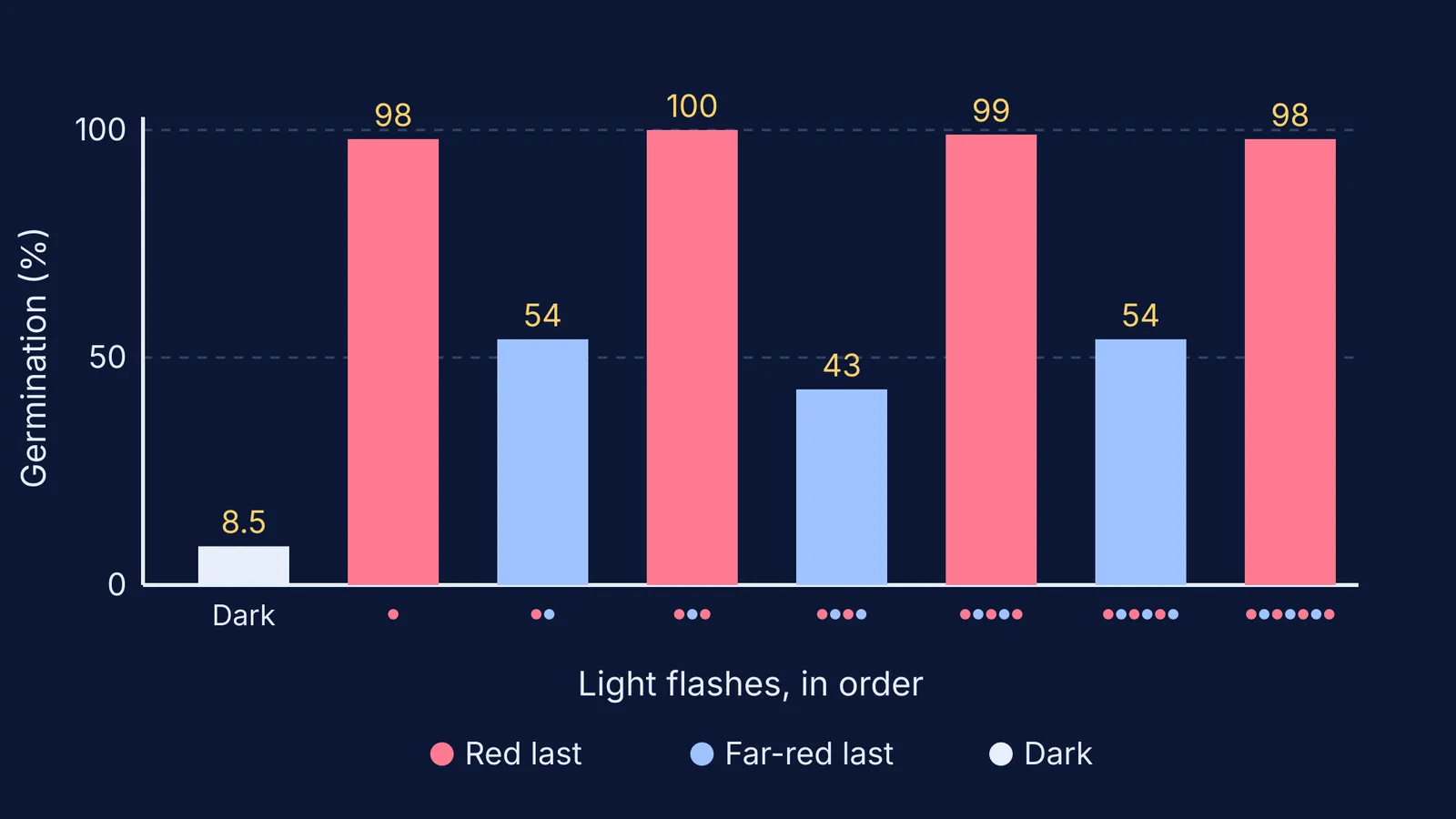
The USDA's own history of the work dates the key result to 9 April 1952: "Seed hit with red light germinated unless it was then hit with far-red; but if red again ensued, it would germinate." The team alternated the flashes several times. Here are the germination figures for Grand Rapids lettuce seeds, as reproduced in this plant physiology lecture on phytochrome:
Dark, no light: 8.5%
Red: 98%
Red, far-red: 54%
Red, far-red, red: 100%
Red, far-red, red, far-red: 43%
Five flashes, ending red: 99%
Six flashes, ending far-red: 54%
Seven flashes, ending red: 98%
The number of flashes made little difference. The last colour decided the outcome: red last meant almost every seed sprouted, and far-red last brought germination back down.
Why did "the last flash wins" point to one pigment?
If red and far-red worked through two separate pigments, you might expect their effects to pile up, so the result would depend on the whole history of flashes. Instead, each flash undid the one before it. The simplest explanation was one molecule with two forms. Red light turns it into the active form. Far-red light turns it back. Hendricks wrote that this showed the pigment "had at least two forms, only one of which was biologically effective" (NAS memoir).
Today the two forms are called Pr and Pfr. Pr absorbs most strongly at about 666 nm (red) and Pfr at about 730 nm (far-red) (lecture notes). Pfr is the active form that lets the seed germinate.
How was phytochrome finally seen in 1959?
For seven years the pigment was only a prediction. In mid-June 1959, Hendricks took dark-grown turnip seedlings to the biophysicist Warren Butler, who measured their absorption after red and after far-red light. The difference was "precisely that predicted for phytochrome", according to the NAS memoir of Butler. According to Borthwick, Butler had suggested the name "half jokingly", from the Greek words for plant and colour. The finding was published as Butler, Norris, Siegelman and Hendricks (1959). The USDA history adds that boiling the extract destroyed its reversibility, as expected for a protein.
How do you answer a red/far-red question in an exam?
Use this three-step method on any question about flash sequences.
Find the last flash. Ignore everything before it.
Red last means the pigment ends as Pfr, the active form, so germination is high. Far-red last means it ends as Pr, so germination is low.
Explain why in one line: each flash converts the pigment, so only the final conversion counts.
Worked example: a seed gets red, far-red, red, far-red, red. The last flash is red, so most of the pigment is Pfr and the seed germinates. The 1952 data agrees: five flashes ending in red gave 99%.
To practise, write out three sequences of your own and predict each one before you check. If Pr and Pfr still feel like two labels rather than one molecule switching, the Fermi Concept Library gives each biology concept its own lesson and shows where it sits in the map. The idea also links to dormancy, covered in seeds, dormancy and germination, and to plant hormones, which began with Frits Went and his oat seedlings.
Phytochrome biology started with a simple test: change the colour of the last flash and watch what the seeds do.


