On this page
Chemistry gives you two kinds of smog. One comes from coal fires on cold, foggy mornings; the other is made by sunlight acting on vehicle exhaust. Their chemistry runs in opposite directions: one is reducing, the other oxidising, and that one word is usually what an examiner is checking.
What is the difference between classical and photochemical smog?
Classical smog is a reducing smog because its main gas, sulphur dioxide, is easily oxidised, according to the e-PG Pathshala module on photochemical and classical smog from INFLIBNET. The same module calls photochemical smog oxidising in nature, because of the ozone it forms.
The module also gives the weather each needs. Classical smog forms in cool, still, foggy air under a temperature inversion and peaks in the early morning. Photochemical smog needs sunshine, low wind and a crowded city, and peaks in the afternoon.
Classical (London, sulphurous) smog: smoke, soot and SO₂ from coal, plus fog. It ends in sulphuric acid droplets.
Photochemical (Los Angeles) smog: nitrogen oxides and unburnt hydrocarbons from vehicles, plus sunlight. It ends in ozone, PAN and aldehydes.
How does classical smog form, and why is it called reducing?
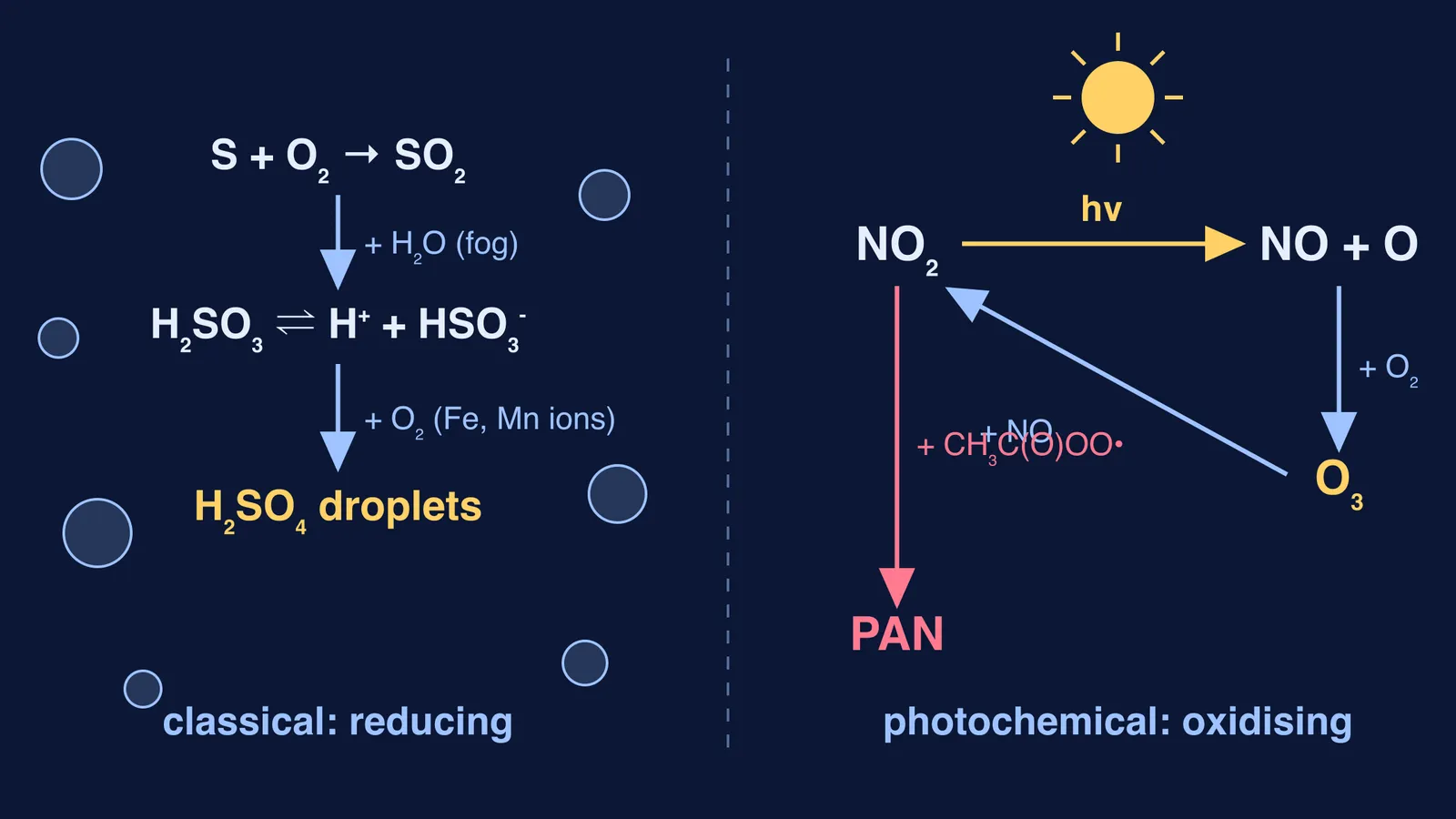
The e-PG Pathshala smog module gives the steps. Burning coal oxidises its sulphur: S + O₂ → SO₂. In fog, SO₂ dissolves: SO₂ + H₂O → H₂SO₃, giving hydrogen sulphite ions, HSO₃⁻. Traces of iron and manganese ions in the water then catalyse 2HSO₃⁻ + O₂ → 2SO₄²⁻ + 2H⁺, leaving sulphuric acid droplets.
Notice the direction. The main gas takes in oxygen and is itself oxidised, so it acts as a reducing agent. That is why the mixture is called reducing.
The best-known case is London in December 1952. The Met Office case study of the Great Smog says it lasted from 5 to 9 December and that about 4,000 people were known to have died as a result, though it could be many more. During the episode, 370 tonnes of sulphur dioxide were converted into 800 tonnes of sulphuric acid. Beneath a temperature inversion, a layer of fog 100 to 200 metres deep held the coal smoke near the ground, and the Clean Air Acts of 1956 and 1968 followed.
What are the reactions in photochemical smog formation?
Ground-level ozone is not emitted directly; it forms when nitrogen oxides and volatile organic compounds react in sunlight, as the US EPA explains. Caltech's account of Arie Haagen-Smit's work says he traced Los Angeles smog to hydrocarbons from petrol and oxides of nitrogen; his paper Chemistry and Physiology of Los Angeles Smog appeared in 1952.
Here is the chain. Steps 1 to 4 use the equations in the e-PG Pathshala module:
Hot engines make nitric oxide: N₂ + O₂ → 2NO.
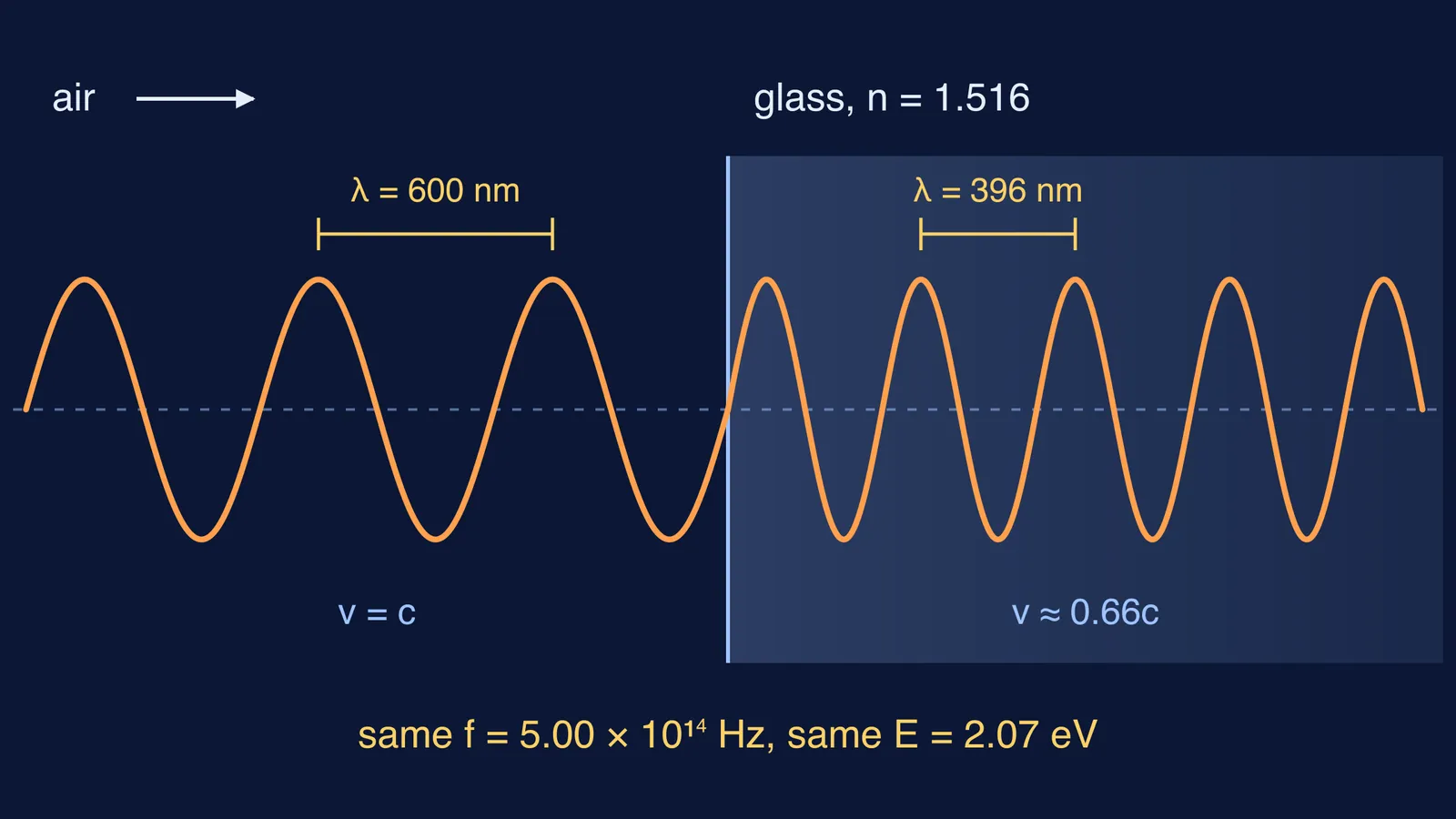
Sunlight splits nitrogen dioxide: NO₂ + hν → NO + O. LibreTexts/10%3A_Blue_Skies_for_a_Green_Environment/10.11%3A_Photochemical_Smog) puts the light needed below about 398 nm, in the ultraviolet.
The oxygen atom makes ozone: O + O₂ + M → O₃ + M, where M is a third molecule that carries away extra energy.
Ozone turns nitric oxide back into NO₂: O₃ + NO → NO₂ + O₂.
Hydrocarbon peroxyl radicals, written RO₂•, also turn NO into NO₂, as this Vancouver Island University smog summary shows, so NO₂ comes back without using up ozone.
The same summary shows hydrocarbon radicals forming aldehydes, then aldehyde peroxides that join NO₂ to form peroxyacyl nitrates. The commonest is peroxyacetyl nitrate (PAN): CH₃C(O)OO• + NO₂ → CH₃C(O)OONO₂.
The products are what hurt. LibreTexts/10%3A_Blue_Skies_for_a_Green_Environment/10.11%3A_Photochemical_Smog) notes that 0.15 parts per million of ozone irritates the airways, causing coughing and wheezing, and that PAN and aldehydes irritate the eyes.
How do you write a smog answer that scores?
Syllabuses get revised, so first check that smog is on your current board or entrance-exam syllabus. Then use this checklist:
Name both: classical (London, sulphurous) and photochemical (Los Angeles).
Give the weather: cool, foggy, early morning versus sunny, still, afternoon.
Give the source: coal smoke versus vehicle exhaust.
State the nature and the reason: reducing, because SO₂ is itself oxidised; oxidising, because of O₃, NO₂ and PAN.
Write the photochemical equations in order: NO₂ photolysis, ozone formation, ozone plus NO, then PAN.
Close with one control for each: smokeless fuels, as London's Clean Air Acts required, versus cutting nitrogen oxides and hydrocarbons from exhaust.
A one-line model answer to adapt: "Classical smog is reducing because its main gas, SO₂, is oxidised to H₂SO₄ in fog; photochemical smog is oxidising because sunlight turns NO₂ into O₃, which, with PAN, oxidises what it touches."
If a step still feels like a string of symbols, the Fermi Concept Library gives every concept in chemistry its own lesson. For practice, the Fermi Problem Library has worked problems with a step-by-step solver that explains the reasoning rather than printing an answer.
Learn the photochemical chain once, in order, and the comparison question writes itself.