On this page
Put a compass on a desk next to a steel almirah and the needle may settle well away from north. The compass is not broken. It is reading the field where it sits, and near iron that field is no longer only Earth's.
What does a compass needle actually point at?
A compass needle is a small magnet that swings until it lies along the horizontal part of the local magnetic field. NOAA's National Centers for Environmental Information say the compass points along the horizontal component of the field where it is, "and not to any single point" (NOAA NCEI geomagnetism FAQ).
Earth's field is weak: at the surface it is roughly 25,000 to 65,000 nanotesla, or 0.25 to 0.65 gauss (NOAA NCEI). Any extra field from a nearby object adds to it as a vector, and the needle follows the sum.
Why does iron bend the field around the needle?
Iron, nickel and cobalt are ferromagnetic. Inside them, electron spins line up in small regions called domains, and HyperPhysics explains that "a small externally imposed magnetic field, say from a solenoid, can cause the magnetic domains to line up with each other", which magnetises the material (HyperPhysics on ferromagnetism). Earth's field does the same to a steel cupboard or a pair of scissors: the iron becomes a weak magnet, and its field joins Earth's.
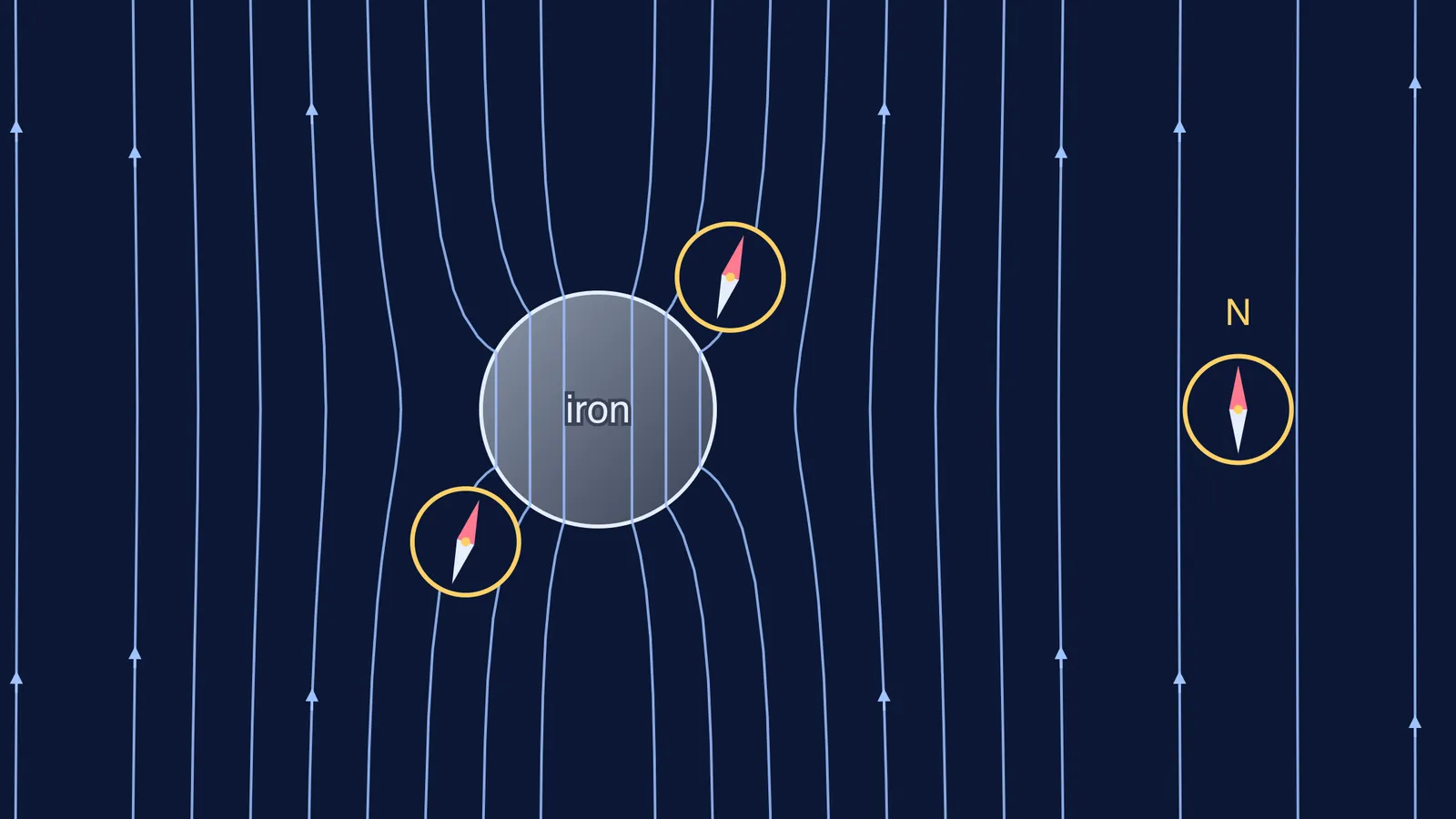
Iron also pulls field lines into itself. Relative permeability measures how strongly a material does this, and it is exactly 1 for empty space. Annealed iron that is 99.8% pure has an initial relative permeability of about 150, and quenched steel about 50 (HyperPhysics table of magnetic properties). That is the bunching in the diagram above: lines crowd into the iron and spread around it, so a compass just beside the iron sits in a tilted field.
Not every metal does this. The same table lists aluminium's magnetic susceptibility as 2.2 × 10⁻⁵ and copper's as −1.0 × 10⁻⁵, while for that iron the susceptibility (relative permeability minus 1) is about 149 (HyperPhysics). That is why an iron nail swings a compass and an aluminium spoon barely does. Our guide to diamagnetic, paramagnetic and ferromagnetic materials sorts everyday objects into these groups, and testing whether a magnet can lift pins through paper, aluminium or iron shows iron soaking up field lines.
How far does a nearby object turn the needle?
Here is a worked example with school trigonometry. Call Earth's horizontal field E, pointing north, and say a steel object adds a sideways field S, pointing east. The needle lies along their sum, so its angle θ from north obeys tan θ = S / E.
If S is one-tenth of E, tan θ = 0.1 and θ ≈ 5.7°.
If S equals E, tan θ = 1 and θ = 45°.
Distance helps fast. Far from a small magnet, its field falls off as the cube of the distance; the University of Illinois Physics Van gives the example that the field two feet away is only 1/8 of the field one foot away (Illinois Physics Van on magnets at a distance). Suppose a small steel key 10 cm from your compass turns it by 45°:
At 10 cm, S = E, so θ = 45°.
At 20 cm, S = E/8, so tan θ = 0.125 and θ ≈ 7.1°.
At 40 cm, S = E/64, so θ ≈ 0.9°.
The cube rule only holds once you are several object-lengths away, so a car or a steel railing needs far more room than a key does. If adding fields as arrows is hard to picture, the Fermi Simulation Lab has interactive simulations for ideas that are easier to see than to read.
How do ships deal with all that steel?
Navigators call this error magnetic deviation: compass error caused by local fields from nearby iron, steel or electrical equipment (Magnetic deviation, Wikipedia). Ships correct it with small magnets and two soft-iron spheres beside the compass, called Kelvin's balls after Lord Kelvin, and any leftover error goes on a compass correction card (same article).
How do you get an honest compass reading?
Use this checklist for a school practical or a trek:
Clear the table of keys, scissors, a steel geometry box, your phone and any magnets.
Work on a wooden table, not a steel one, when you plot a bar magnet's field lines.
Stand well clear of steel cupboards, railings and parked vehicles; the bigger the object, the more room it needs. For a small object, the cube rule means ten times the distance leaves a thousandth of its field.
Do the slide test: move the compass 30 cm to one side. If the needle changes direction, something nearby is pulling it.
Phone compasses face the same problem; our explainer on how a phone's compass works without a needle covers what is inside.
To go deeper into domains and permeability, the Fermi Concept Library has a lesson for every concept in physics.