

On this page
Most of us have used a map app and watched the little blue cone pivot as we turn. But without a physical magnet inside, how does the compass in a phone work without a needle?
The answer lies in solid-state physics and microscopic sensors. Instead of a free-floating needle aligning with north, your phone measures the magnetic field directly using an electronic component called a magnetometer.
How does the compass in a phone work without a needle?
Your phone is equipped with a Micro-Electro-Mechanical System (MEMS) magnetometer. This is a tiny silicon chip that measures the surrounding magnetic field.
The Earth's magnetic field is relatively weak; at the surface, it ranges from 30 to 60 microteslas (Wikipedia). Despite this, smartphone magnetometers can resolve angles as small as 0.1° (Wikipedia). By detecting the precise strength and angle of the invisible field lines passing through the phone, the software calculates a vector that points to Magnetic North.
What is the Hall effect?
Most smartphone compasses rely on the Hall effect, discovered by the physicist Edwin Hall in 1879 (Wikipedia). It is a clear demonstration of how magnetic fields interact with moving charges.
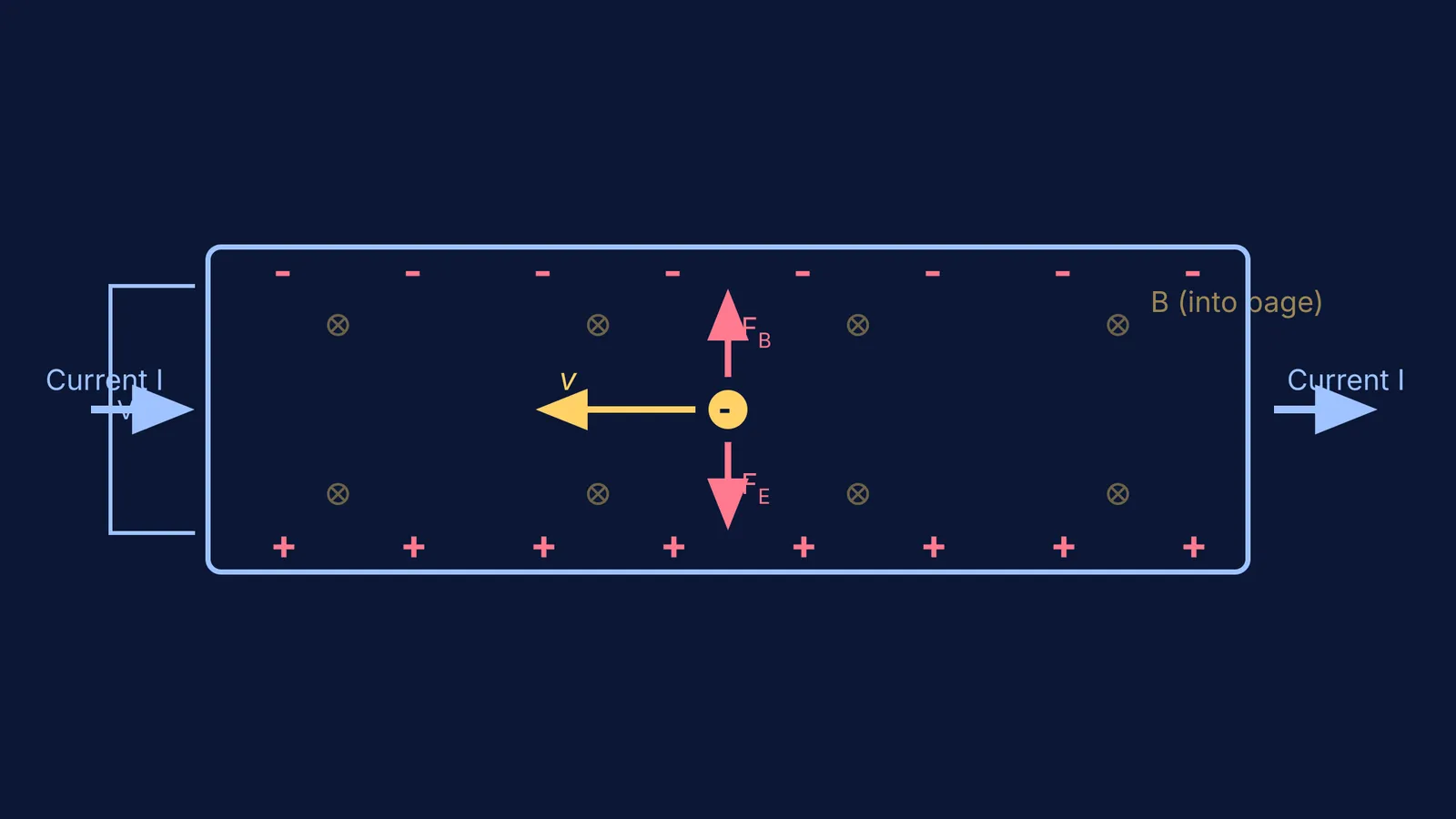
When an electric current flows through a conductive strip inside the sensor, charge carriers (typically electrons) move from one end to the other. If you place this strip in a magnetic field, the field exerts a sideways push on these moving electrons. This push is mathematically described by the Lorentz force, which states that the force is proportional to the charge, the velocity of the electrons and the strength of the magnetic field.
As the electrons are deflected sideways, they accumulate on one edge of the strip. This leaves the opposite edge with a scarcity of electrons, creating a net positive charge. You can see a similar principle at work when studying the helical path of a charge in a magnetic field.
This separation of charges creates an electric field that pushes back against the magnetic force. Once the two forces balance out, a steady potential difference remains across the strip, which is called the Hall voltage. The stronger the external magnetic field, the greater the sideways force on the electrons and the higher the resulting Hall voltage. By measuring this tiny voltage, the microchip determines the precise strength of the magnetic field. If you want to build and test your own simulated circuits to see how fields interact, Fermi simulations allow you to visualise the Lorentz force in real time.
How do the three axes work together?
A single Hall effect sensor can only measure the magnetic field perpendicular to its face. If you tilt the sensor, the magnetic field lines hit it at an angle, and the measured Hall voltage drops.
To solve this, a smartphone magnetometer uses three separate sensors arranged at 90-degree angles to each other, representing the X, Y and Z axes. The X and Y sensors measure the horizontal components of the magnetic field (front-to-back and side-to-side), while the Z sensor measures the vertical component (up-and-down).
When you hold the phone flat, the X and Y sensors do most of the work to find north. However, the Earth's magnetic field does not run perfectly parallel to the ground; it plunges downwards towards the poles. This vertical angle is known as magnetic dip or inclination. The Z-axis sensor measures this vertical field, allowing the phone's software to calculate the true three-dimensional vector of the magnetic field regardless of how the device is tilted.
Why do you need to calibrate your compass?
You have likely seen your phone ask you to wave it in a figure-8 motion. This calibration is necessary because the MEMS sensor measures *all* magnetic fields in its vicinity, not just the Earth's.
Your phone is full of components that generate their own magnetic fields, such as the battery, the speaker magnets and the currents flowing through the motherboard. These internal fields can easily drown out the faint pull of the Earth, much like the interference you learn about when studying magnetic effects of current in Class 10.
A practical checklist for a confused compass
If your map app is pointing you the wrong way, the magnetometer is likely reading a stray field. Here is a quick plan to reset it:
Remove magnetic interference: Take off any case that contains a magnet (such as wallet folios or magnetic mounts).
Step away from metal: Move away from cars, steel-framed buildings or large speakers.
Recalibrate the axes: Open your compass or maps app and slowly wave the phone in a large figure-8 pattern three or four times, turning your wrist to ensure the phone tilts in different directions.
Check true north settings: Most apps allow you to choose between Magnetic North (where the field lines point) and True North (the geographic North Pole). Ensure GPS is enabled so the phone can apply the correct offset for your city.
Understanding the physics behind your device turns a common feature into a tangible application of the Lorentz force. The same principles that govern current loops as magnetic dipoles are working in your pocket right now to guide you home.


