

On this page
A magnet acts on every material, not just iron. What changes from one material to the next is which way the material is pushed and how hard. One number captures both: the magnetic susceptibility, χ. Get its sign and its size right and most textbook questions on magnetic materials become a lookup.
How do diamagnetic, paramagnetic and ferromagnetic materials behave in a non-uniform field?
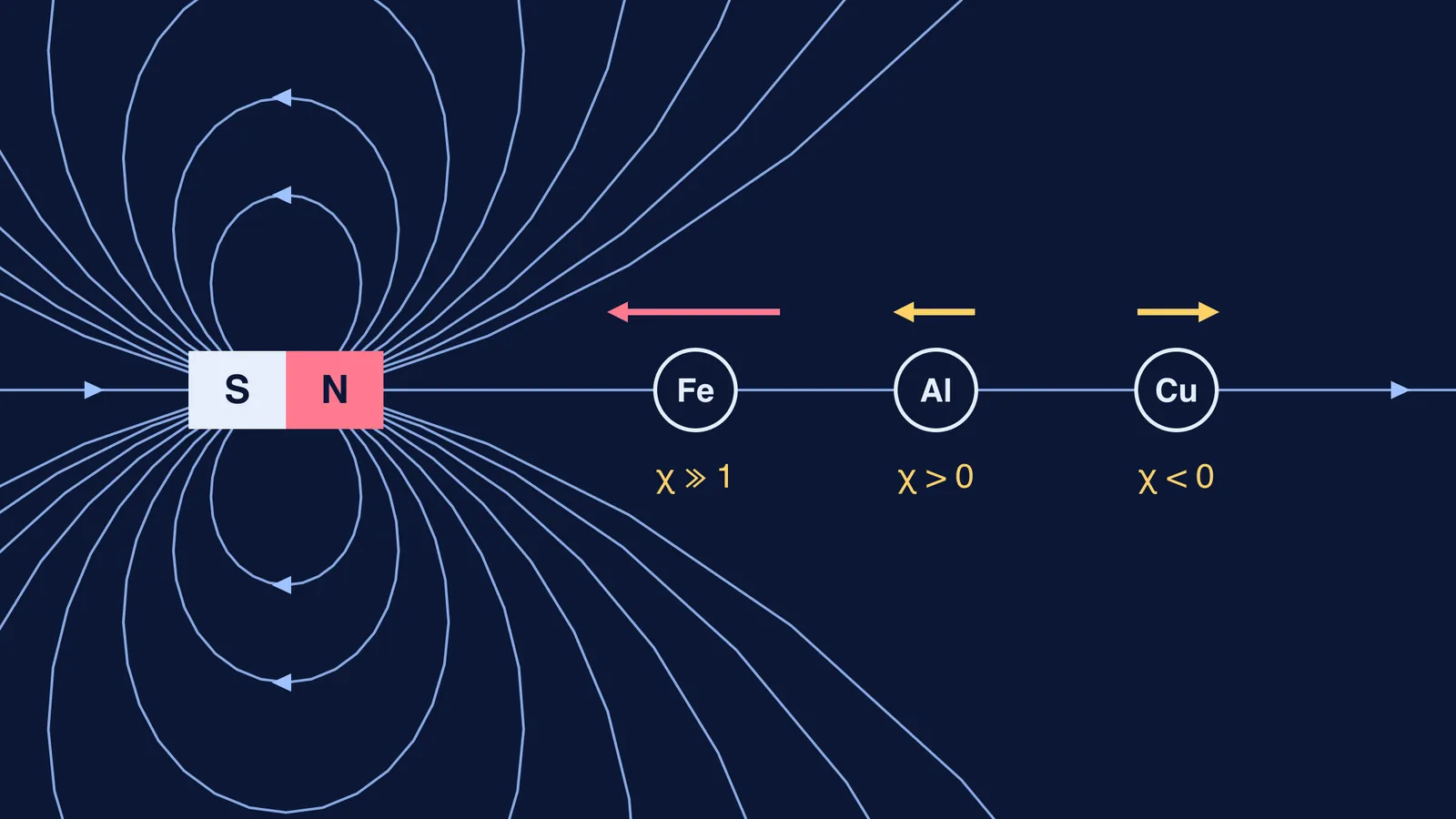
In a uniform field, a small sample of a weakly magnetic material feels no net push. Put it near the pole of a magnet, where the field is stronger on one side than the other, and it moves. For a weakly magnetic sample of volume V, the magnetic energy is U = −χVB²/(2μ₀). So the force points toward stronger field when χ is positive and toward weaker field when χ is negative.
Diamagnetic materials develop an induced field opposite to the applied one, which causes a repulsive force (Diamagnetism, Wikipedia), so they are pushed toward regions of weaker field.
Paramagnetic materials are weakly attracted and drawn into regions of stronger field; liquid oxygen can even be held between the poles of a strong magnet (Paramagnetism, Wikipedia).
Ferromagnetic materials are pulled toward the strong field far harder, and their atomic dipoles "become locked together so that a permanent magnetization results" (OpenStax University Physics Volume 2, section 12.7).
What are the susceptibility values of each type?
The figures below come from Table 12.2 of OpenStax University Physics Volume 2. χ has no units.
Copper has a susceptibility of −9.7×10⁻⁶.
Water has a susceptibility of −9.1×10⁻⁶.
Diamond has a susceptibility of −2.2×10⁻⁵.
Aluminium has a susceptibility of +2.2×10⁻⁵.
Oxygen gas has a susceptibility of +1.8×10⁻⁶, and liquid oxygen +3.5×10⁻³.
Ferromagnets have susceptibilities "usually on the order of 10³ to 10⁴".
So diamagnets and paramagnets differ in sign but share a size of around one part in 10⁵, while ferromagnets are 10⁸ to 10⁹ times stronger. Liquid oxygen stands out among the paramagnets: the liquid is far denser than the gas, and by Curie's law a paramagnet's susceptibility grows as the temperature falls (Paramagnetism, Wikipedia). At the other extreme, a superconductor behaves as a perfect diamagnet, with χ = −1, because it expels magnetic fields (Diamagnetism, Wikipedia).
What are everyday examples of diamagnetic, paramagnetic and ferromagnetic materials?
Diamagnetic: water, copper wire, diamond, bismuth, lead and mercury (OpenStax Table 12.2). With a strong enough field, the repulsion can balance gravity. M V Berry and A K Geim explained experiments in which a variety of objects, one of them a living frog, were levitated in a field of about 16 tesla (Berry and Geim, European Journal of Physics, 1997).
Paramagnetic: aluminium foil, the oxygen in air, titanium and tungsten. Paramagnetism comes from unpaired electrons (Paramagnetism, Wikipedia), which is why counting unpaired electrons with Hund's rule lets you predict it in chemistry.
Ferromagnetic: iron, cobalt, nickel, gadolinium, dysprosium and their alloys (OpenStax). Inside, the dipoles line up in small regions called domains, the idea Pierre Weiss used to explain ferromagnetism. Above its Curie temperature a ferromagnet becomes paramagnetic. Nickel's Curie temperature is 627 K, cobalt's is 1400 K and gadolinium's is 293.2 K, about 20 °C, so gadolinium sits right on the boundary on a mild day (Curie temperature, Wikipedia).
How do you classify a material in an exam question?
Ask three questions, in this order.
Is it strongly attracted, or does it stay magnetised after the magnet is removed? Ferromagnetic, as long as it is below its Curie temperature.
Is χ negative, or is the sample pushed toward the weaker field? Diamagnetic.
Is χ small and positive, so the sample is weakly drawn toward the stronger field? Paramagnetic.
How much harder is aluminium pulled than copper is pushed?
Hold two identical small pellets, one aluminium and one copper, at the same spot near a magnet's pole. They have the same volume and sit in the same field gradient, so the force on each is proportional to its χ. Using the OpenStax values, |F(Al)| / |F(Cu)| = 2.2×10⁻⁵ / 9.7×10⁻⁶ ≈ 2.3. The aluminium is pulled toward the pole with about 2.3 times the force that pushes the copper away.
Do not extend the same ratio to iron. The energy formula assumes χ is tiny. Iron's magnetisation saturates and depends on the shape of the piece and on its magnetic history (hysteresis), so the force on it is far larger, but not simply χ times larger.
If a definition here still feels shaky, the Fermi Concept Library gives every concept in physics, chemistry, biology, mathematics and computing its own lesson. For practice, the Fermi Problem Library has worked problems with a step-by-step solver that explains the reasoning rather than printing an answer.
Next time a material turns up in a question, write down the sign of χ first. The direction it moves follows from that.


