

On this page
Finding the number of unpaired electrons is a routine step in chemistry, whether you are predicting magnetic properties or working out an element's valency. The most reliable way to find this number is to draw out the orbital boxes and apply Hund's rule.
What is Hund's rule of maximum multiplicity?
Hund's rule of maximum multiplicity states that the lowest-energy configuration for an atom with electrons within a set of degenerate orbitals (orbitals with the same energy, like the three 2p orbitals) is the one that has the maximum number of unpaired electrons.
In practice, this means you must fill each empty orbital in a subshell with a single electron before you start pairing them up. The single electrons all take parallel spins (typically represented as "up" arrows in a diagram). Only when every orbital in that subshell has one electron do you add a second, paired electron (a "down" arrow) to any of them.
The physical reason behind this rule is electron repulsion. Electrons are negatively charged and repel one another. By occupying separate orbitals, they stay as far apart as possible, which lowers the overall energy of the atom.
If you are ever stuck on a textbook question about orbital filling or transition metal valency, the Fermi Problem Library has worked problems with a step-by-step solver that explains the reasoning rather than printing an answer.
How to count unpaired electrons?
To count unpaired electrons without making a mistake, use the box method. This method brings together the Aufbau principle (which dictates the order of subshells) and Hund's rule.
Write down the full electron configuration of the atom or ion.
Identify the outermost (valence) subshells, as inner shells are always completely paired.
Draw a box for each orbital in that subshell: one box for an s subshell, three boxes for a p subshell, five boxes for a d subshell, and seven boxes for an f subshell.
Distribute the electrons among the boxes, strictly following Hund's rule by placing one electron in every box before pairing any.
Count the boxes that contain only one arrow.
How many unpaired electrons are in carbon, nitrogen and oxygen?
Let us apply the box method to the elements in the second period of the periodic table.
Carbon (C) has an atomic number of 6. Its electron configuration is 1s² 2s² 2p². The 2p subshell holds two electrons. We draw three boxes for the 2p orbitals and place one electron in the first box and one in the second box. Both have parallel spins. Because there are no electrons left to pair up, carbon has 2 unpaired electrons.
Nitrogen (N) has an atomic number of 7. Its electron configuration is 1s² 2s² 2p³. The outermost subshell is 2p, which contains three orbitals and must hold three electrons.
Following Hund's rule, we place one electron into each of the three 2p boxes. Since all three electrons are placed singly, nitrogen has 3 unpaired electrons. This exactly half-filled subshell makes the nitrogen atom unusually stable.
Oxygen (O) has an atomic number of 8, giving it an electron configuration of 1s² 2s² 2p⁴. The 2p subshell now holds four electrons.
We first put one electron into each of the three 2p boxes. We then take the fourth electron and pair it up with the electron in the first box (represented as a "down" arrow). This leaves one paired orbital and two singly occupied orbitals. Therefore, oxygen has 2 unpaired electrons.
Even though oxygen has more total electrons than nitrogen, it has fewer unpaired electrons because the pairing process has begun.
How to find unpaired electrons in Fe and Fe³⁺?
Transition metals like iron often confuse students because they involve both the 3d and 4s subshells. Let us look at iron (Fe) and the iron(III) ion (Fe³⁺).
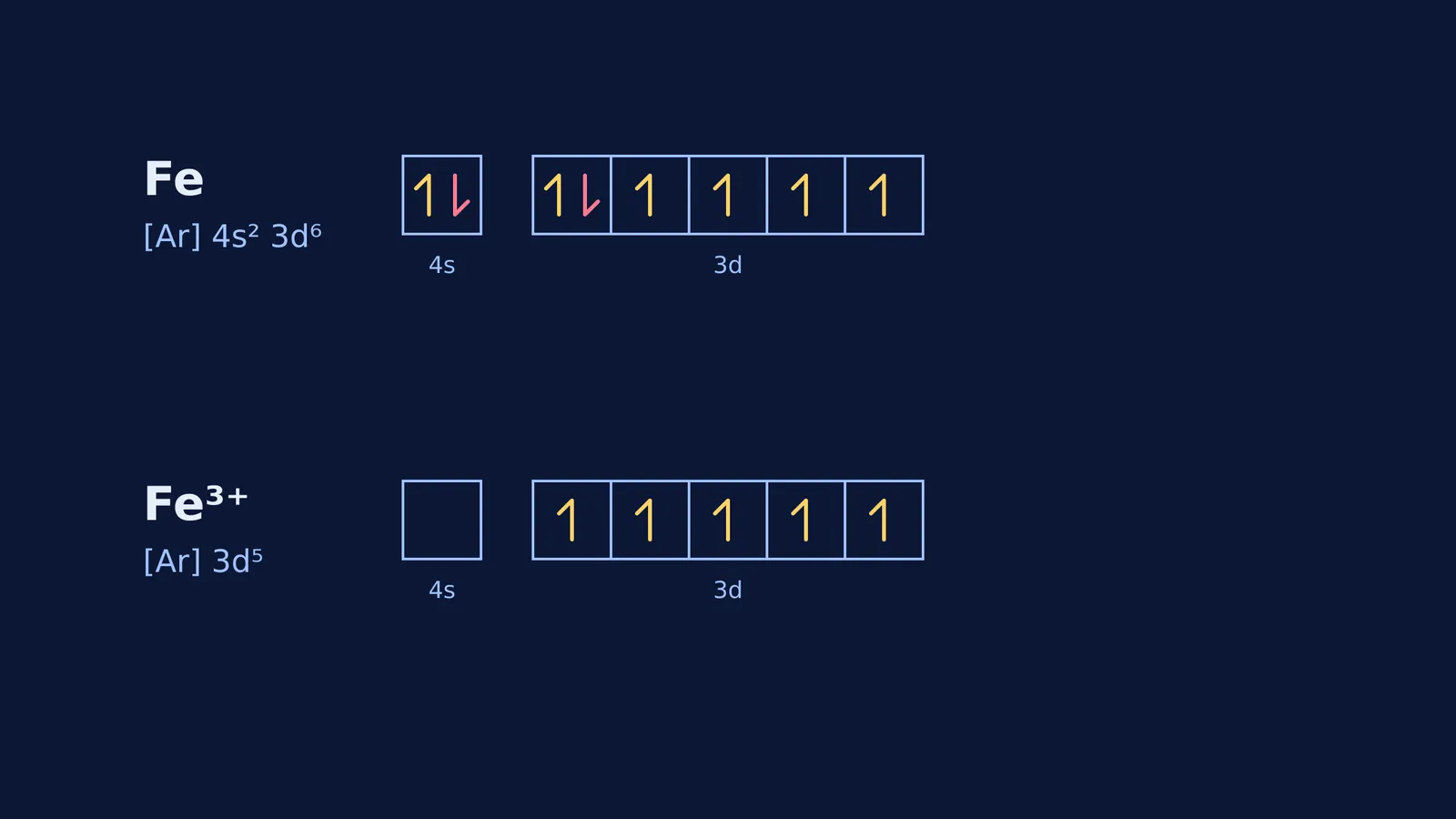
Iron (Fe) has an atomic number of 26. Its neutral electron configuration is [Ar] 4s² 3d⁶.
The 4s subshell is full, so its two electrons are paired. The 3d subshell has five degenerate orbitals and holds six electrons. We put one electron into each of the five 3d boxes, which uses up five electrons. The sixth electron then pairs up in the first box. This leaves one paired orbital and four singly occupied orbitals. Hence, iron has 4 unpaired electrons.
If you are dealing with the electronic configuration of ions, remember that transition metals lose their 4s electrons before their 3d electrons.
Iron(III) (Fe³⁺) loses three electrons from the neutral iron atom: the two 4s electrons first, and then one 3d electron. This leaves the configuration [Ar] 3d⁵.
When we distribute these five electrons across the five 3d boxes, Hund's rule dictates that each box receives exactly one electron. None of them pair up. Therefore, the Fe³⁺ ion has 5 unpaired electrons, making it highly paramagnetic and chemically stable due to its half-filled subshell.


