On this page
This is a ten-minute kitchen-table experiment with one rule: write your predictions down before you test anything. You need a magnet, a small box of steel pins, a sheet of paper, kitchen aluminium foil and a thin iron or mild-steel sheet. A biscuit-tin lid or a steel plate will do, but only if it sticks firmly to the magnet (more on that below).
The question is simple. Hold each sheet flat against the magnet's face, lower it onto the pins, lift, and count how many pins come up with it. The iron result often surprises people.
What should you predict before you test?
Copy this list into your notebook and fill in every line before you start:
No sheet: how many pins does the magnet lift on its own?
Paper: more, the same, or fewer than with no sheet? Why?
Aluminium foil: more, the same, or fewer? Why?
Iron sheet: more, the same, or fewer? Why?
Iron sheet: if any pins cling, where on the sheet do you expect them?
To keep the test fair, keep the gap between the magnet and the pins the same each time. A sheet adds distance, and magnetic pull falls off quickly with distance. So fold the paper and foil until each stack is about as thick as your iron sheet. If the pin count changes, you then know it was the material and not the gap. For more, try these simple magnet experiments for kids at home.
Can a magnet attract pins through paper?
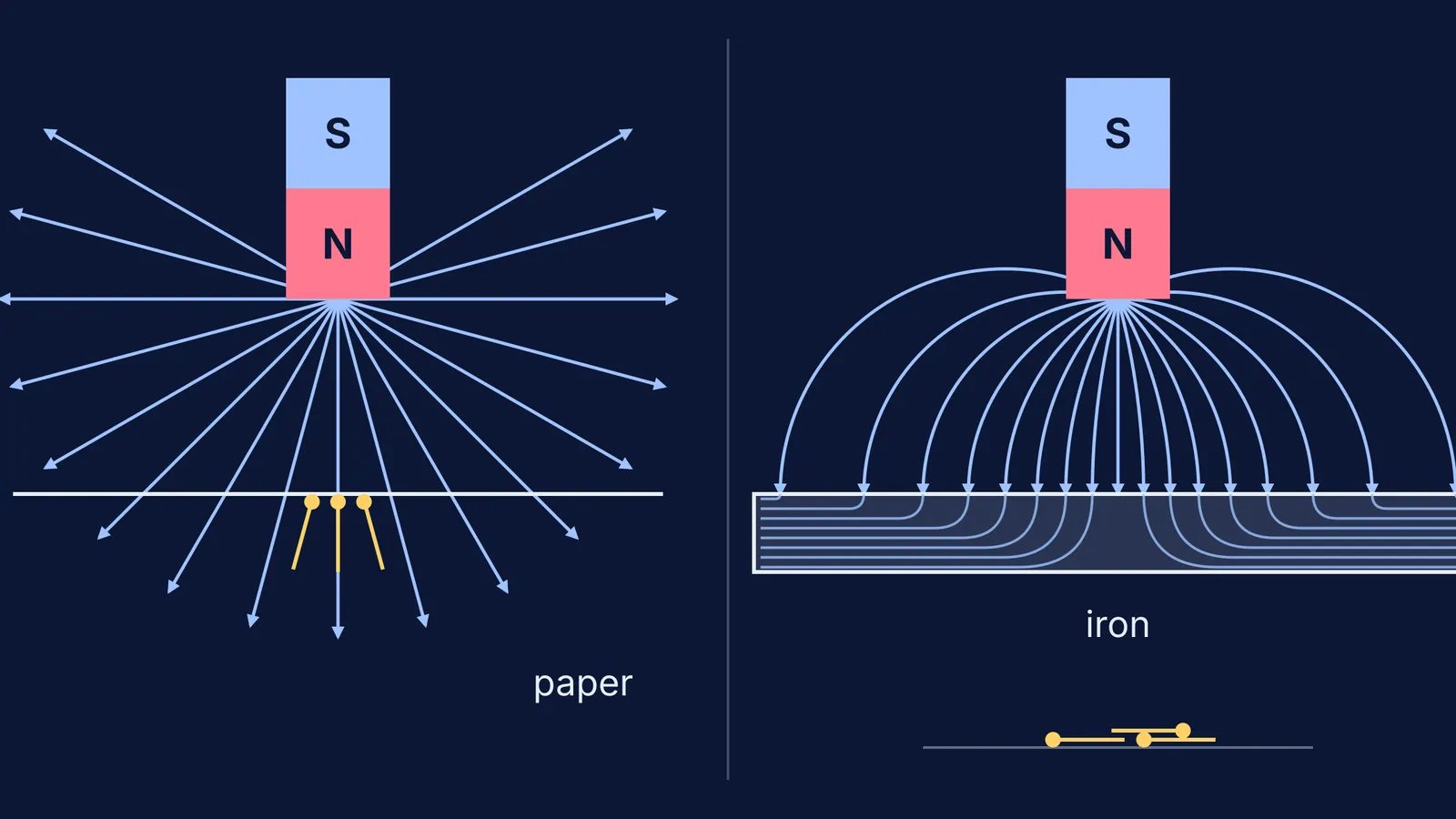
Yes. Paper is made from wood pulp, and the relative permeability of wood is listed as 1.00000043, against 1.00000037 for air (Wikipedia, permeability table)). Relative permeability compares how a material responds to a magnetic field with empty space, which is set at exactly 1. If your thickness-matched paper lifts fewer pins than the bare magnet, the gap did that, not the paper.
Does aluminium foil block a magnet?
No, although many people expect it to, because foil is a metal. Aluminium's magnetic susceptibility is 2.2 × 10⁻⁵ at 20 °C (HyperPhysics, magnetic properties table). Susceptibility is just relative permeability minus 1, so aluminium's relative permeability is about 1.000022. The same table lists copper at −1.0 × 10⁻⁵ and water at −0.91 × 10⁻⁵, which are just as close to zero. So the pins come up through foil much as they do through paper. Our list of magnetic and non-magnetic materials explains why.
Foil can block phone signals, so why not a magnet? Conducting shields work against changing fields. For static or slowly varying magnetic fields (below about 100 kHz), that kind of shielding is ineffective (Wikipedia, electromagnetic shielding). A still magnet's field does not change.
Can a magnet attract pins through an iron sheet?
Far less well. Iron is ferromagnetic. Annealed 99.8% pure iron has a maximum relative permeability of 5,000 (HyperPhysics), so field lines find it far easier to travel through iron than through air. High-permeability shields "do not block the magnetic field" but "draw the field into themselves, providing a path for the magnetic field lines around the shielded volume" (Wikipedia, electromagnetic shielding). The lines from the magnet bend into the sheet, run sideways inside it, and leave near its edges on their way back to the other pole. Magnetic field lines are continuous closed loops, unlike electric field lines, so they never just stop. That is also the answer to question 5: if any pins cling, look near the sheet's edges.
Two things can spoil the iron result:
The sheet is too thin. Magnet supplier K&J Magnetics notes that when a shield is too thin it becomes saturated and "can't 'hold' any more lines of flux" (K&J Magnetics). So a strong neodymium magnet may still lift pins through a thin tin lid. Try two lids stacked.
The sheet isn't really magnetic. Austenitic stainless steels such as Type 304, with about 18% chromium and 8% nickel, are usually not magnetic (Scientific American, Thomas Devine). Some stainless-steel kitchen plates are this kind, and they behave like the foil. That is why you check that your sheet sticks to the magnet first.
How do you explain your results?
A sample write-up (use your own numbers):
Observation: paper and foil lifted about as many pins as each other; the iron sheet lifted almost none, and a few pins stuck near its edge.
Claim: paper and aluminium are almost non-magnetic, so the field passes through them. Iron reroutes the field.
Evidence: the thickness-matched stacks rule out distance as the cause.
Check: repeat the iron test with two sheets stacked. If fewer pins come up, the single sheet was saturating.
If your predictions and results disagree, that is the useful part. Write one sentence on which idea you held and what replaced it. Field lines are easier to see than to read about, and the Fermi Simulation Lab has interactive simulations for ideas like this.
A safety note for parents: strong magnets can pinch fingers, and small magnets and pins should be kept away from young children.