On this page
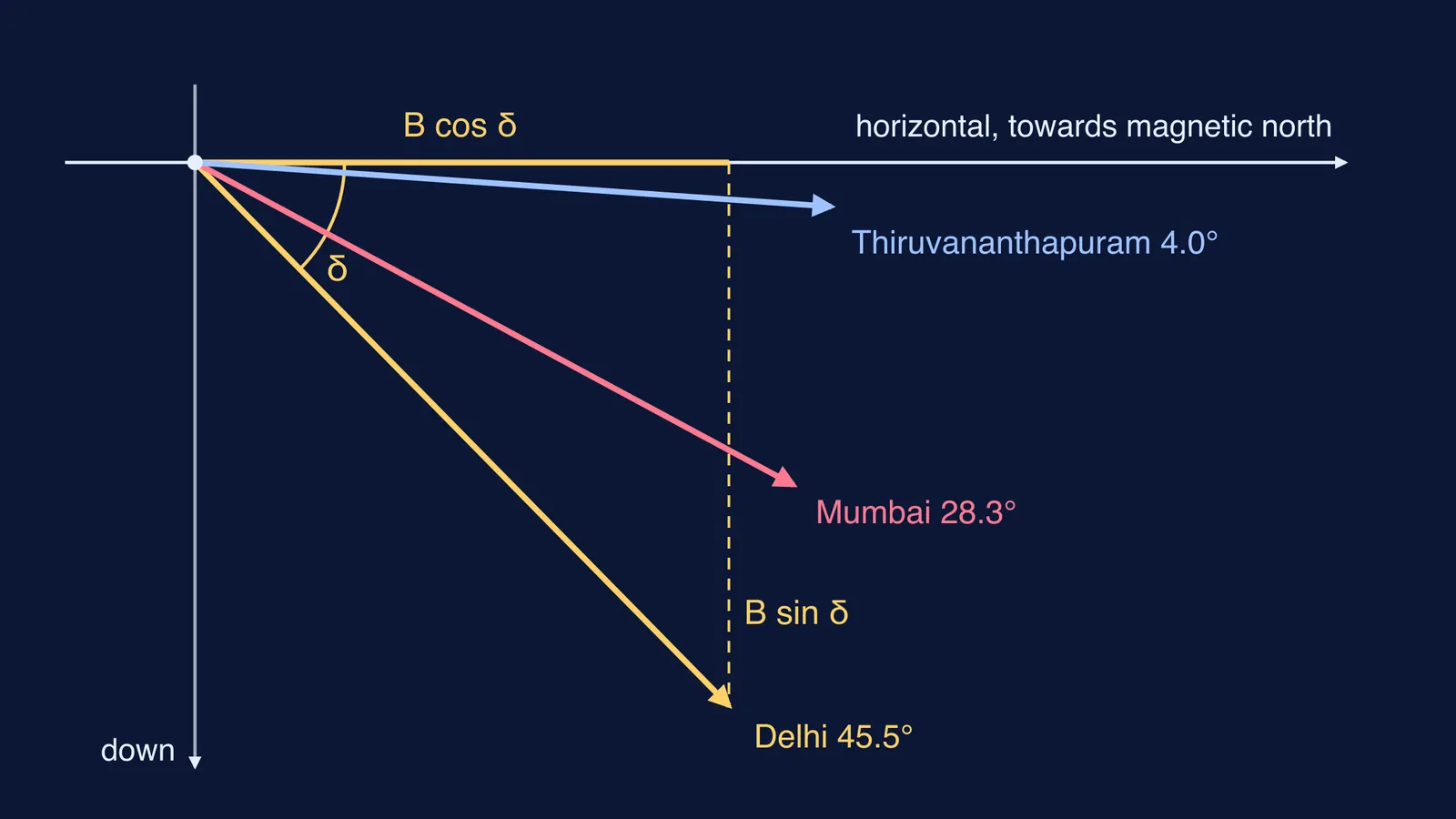
A needle free to swing up and down tilts about 45° into the ground in Delhi and lies almost flat in Thiruvananthapuram (IGRF-14 via BGS). Three numbers describe this, and two formulas handle most Class 12 questions on it.
What are the three elements of Earth's magnetic field?
The British Geological Survey defines declination as "the horizontal angle between true north and the field vector, measured positive eastwards" (BGS, the Earth's magnetic field).
Inclination, or the angle of dip, is the angle between the horizontal plane and the field vector, measured positive downwards (BGS).
The third element is the horizontal component BH, the part of the field that turns a compass needle. Know declination, dip and BH at a place and you can rebuild the full field vector there.
At Earth's surface the total field ranges from about 22,000 nT to 67,000 nT, according to the same BGS page. One nanotesla (nT) is 10⁻⁹ T.
How do you find the horizontal component from the angle of dip?
Picture the field vector B in the vertical plane that contains magnetic north. This plane is the magnetic meridian. B makes the angle δ with the horizontal, so you resolve it like any other vector:
BH = B cos δ
BV = B sin δ
tan δ = BV / BH
B = √(BH² + BV²)
Check the extremes. At the magnetic equator δ = 0, so BV = 0 and the whole field is horizontal. At a magnetic pole δ = 90°, so BH = 0 and a compass has nothing horizontal to line up with.
What is the angle of dip in India?
IGRF-14 is the latest generation of the International Geomagnetic Reference Field, the standard model of Earth's main field, developed and maintained by the International Association of Geomagnetism and Aeronomy; its coefficients were finalised in November 2024 (NOAA NCEI on the IGRF). We ran the BGS IGRF-14 web service for 1 November 2026:
Srinagar: δ = 53.4°, B = 51,418 nT, declination 2.8° E (BGS calculation)
Delhi: δ = 45.5°, B = 48,818 nT, declination 1.3° E (BGS calculation)
Mumbai: δ = 28.3°, B = 43,579 nT, declination close to 0° (BGS calculation)
Thiruvananthapuram: δ = 4.0°, B = 40,873 nT, declination 1.7° W (BGS calculation)
So dip drops by almost 50° between Kashmir and Kerala. A dip of 4° means the magnetic equator, where dip is zero, is not far south of Thiruvananthapuram. Declination stays under 3° at all four cities, so an ordinary compass points close to true north across India.
These values drift. The same Delhi calculation shows declination moving east by 1.2 arcminutes a year, which is why older books print slightly different figures. India has long tracked them: the Indian Institute of Geomagnetism says the Colaba observatory in Mumbai was set up in 1841, with regular observations from 1846 (IIG history).
How do you calculate BH and BV for an Indian city?
Example 1, Delhi (BGS output). B = 48,818 nT and δ = 45.5°. Find BH and BV.
cos 45.5° = 0.701 and sin 45.5° = 0.713.
BH = 48,818 × 0.701 ≈ 34,200 nT.
BV = 48,818 × 0.713 ≈ 34,800 nT.
Because δ is just over 45°, BV is slightly larger than BH. The model lists 34,223 nT and 34,814 nT.
Example 2, Mumbai, working backwards (BGS output). A dip needle reads 28.3° and BH = 38,366 nT. Find B and BV.
B = BH / cos δ = 38,366 / 0.880 ≈ 43,600 nT.
BV = BH × tan δ = 38,366 × 0.539 ≈ 20,700 nT.
The Mumbai output gives 43,579 nT and 20,669 nT.
Example 3, Thiruvananthapuram. With δ = 3.97° and B = 40,873 nT, BV = 40,873 × 0.069 ≈ 2,830 nT. That is under 7% of the field, so almost all of it is horizontal (BGS output).
If the same step keeps going wrong in problems like these, the Fermi Problem Library has worked problems with a step-by-step solver that explains the reasoning rather than printing an answer.
Where do students lose marks on dip questions?
Using sin for BH. Draw the right triangle first, every time.
Putting declination into B cos δ. Declination tells you which way the magnetic meridian points, not how steeply the field dips.
Measuring dip outside the magnetic meridian. A needle turned away from the meridian shows a larger apparent dip, explained in our post on apparent dip and the cot² rule.
Mixing units. 1 gauss = 10⁻⁴ T = 100,000 nT (BGS).
Trusting a compass next to steel. Nearby iron bends the local field, as we show in why a compass points wrong near iron. Your phone finds magnetic north without a needle by sensing the same field; see how a phone compass works.
To see how dip connects to bar magnets and field lines, the Fermi Concept Library gives every concept in physics its own lesson and its place in the map.