

On this page
You set up a dip circle, but instead of lining it up with the magnetic meridian you turn it to some other vertical plane. The needle settles at a steeper angle than the true dip. That steeper reading is the apparent dip, and two of them, taken in perpendicular planes, recover the true dip without ever finding the meridian.
What is the angle of dip, and why does the plane matter?
The British Geological Survey defines inclination, or dip, as the angle between the horizontal plane and the field vector, measured positive downwards, and gives tan I = Z/H, where H is the horizontal component and Z the vertical component (BGS: The Earth's magnetic field).
At the magnetic poles a dip needle stands vertical, with dip = 90°, and at the magnetic equator the dip is zero (NOAA NCEI geomagnetism FAQ).
A dip needle can only turn in the vertical plane of its circle, so it responds only to the part of Earth's field lying in that plane. Any component sticking out of the plane just presses on the pivot. For a refresher, see finding the component of a vector along another vector.
How do you derive cot²δ = cot²δ₁ + cot²δ₂?
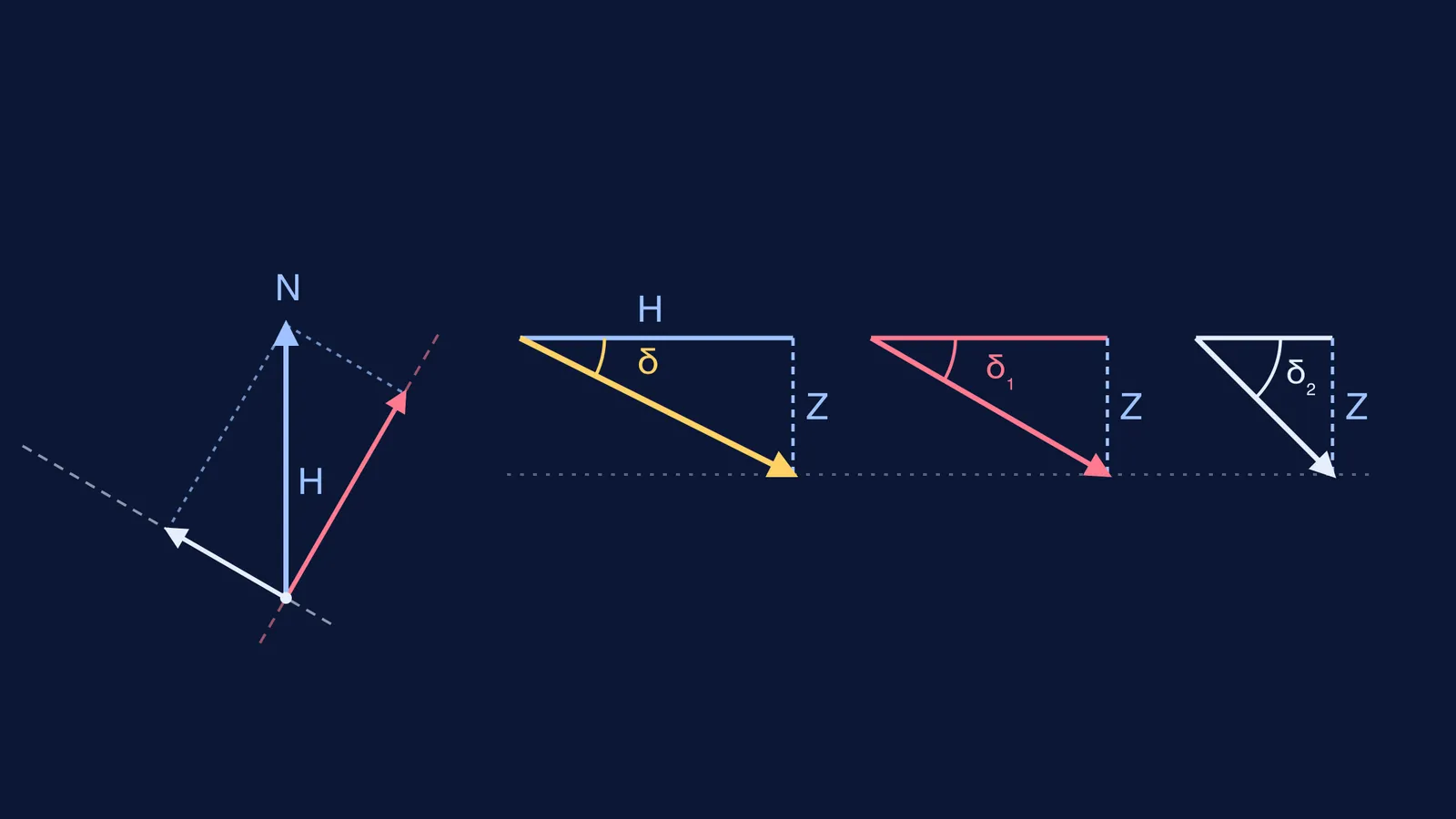
Call the true dip δ, so tan δ = Z/H. Now turn the dip circle so that its plane makes an angle θ with the magnetic meridian.
The vertical component lies in every vertical plane, so the needle still feels all of Z.
The horizontal component H points along the meridian, so only H cos θ lies in the new plane.
The needle settles along the resultant of Z and H cos θ, so the apparent dip δ₁ obeys tan δ₁ = Z / (H cos θ).
Flip it over: cot δ₁ = (H cos θ)/Z = cot δ cos θ.
Now turn the circle through 90°. The new plane makes an angle of 90° − θ with the meridian, so the horizontal component in it is H sin θ. The same four steps give cot δ₂ = cot δ sin θ.
Square both results and add them. Because cos²θ + sin²θ = 1, you get cot²δ₁ + cot²δ₂ = cot²δ (cos²θ + sin²θ) = cot²δ.
So cot²δ = cot²δ₁ + cot²δ₂. The angle θ has dropped out, which is the whole point: you never needed to know where the meridian was.
Worked example: apparent dips of 30° and 45°
A dip circle reads 30° in one vertical plane and 45° in the vertical plane perpendicular to it. Find the true dip, and the angle the first plane makes with the magnetic meridian.
cot 30° = √3, so cot²30° = 3.
cot 45° = 1, so cot²45° = 1.
cot²δ = 3 + 1 = 4, so cot δ = 2 and tan δ = 1/2.
δ = tan⁻¹(0.5) ≈ 26.6°.
The true dip comes out smaller than both readings, exactly as the sanity check says it must.
For the second part, divide the two results from the derivation: cot δ₂ / cot δ₁ = sin θ / cos θ, so tan θ = 1/√3 and θ = 30°. Check it by going forwards: cot δ cos 30° = 2 × (√3/2) = √3, which is cot 30°. It matches, and the second plane sits at 60° to the meridian.
Two more to try on your own
Both apparent dips are 45°. Then cot²δ = 1 + 1 = 2, so cot δ = √2 and δ ≈ 35.3°.
One plane is the meridian itself, reading 40°. The perpendicular plane must then read 90°. Put cot 90° = 0 into the formula and it returns δ = 40°, as it should.
If a variant stalls you, such as finding θ or working backwards from the true dip, the Fermi Problem Library has worked problems with a step-by-step solver that explains the reasoning rather than printing an answer.
Where do students lose marks on apparent dip?
Adding the angles, or the plain cotangents, instead of the squares of the cotangents.
Using tan in place of cot: tan²δ₁ + tan²δ₂ is not tan²δ.
Using the formula for planes that are not at 90°. It relies on cos²θ + sin²θ = 1.
Reporting a true dip larger than either apparent dip.
Mixing dip with declination. BGS defines declination as the horizontal angle between true north and the field vector, not an angle with the horizontal (BGS).
In a real lab, keep the dip circle away from steel benches for the reason explained in why a compass points wrong near iron. If resolving vectors is the step that slips, the Fermi Concept Library gives each concept in physics and mathematics its own lesson.
Next step: cover the derivation, rebuild it from tan δ = Z/H on a blank page, then do the 30° and 45° example without looking.


