

On this page
An odd-shaped card has no centre you can find with a ruler. A pin, a thread and a small weight will find its centre of gravity in minutes. The method is in the NCERT Class 11 textbook, and the reason it works is a short torque argument.
How do you find the centre of gravity of an irregular lamina?
A lamina is a thin, flat sheet, such as cardboard. You need the card, a pin fixed to a stand, a thread with a small weight tied on (your plumb line) and a sharp pencil.
Make three small holes near the edge of the card, spread well apart.
Push the pin through the first hole so the card swings freely, and let it come to rest.
Hang the plumb line from the same pin and wait for it to stop moving.
Mark two points under the thread, one near the pin and one near the bottom edge. Take the card down and join them with a ruler.
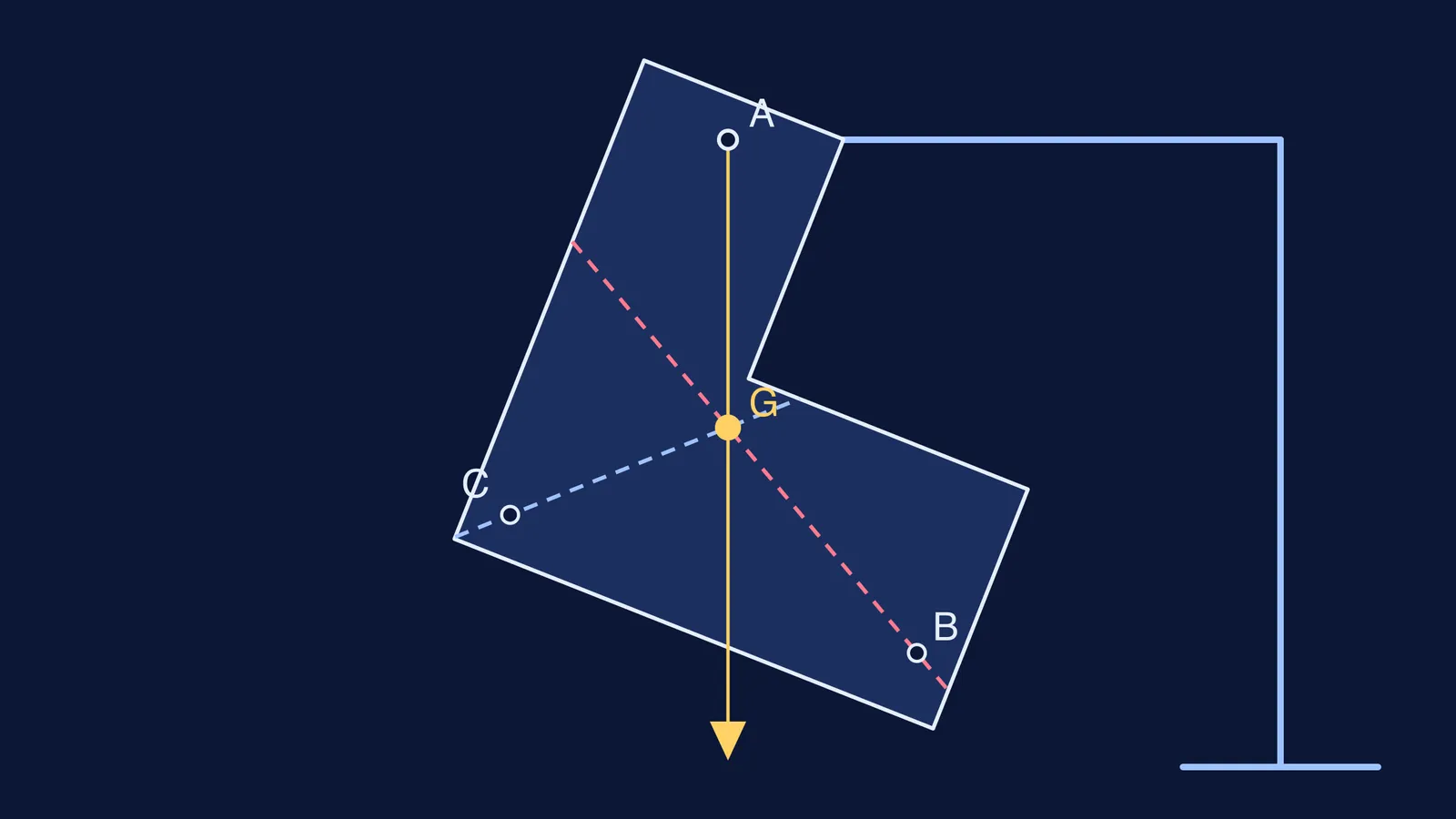
Repeat from the second hole. The two lines cross at the centre of gravity, G.
Repeat from the third hole as a check. Its line should pass through the same point.
This is the suspension method shown in Fig. 6.25 of NCERT Class 11 Physics, Chapter 6, which says the vertical line through the point of suspension passes through the centre of gravity, and the intersection of the verticals from different points gives G.
Why do the plumb lines cross at the centre of gravity?
NCERT defines the centre of gravity as the point about which the total gravitational torque on the body is zero (Section 6.8.2). The same section shows that, where gravity is uniform, the centre of gravity coincides with the centre of mass.
Now look at the hanging card. Two forces act on it: the pin's push at the hole, and the weight acting at G. Take torques about the pin. The pin's force has no torque about its own point, so the card can rest only if the weight has none either, which means its line of action passes through the pin. So at rest, G lies on the vertical through the pin, and the plumb line traces that vertical. One hole gives a line; two lines fix a point.
A worked example you can check at home
Cut an L shape from cardboard: a strip 12 cm long and 6 cm high, with an arm 5 cm wide and 6 cm high standing on its left end. Put the bottom left corner at (0, 0).
Strip: area 72 square cm, centre at (6, 3).
Arm: area 30 square cm, centre at (2.5, 9).
x of G = (72 × 6 + 30 × 2.5) ÷ 102 = 507 ÷ 102, about 4.97 cm.
y of G = (72 × 3 + 30 × 9) ÷ 102 = 486 ÷ 102, about 4.76 cm.
Now hang it from holes near the top of the arm, the far right and the bottom left corner. If your lines cross within a few millimetres of (4.97, 4.76), your technique is sound.
G need not lie on the material at all; see when the centre of mass lies outside the body.
What goes wrong, and how do you fix it?
Holes too close together. The lines cross at a shallow angle, so a small pencil error moves G a long way. Spread the holes out.
A tight pin. Friction can hold the card off its true rest position. Widen the hole slightly and tap the card before marking.
A floppy card. If it bends, it is no longer a lamina. Use stiff board.
A small triangle instead of a point. Take its centre as G and its size as your uncertainty.
If the idea of torque about a chosen point still feels shaky, our post on choosing the torque axis to remove unknowns uses the same move, and the Fermi Concept Library gives every concept in physics its own lesson and its place in the map.
How is the plumb line method asked in exams?
The Cambridge IGCSE Physics 0625 syllabus for 2026 to 2028 asks students to describe an experiment to find the centre of gravity of an irregularly shaped plane lamina, and to describe how its position affects stability. NCERT ends its own description with the prompt "Explain why the method works".
The usual follow-up is stability, covered in why a leaning object topples. For practice with full working, the Fermi Problem Library has worked problems with a step-by-step solver that explains the reasoning rather than printing an answer.


