

On this page
The centre of mass is not a physical part of an object; it is simply the unique point where all its mass is evenly balanced in all directions. If you imagine an object shrinking down until all its mass is concentrated into a single, infinitely small dot without changing how it responds to gravity, that dot is the centre of mass.
For solid, symmetric objects like a solid sphere or a block, this point lies squarely inside the material. But what happens when an object bends, loops, or has a hollow middle?
Where is the centre of mass of a ring or boomerang?
Because the centre of mass is just a mathematical average of where the mass is distributed, it does not have to fall on the object's physical material.
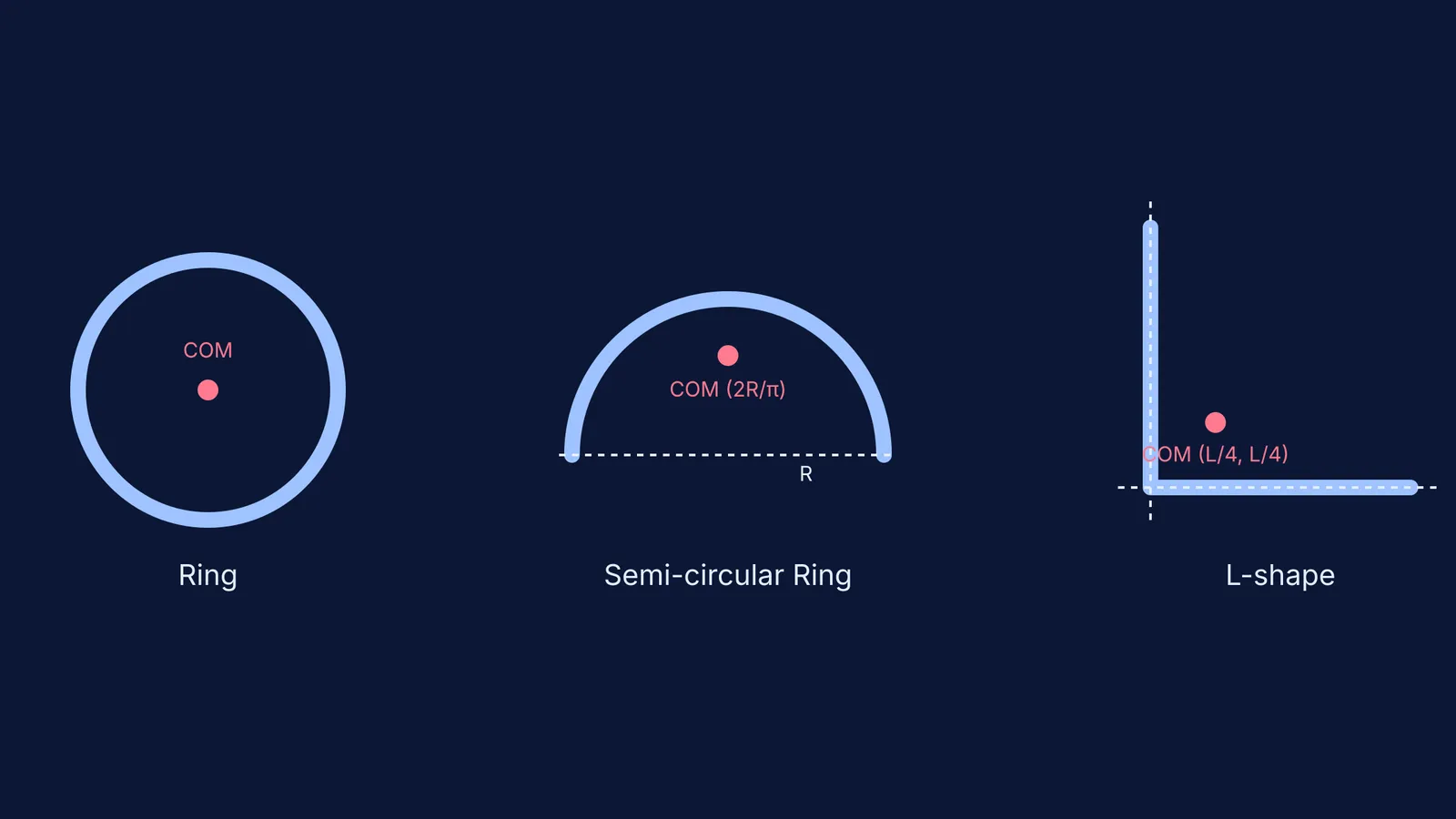
If you calculate the average position of all the material in a uniform ring, that point lies exactly in the empty centre of the hole. For a uniform semi-circular ring of radius R, the centre of mass sits along its axis of symmetry at a distance of 2R/π from the centre, floating in the empty space between the curve and its flat diameter.
This is true for any shape that curves around an empty space. If you take a uniform L-shape or a V-shaped boomerang, the mass is distributed heavily into the two long arms. The single point that averages out their positions is pushed into the empty space cradled between them.
When a boomerang is thrown, it spins around its centre of mass. Because this point lies in the empty air between its wings, the boomerang appears to rotate around an invisible pivot as it flies. This gives it the stability needed to complete its returning flight path. If the mass were not distributed this way, its rotation would be erratic.
Similarly, think of an L-shaped carpenter's square. If you slide it across an ice rink, it will naturally tend to rotate around that empty point cradled by its arms. When physicists calculate the motion of such objects, they can treat the entire complicated shape as if all its weight were concentrated at that single hovering dot.
Can the centre of mass lie outside the human body?
Yes, the centre of mass frequently lies outside the physical body for both inanimate objects and human beings. While a person standing straight up has their centre of mass safely inside their torso (usually near the pelvis), human bodies are flexible. By bending, arching, or reaching, athletes manipulate where their mass is distributed, shifting that mathematical average completely outside their bodies.
If you need to visualise how different distributions shift this point, the Fermi Concept Library holds interactive lessons on mass distribution and mechanics, while our guide to Centre of mass problems: finding it and using it to simplify motion explores the mathematics in detail.
Why do high jumpers arch their backs?
The ability to move the centre of mass outside the body is the physics trick behind the modern high jump. Before 1968, jumpers used techniques like the straddle or the scissors jump. In these older styles, the athlete kept their body relatively straight or parallel to the ground, meaning their centre of mass had to be lifted physically *above* the crossbar for them to clear it.
Then came the Fosbury Flop, where the jumper goes over the bar backward, arching their spine into a tight "U" or "C" shape and dropping their head and legs. By wrapping their mass around the bar like a semi-circular ring, the athlete's average mass position is pushed out of their torso and into the empty space directly beneath their arched back.
According to a seminal 1980 study by Jesús Dapena in *Medicine and Science in Sports and Exercise*, an elite jumper using the Fosbury Flop can clear a crossbar even when the peak height of their centre of mass is only at the same level as the bar itself. To achieve this, athletes use a curved, J-shaped approach run. This path creates centripetal force and allows the jumper to lean inward. When they plant their takeoff foot, they convert that horizontal speed into vertical lift and angular momentum, rotating their back to the bar.
Because lifting the centre of mass against gravity is what requires energy, this technique allows athletes to clear much higher bars with the exact same amount of leg power. They lift their bodies over the bar segment by segment — first the head, then the arched torso, and finally the kicking legs — while the invisible point of their mass slides underneath or level with the bar.
If you are trying to calculate these distributions for your own physics homework, Fermi's AI tutor works out what you already know and builds a plan for the session, teaching you the math of irregular shapes step by step rather than just printing an answer. You can also read more about Centre of gravity vs centre of mass: when they differ and why.


