

On this page
What makes a leaning object topple?
An object resting on a flat surface does not fall merely because it leans. Stability is determined by the relationship between the object's centre of gravity and the boundaries of its base of support. Laboratory measurements confirm that a body remains in static equilibrium as long as the vertical line of action of gravity drawn downwards from its centre of gravity passes within the footprint of its base (Hinrichsen, 2021).
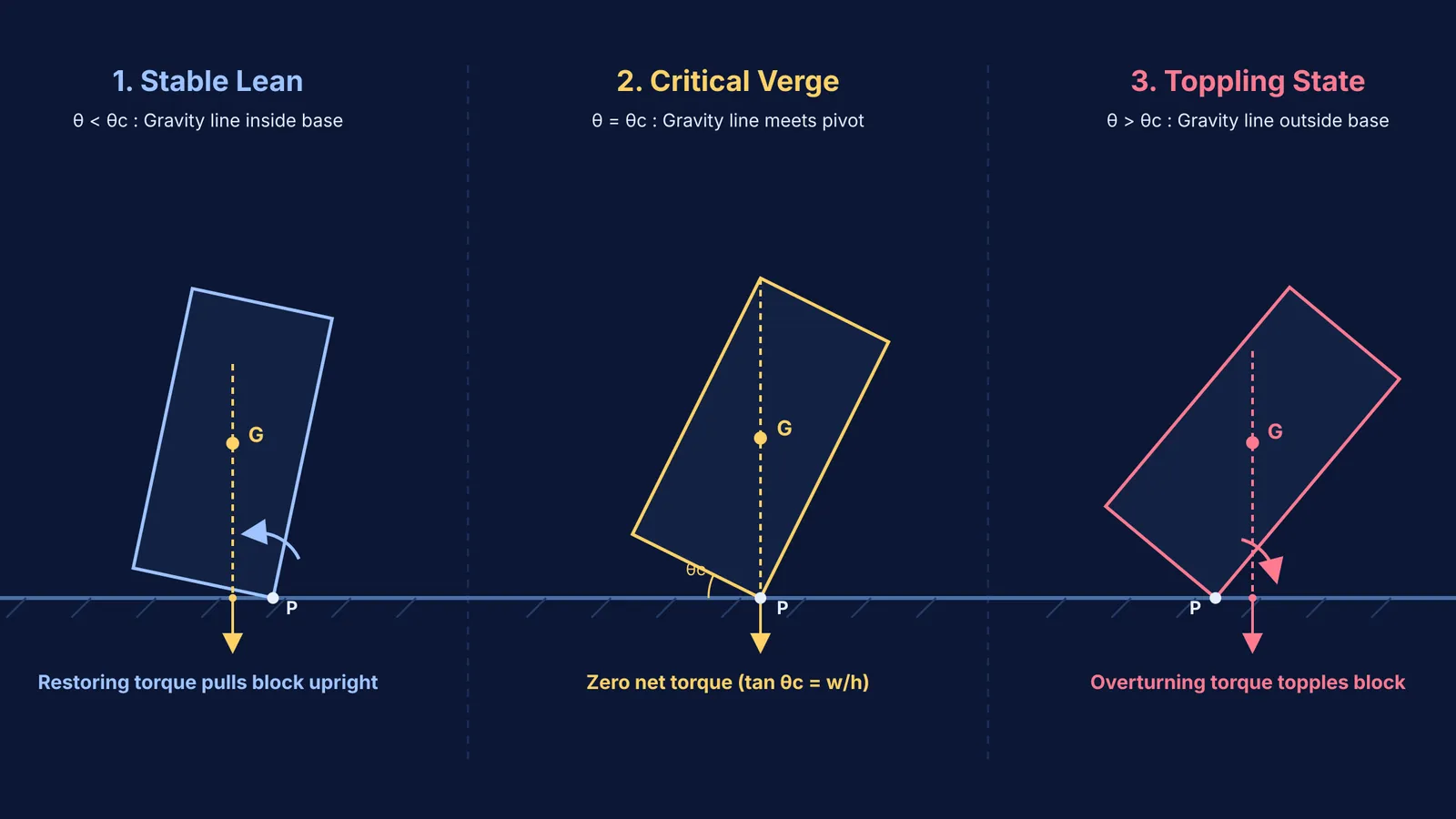
This boundary is governed by torque. When an object tilts, its contact force concentrates at the pivot edge touching the floor. Because the normal contact force and friction act through this pivot, they produce zero torque about that edge. Gravity acts downwards through the centre of gravity. At small tilts, the centre of gravity stays behind the pivot edge, creating a restoring torque that pulls the object back upright. The moment the lean moves the centre of gravity past the pivot edge, the lever arm reverses sign. Gravity now exerts an overturning torque in the direction of the lean, causing the object to topple. For tall or non-uniform bodies, understanding how centre of gravity differs from centre of mass helps pinpoint this critical balance point.
How do you calculate the critical toppling angle?
For a uniform rectangular block or cylinder of base width w and height h, the centre of gravity lies at height h/2 and horizontal distance w/2 from each edge (Hinrichsen, 2021).
Tilting the block clockwise about its bottom-right corner shifts the vertical line of gravity towards the pivot. At the critical angle θc, this vertical line passes directly through the pivot edge. From right-triangle geometry, tan θc = (w/2) / (h/2) = w/h, giving the critical tilt angle:
θc = arctan(w/h)
For example, a wooden block measuring 10 cm wide and 24 cm high has a ratio w/h = 10/24 ≈ 0.417. Evaluating arctan(0.417) yields a critical angle of 22.6°. Any tilt below 22.6° returns to the base; any tilt past 22.6° topples. A cubic block (w = h) has tan θc = 1, tolerating a lean of 45°.
When an object is pushed or placed on a slope, toppling also competes with sliding. As demonstrated by Dietz and Aguilar (2012), applying a horizontal force at varying heights reveals a precise boundary between slipping and tipping governed by the friction coefficient μ and the block's base width w: pushing below a critical height hc = w / (2μ) causes the block to slip, whereas pushing above hc causes it to tip. On an inclined plane, the same physical competition dictates whether a block slips or topples as the angle θ increases: sliding occurs when tan θ > μ, while toppling occurs when tan θ > w/h. If μ > w/h, static friction holds the base firm and the block topples at θc; if μ < w/h, the block slides before reaching θc. Mastering this distinction avoids common rotational motion mistakes on exams.
Why did the Leaning Tower of Pisa not fall?
The Leaning Tower of Pisa offers a dramatic test of this rule. Standing approximately 56 metres high on an annular foundation 19.58 metres in diameter, the medieval tower began settling into soft silt during construction (Burland et al., 2020).
By 1990, its tilt reached 5.5 degrees, displacing the top horizontally by 4.5 metres. Because the hollow tower has a low centre of gravity roughly 22.6 metres above the base, a 5.5-degree lean displaced the centre of gravity line horizontally by 2.2 metres south. Because 2.2 metres remained inside the 9.8-metre foundation radius, the vertical line of gravity never crossed the foundation edge.
Between 1993 and 2001, an international committee led by Michele Jamiolkowski stabilised the monument through ground extraction on the north side, reducing the tilt by 0.5 degrees and shifting the top back by 44 centimetres to ensure long-term stability.
How can students predict and test toppling angles?
The Predict-Observe-Explain model described by White and Gunstone (1992) shows that making an explicit written prediction before an experiment solidifies mechanics concepts:
Measure dimensions: Measure the base width w and height h of a block or empty carton.
Predict the angle: Calculate θc = arctan(w/h) before testing.
Attach a plumb line: Suspend a thread and small weight from the object's centre of gravity to trace gravity's downward line of action.
Tilt and verify: Rest the object on a board, tilt it slowly with a phone clinometer app, and observe that it topples the instant the plumb line crosses the pivot corner.
Tracing rotational equilibrium and torque balance connects static equations to dynamic motion. Visualising how lines of force shift during complex tilts can be challenging on paper alone. Students exploring these mechanics can run them in the Fermi Simulation Lab, which provides interactive simulations for ideas that are easier to see than to read. For questions involving friction thresholds and pivot torques, the Fermi Problem Library offers worked problems with a step-by-step solver that explains the reasoning rather than printing an answer.


