On this page
Stand in front of the Delhi iron pillar and you see something surprising: a column of iron that has stood in open air for about 1,600 years without crumbling into rust. In a 2002 paper in Current Science, metallurgist R. Balasubramaniam of IIT Kanpur put its weight at approximately 6,000 kg and its exposed surface at about 18,000 cm². The explanation is ordinary chemistry, running very slowly, in an unusual piece of iron.
Why does the Delhi iron pillar not rust?
It does rust; it just stopped rusting fast long ago. Balasubramaniam's Current Science paper describes the pillar's rust as layered. The outer layer holds the usual porous, non-protective rust. The inner layers, next to the metal, are protective, and they form because the iron contains a significant amount of phosphorus.
The oldest rust on the pillar contains lepidocrocite (γ-FeOOH), goethite (α-FeOOH), misawite (δ-FeOOH), magnetite and a crystalline iron hydrogen phosphate hydrate, FePO₄·H₃PO₄·4H₂O, according to the same paper.
For why iron rusts at all, read why all rusting is corrosion but not all corrosion is rusting.
What is misawite, and how does phosphorus make it?
Misawite is δ-FeOOH, an amorphous iron oxyhydroxide that forms as a compact, adherent layer right next to the metal (Balasubramaniam, 2002). Phosphorus in the iron catalyses its formation, and once it forms it sits as a barrier between the outer rust and the metal.
The paper describes a second protective step. Phosphorus that collects at the metal-rust boundary reacts with moisture, creating conditions for phosphoric acid and, over time, the precipitation of phosphates. Alternating wet and dry cycles then turn the first amorphous phosphate into a crystalline form, which sharply reduces how porous the layer is. Ancient Indian irons contain significant amounts of phosphorus, more than 0.1%, the paper notes, and that is what sets this chemistry going.
Why so much phosphorus? Quoted in a 2002 Down To Earth article, Balasubramaniam said: "The film was formed catalytically by the presence of high amounts of phosphorous in the iron -- as much as one per cent against less than 0.05 per cent in today's iron." The article explains that ancient smiths reduced ore with charcoal in one step, while in modern blast furnaces most phosphorus is carried away by the slag. See also how the Gilchrist Thomas process kept phosphorus out of steel.
Why did the first three years matter so much?
The Current Science paper used photographs of a patch polished by visitors' hands, taken after the Archaeological Survey of India put an iron grill around the pillar in 1997. Within about three years, the polished patch looked almost the same colour as the rest of the pillar. Balasubramaniam took this as the point at which protective film growth begins.
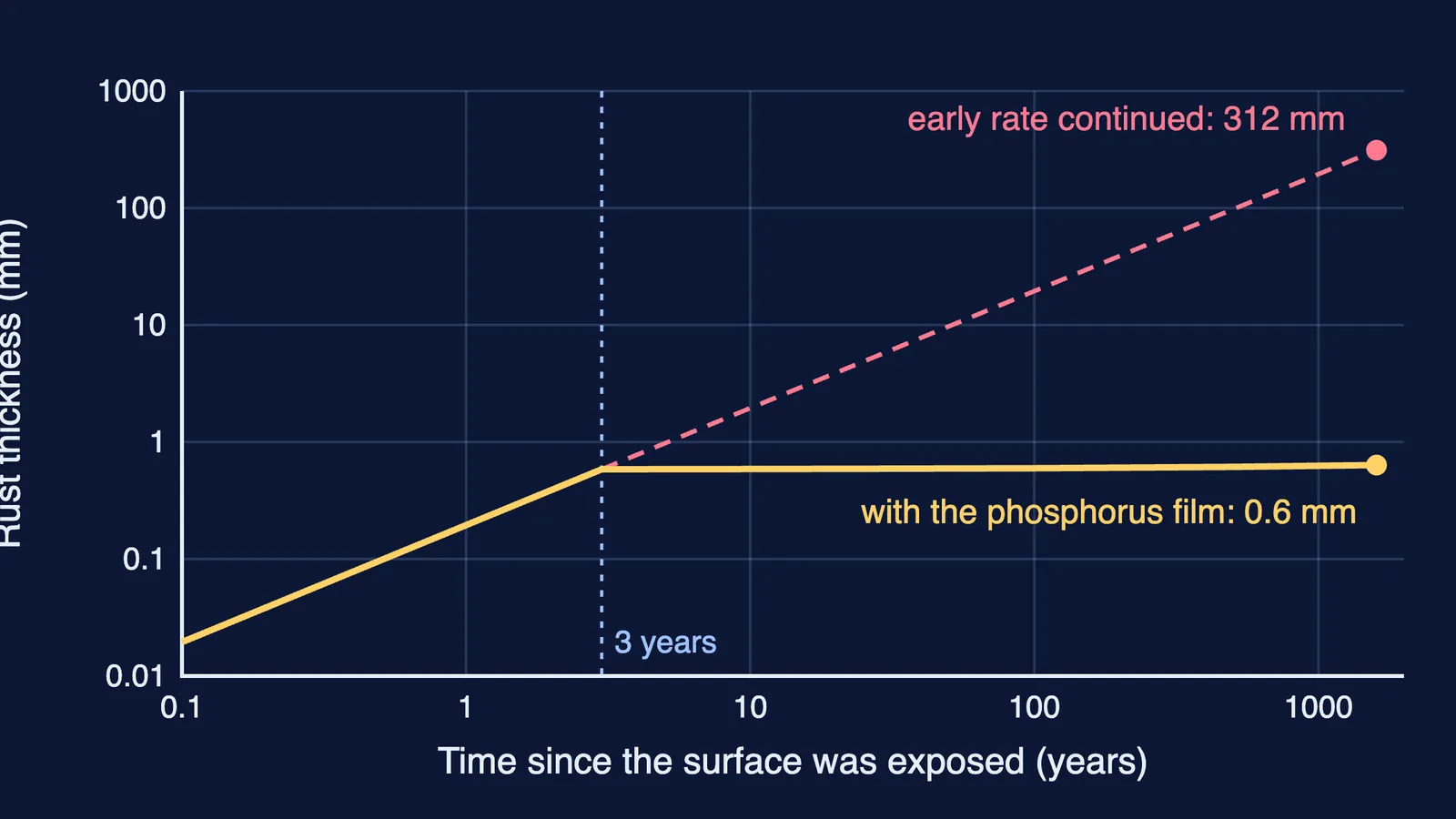
His model has two stages. For roughly the first three years, rust grows quickly and in a straight line with time. The slag particles trapped in the iron actually speed up this early corrosion, which concentrates phosphorus at the metal surface. After that, the film controls everything: ions, oxygen and moisture must diffuse through it, and corrosion of the pillar "virtually ceases", in the paper's words.
Worked example: how thick is the shield after 1,600 years?
The paper writes corrosion damage as y = ktⁿ, where n = 1 is linear growth and n = 0.5 is parabolic, diffusion-limited growth (Balasubramaniam, 2002). Taking the film as about 2 mils thick, from earlier measurements, it estimates a parabolic rate constant of 0.0025 mil²/year (1 mil is 0.001 inch, or 25.4 µm). You can run the numbers back:
Parabolic law: y² = k × t = 0.0025 × 1,600 = 4 mil².
Take the square root: y = 2 mils.
Convert: 2 × 25.4 µm = 50.8 µm, about one-twentieth of a millimetre, the figure Down To Earth reported.
Compare: the paper's early linear rate is 7.67 mils/year. Had that rate continued for 1,600 years, 7.67 × 1,600 = 12,272 mils, about 312 mm of rust. That is our illustration, not a measurement.
The idea to carry into JEE chemistry and physics: when a product layer slows down the reaction that makes it, thickness grows as √t, not t. Doubling the time does not double the damage.
Can we make rust-proof iron the same way today?
Partly. The Current Science paper notes that a similar mechanism works in weathering steels containing copper and phosphorus.
The pillar is not invincible. The paper reports that its buried part, which is coated with lead, suffers intense galvanic corrosion. To see why contact with a different metal changes everything, read why galvanised iron does not rust, using electrode potentials.
If oxidation states, electrode potentials or rate laws still feel shaky, the Fermi Concept Library gives each chemistry concept its own lesson and its place in the map. To practise rate-law numericals, the Fermi Problem Library has a step-by-step solver that explains the reasoning rather than printing an answer.
Look closely at the pillar's dark surface: a film about 0.05 mm thick has done its job for sixteen centuries.