

On this page
If you have seen a green copper vessel, a blackened silver bowl and a rusty iron gate on the same street, you have seen three kinds of corrosion. Only one of them is rust, and Class 10 science and Class 12 chemistry answers need you to know which.
What is the difference between corrosion and rusting?
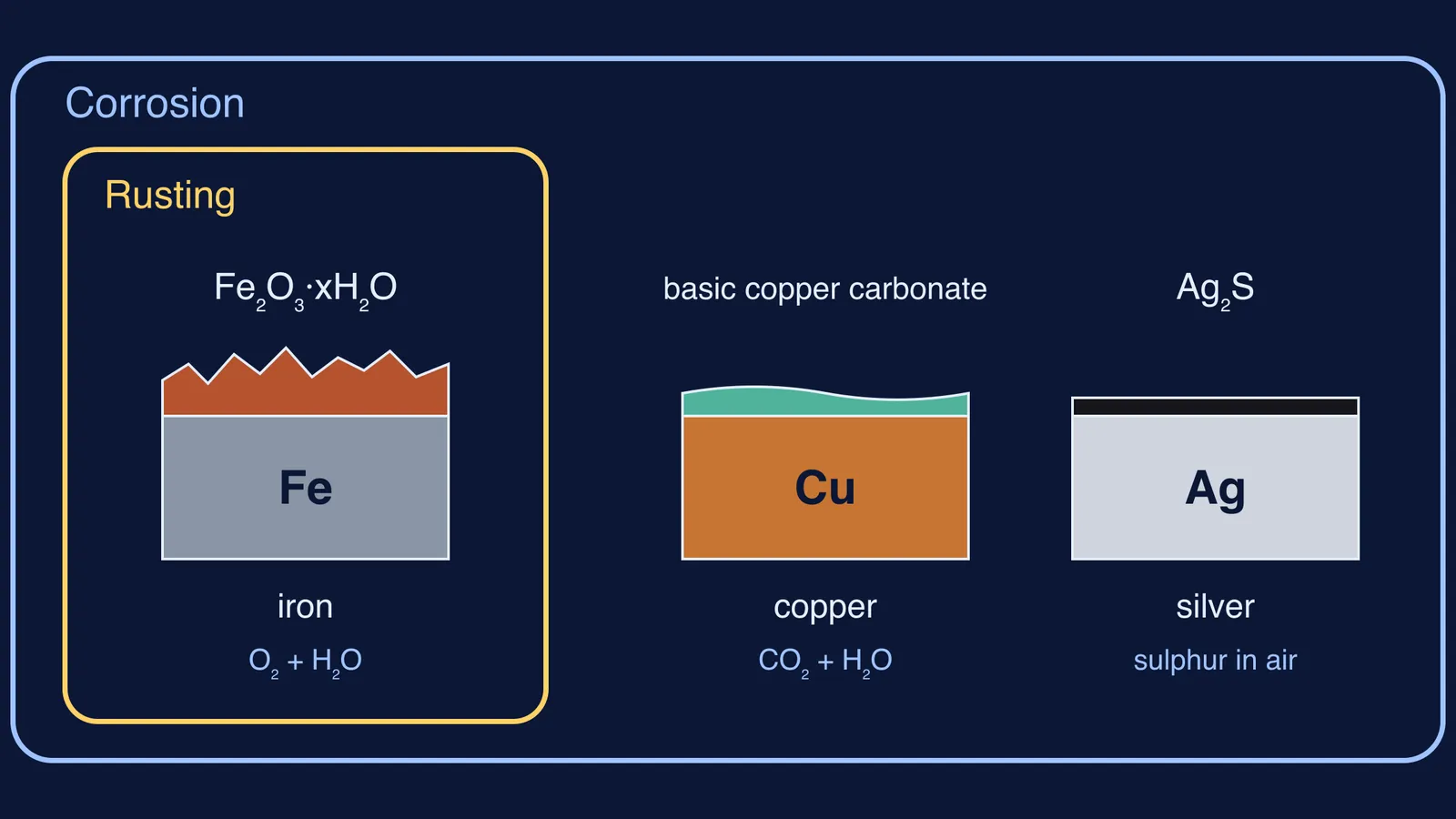
Corrosion is the general process: a metal that is attacked by substances around it, such as moisture and acids, is said to corrode, according to the NCERT Class 10 science textbook, Chapter 1. The same section gives the black coating on silver and the green coating on copper as examples of corrosion.
Rusting is one particular case: the corrosion of iron. In the NCERT Class 12 chemistry textbook, Chapter 2, rust is hydrated ferric oxide, Fe₂O₃·xH₂O, formed when iron is oxidised in the presence of air and water.
So the rule fits in one sentence: all rusting is corrosion, but not all corrosion is rusting. Ordinary steel, which is mostly iron, rusts too. Stainless steel, iron mixed with nickel and chromium, does not rust, according to the NCERT Class 10 metals chapter.
Why do copper and silver corrode but never rust?
Rust is an iron compound, so a metal with no iron in it cannot form rust. Section 3.5 of the NCERT Class 10 chapter on metals and non-metals lists what forms on each metal:
Iron: left in moist air for a long time, it gains a coating of a brown, flaky substance called rust.
Copper: it reacts with moist carbon dioxide in the air, slowly loses its shiny brown surface and gains a green coat of basic copper carbonate.
Silver: it reacts with sulphur in the air and turns black with a coating of silver sulphide.
We go deeper into the silver case in why silver jewellery turns black over time.
How does iron rust, step by step?
The Corrosion section of NCERT's Class 12 Electrochemistry chapter treats rusting as a tiny electrochemical cell set up on the surface of the iron itself:
At one spot, iron is oxidised and acts as the anode: 2Fe(s) → 2Fe²⁺(aq) + 4e⁻, where E°(Fe²⁺/Fe) = −0.44 V.
The electrons travel through the metal to another spot. There, oxygen is reduced in the presence of H⁺ ions, which can come from carbon dioxide dissolving in water: O₂(g) + 4H⁺(aq) + 4e⁻ → 2H₂O(l), with E° = 1.23 V.
The overall reaction, 2Fe(s) + O₂(g) + 4H⁺(aq) → 2Fe²⁺(aq) + 2H₂O(l), has E°cell = 1.23 − (−0.44) = 1.67 V.
Oxygen from the air then oxidises Fe²⁺ to Fe³⁺, which comes out as rust: hydrated ferric oxide, Fe₂O₃·xH₂O.
That is why iron needs both air and water to rust. In Activity 3.14 of the NCERT Class 10 metals chapter, nails rust in a tube with air and water. They do not rust in boiled water under a layer of oil or in dry air. You can run a similar test in our virtual experiment on the conditions that make iron rust.
How do you answer "is this rusting?" in an exam?
Ask three questions, in this order:
Which metal is corroding? If it is not iron or steel, the answer is corrosion, not rusting.
Were both oxygen and water present? Iron in dry air or in air-free water does not rust.
What is the product? Rust is hydrated iron(III) oxide, Fe₂O₃·xH₂O.
Now test yourself on five statements:
"A copper vessel left in moist air has rusted green." Wrong: it has corroded to basic copper carbonate.
"A silver anklet has rusted black." Wrong: it has tarnished to silver sulphide.
"An iron gate left out through the monsoon has rusted." Correct: iron, air and water are all present.
"Iron nails kept in boiled water under a layer of oil rusted quickly." Wrong: with no dissolved air, the NCERT nails do not rust.
"Galvanised iron rusts as soon as its zinc coating cracks." Wrong: NCERT notes that a galvanised article stays protected against rusting even if the zinc coating is broken.
If the E°cell arithmetic is where you get stuck, the Fermi Problem Library has worked problems with a step-by-step solver that explains the reasoning rather than printing an answer.
Why does the difference matter outside the exam?
Corrosion of every kind is expensive. NACE International's IMPACT study put the global cost of corrosion at US$2.5 trillion, equal to 3.4% of global GDP in 2013 (NACE IMPACT, economic impact). It estimated that existing corrosion-control practices could save 15 to 35% of that cost.
Knowing which metal you are protecting helps you choose the fix. The NCERT Class 10 metals chapter lists painting, oiling, greasing, galvanising, chrome plating, anodising and making alloys as ways to prevent rusting. To see why zinc and tin coatings protect iron differently, read galvanisation vs tinning.
If words like oxidation, anode and electrode potential still feel shaky, the Fermi Concept Library has a lesson for every chemistry concept, each placed in its map, so you can fill the gap first.


