

On this page
You can answer the rusting question with five test tubes and a few days of waiting. Or you can set up the tubes on paper first, commit to a ranking, and then test it against the standard school experiment and the chemistry behind it. This guide does that.
What conditions are needed for iron to rust?
Iron needs both oxygen and water to rust; take either away and the nail stays clean. That is the result of Activity 3.14 in the NCERT Class 10 Science chapter on metals and non-metals. There, nails rust in a tube with water and air, but not in boiled water under a layer of oil, and not in air dried by anhydrous calcium chloride.
Rust is a red-brown hydrated iron oxide, Fe2O3·xH2O, which flakes off and exposes fresh metal underneath, as the LibreTexts chapter on corrosion/20%3A_Electrochemistry/20.08%3A_Corrosion) explains.
Rusting is electrochemistry. At one spot on the nail, iron loses electrons: Fe → Fe²⁺ + 2e⁻. The electrons travel through the metal to another spot, where oxygen takes them: O₂ + 4H⁺ + 4e⁻ → 2H₂O. The same LibreTexts chapter says water dissolves the Fe²⁺ and acts as a salt bridge between the two spots. With no water there is no bridge, and with no oxygen nothing takes the electrons.
How do you set up the five-tube rusting experiment?
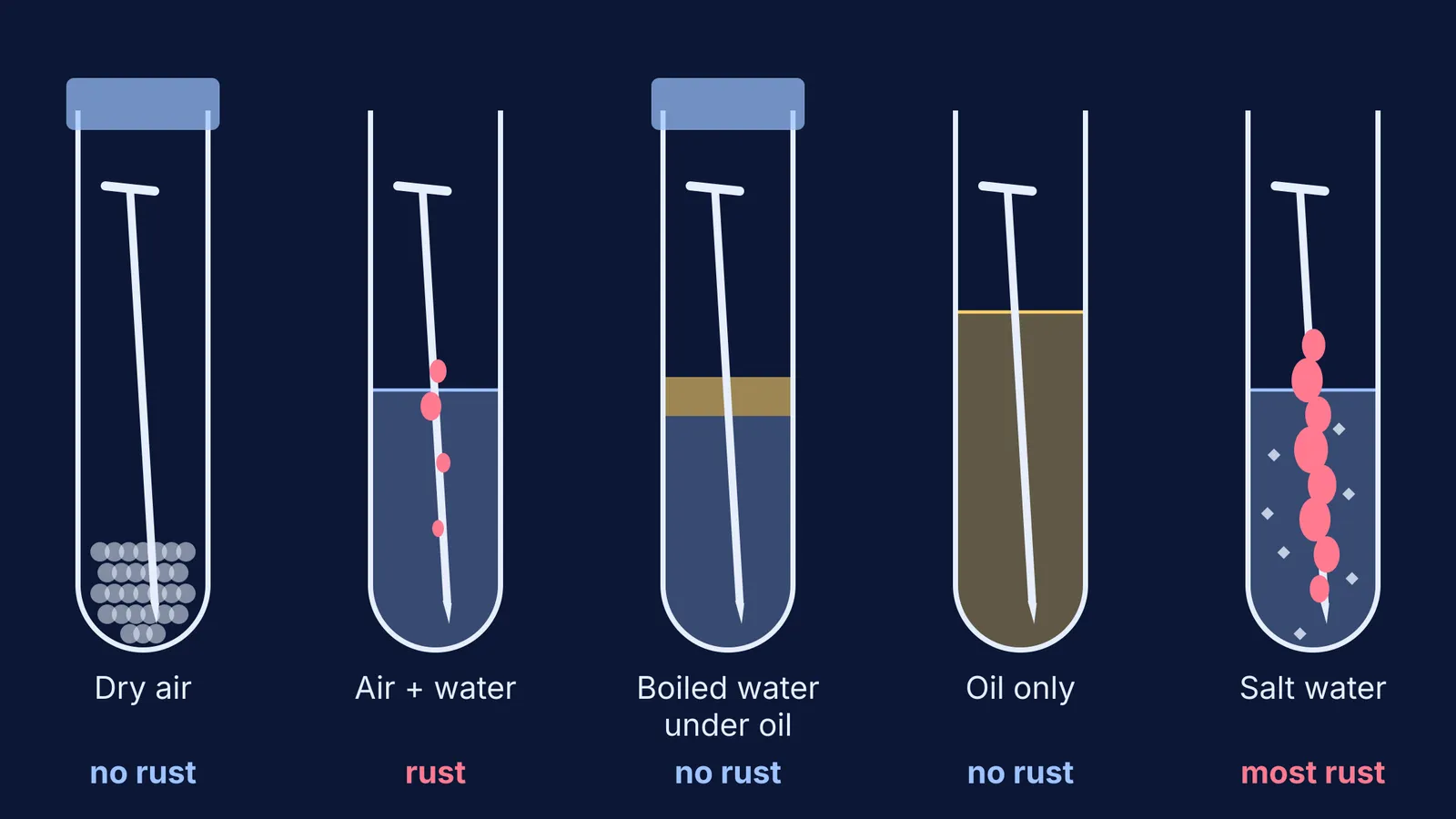
Draw five test tubes on a page, or set them up for real, each with one clean iron nail. This combines the NCERT activity with the Royal Society of Chemistry practical "What causes iron to rust?", which adds a salt-water tube. The oil-only tube tests a point made in the LibreTexts chapter.
Dry air: nail plus about 2 cm of anhydrous calcium chloride granules, which absorb water, with the tube closed by a bung.
Air and water: nail in ordinary water, with part of it above the surface.
Boiled water under oil: nail in boiled water, with a little oil poured on top so air cannot dissolve back in.
Oil only: nail in oil, with no water.
Salt water: nail in water with salt dissolved in it.
Avoid galvanised nails. NCERT notes that a zinc coating protects iron from rusting, so it would hide the very effect you are testing.
Which nail rusts the most, and why?
The RSC practical says to leave the tubes for at least three days, and NCERT says a few days. Here is what the sources report, tube by tube, with the reason.
Dry air: no rust. Oxygen is there but water is not (NCERT).
Air and water: rust. Both conditions are met (NCERT).
Boiled water under oil: no rust. Boiling removes the dissolved air and the oil stops it coming back (NCERT).
Oil only: no rust. LibreTexts notes that a nail in oxygen-saturated oil with no water will not rust.
Salt water: the most rust. The RSC teacher notes say this nail rusts the most and that salt can increase the rate of rusting.
Score one point per tube where both rank and reason match. If you ranked salt first but wrote "salt reacts with iron", you have the result without the mechanism.
Why does salt make iron rust faster?
Salt does not supply oxygen. It changes the water. According to the LibreTexts corrosion section of Averill's General Chemistry/19%3A_Electrochemistry/19.07%3A_Corrosion), salt is an electrolyte that increases the conductivity of water and helps current flow between the anodic and cathodic sites. More ions in the water means charge moves more easily between the spot where iron dissolves and the spot where oxygen is reduced, so the whole cell runs faster.
The same text adds that rust often forms away from the anode, wherever the dissolved Fe²⁺ meets oxygen. The place where you see rust is not always the place where iron is being eaten away.
This is the chemistry behind why iron rusts faster near the sea. For the opposite case, read why stainless steel does not rust.
How can you test the salt explanation yourself?
A result is not yet an explanation. Each what-if below is a prediction the electrolyte idea must pass.
Boiled salt water under oil: the salt is there but the oxygen is not. If oxygen is essential, what should happen?
Sugar water instead of salt water: sugar dissolves but does not split into ions. Should it act like salt or like plain water?
A strong salt solution next to a weak one: does more salt mean more rust within the same number of days?
Keep it fair: same nails, same cleaning, same liquid depth, same place, same days.
If picturing charge moving between two spots on one nail is the hard part, the Fermi Simulation Lab has interactive simulations for ideas easier to see than to read; the limits of simulations explains why the real tube is still the final check. If the half-equations are shaky, the Fermi Concept Library gives each chemistry concept its own lesson.
Set up the five tubes this week, write your ranking first, and check it on day three.


