

On this page
If you leave a clean iron nail on a balcony in New Delhi, it gradually develops a dull brown tarnish over several weeks. Place that identical nail outside in Mumbai or Chennai, and within days it swells with a thick, flaky orange crust. The atmosphere in both places contains oxygen and water vapour, yet coastal iron degrades far more aggressively.
The reason why iron rusts faster near the sea lies in the chemistry of the electrolyte. Rusting is not a straightforward chemical union of iron and oxygen gas; it is a spontaneous electrochemical process governed by microscopic galvanic corrosion cells.
What happens electrochemically when iron rusts?
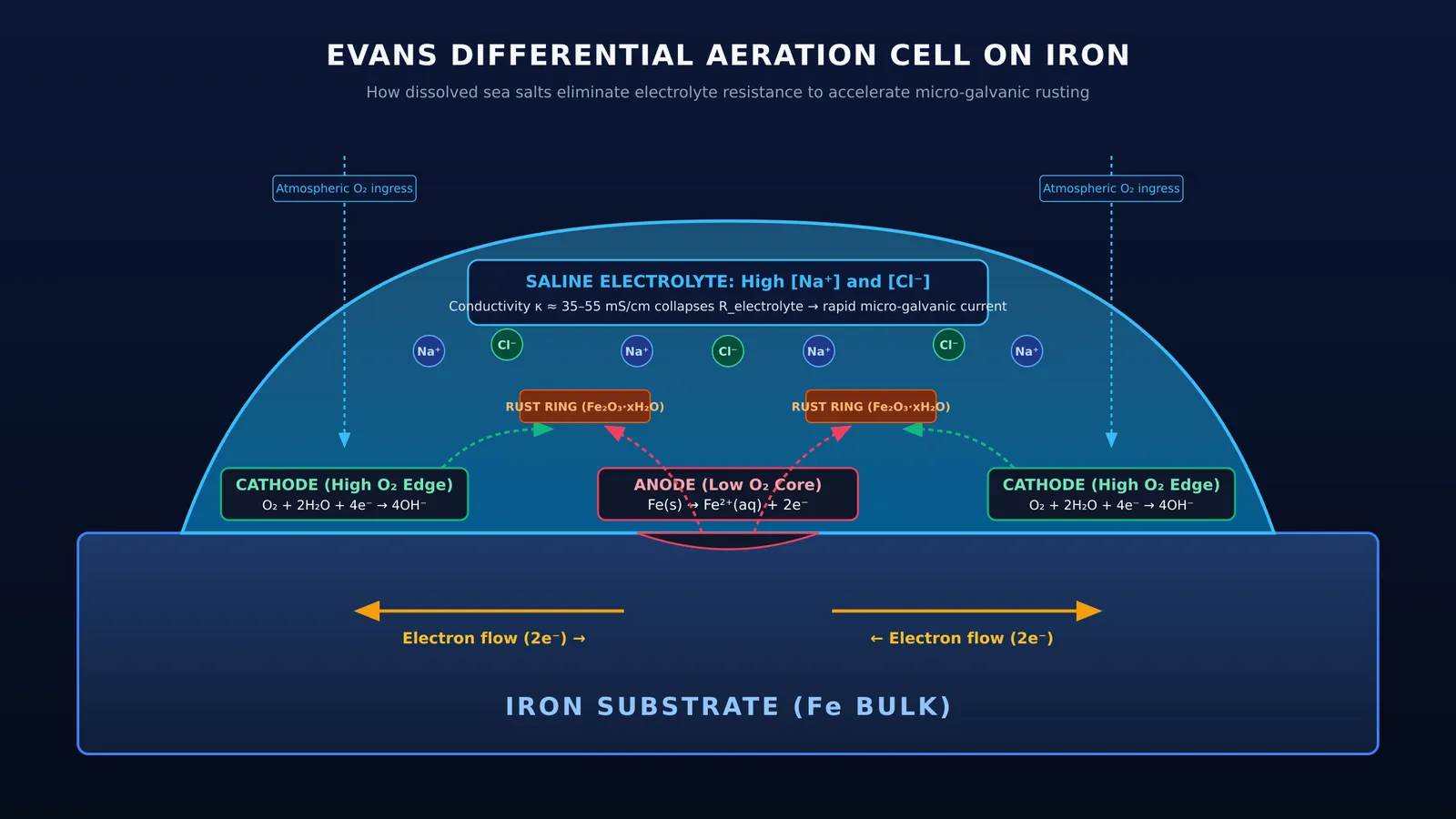
Atmospheric corrosion turns an iron object into an interconnected network of microscopic anodes and cathodes beneath a thin film of surface moisture, a mechanism first systematically formulated by metallurgist Ulick R. Evans in Nature.
At an anodic site—typically an area of mechanical stress, scratch, or lower oxygen concentration—iron atoms surrender electrons and dissolve as ferrous ions:
Fe(s) → Fe²⁺(aq) + 2e⁻ (E° = −0.44 V)
The released electrons travel through the bulk metal to neighbouring cathodic sites, where dissolved oxygen from the air is reduced in an aqueous environment:
O₂(g) + 4H⁺(aq) + 4e⁻ → 2H₂O(l) (E° = +1.23 V)
Combining these half-reactions gives a net standard cell potential of E°cell = 1.23 V − (−0.44 V) = +1.67 V. Under standard conditions, this positive potential yields a large negative standard Gibbs energy change (ΔG° = −nFE°cell), confirming the reaction is spontaneous, as outlined in the NCERT Class 12 Chemistry curriculum. Ferrous ions then react with hydroxide ions to precipitate hydrated ferric oxide (Fe₂O₃ · xH₂O), the familiar red-brown rust. For students reviewing redox tendencies, our guide on standard electrode potentials of transition metals clarifies these potentials.
If you struggle to balance complex redox half-reactions or compute net potentials, the Fermi Problem Library provides step-by-step worked problems that explain the underlying chemical principles rather than simply printing answers.
Why does dissolved salt speed up the corrosion current?
In clean rainwater, this electrochemical cell is throttled by internal resistance, as reviewed by Alcántara and colleagues in Materials. Pure water has very few free ions, yielding an electrical conductivity of roughly 0.055 µS/cm; dissolved carbon dioxide forming weak carbonic acid raises typical rainwater conductivity to only 2 to 50 µS/cm.
By Ohm's law applied to an electrochemical cell, the corrosion current is:
I_corr = (E_cathode − E_anode − η) / (R_metal + R_electrolyte)
where η represents overpotentials, R_metal is the negligible resistance of solid iron, and R_electrolyte is the ohmic resistance of the moisture layer. Because the water film is thin, low conductivity makes R_electrolyte enormous, choking the corrosion current.
Near the ocean, breaking waves create airborne marine aerosols that deposit sodium chloride (NaCl) and magnesium chloride (MgCl₂) onto metal surfaces. When these salts dissolve, they supply abundant mobile Na⁺ and Cl⁻ ions. In coastal moisture films, dissolved sea salts elevate electrical conductivity to between 35,000 and 55,000 µS/cm (35 to 55 mS/cm)—over 1,000 times higher than inland rainwater. This surge in conductivity collapses R_electrolyte toward zero, removing the ohmic bottleneck and allowing high corrosion currents to surge between anodic and cathodic zones. To understand how ionic concentration and cell geometry determine resistance, see our guide on calculating conductivity from cell resistance.
To see how electrolyte conductance and ionic transport link to broader physical chemistry topics, the Fermi Concept Library maps every concept across physical and inorganic chemistry to help students trace prerequisites and see the full picture.
How do chloride ions prevent protective rust layers?
Salt water does more than speed up electron and ion flow; chloride ions actively dismantle the metal's defence mechanisms:
Destruction of passive films: Chloride is a small, highly electronegative anion that readily penetrates imperfections in iron oxide coatings. It forms intermediate soluble complexes, such as [FeCl₄]²⁻ and hydrated FeCl₂, which pull iron away from the metal surface before hydrolysing.
Formation of non-protective akaganeite: Inland rust transforms into compact, adherent goethite (α-FeOOH) and magnetite (Fe₃O₄), which shield the underlying iron. In marine environments, chloride ions catalyse the crystallization of akaganeite (β-FeOOH), as detailed in long-term exposure studies by de la Fuente and co-workers in Corrosion Science. Akaganeite has an open, tubular tunnel structure containing trapped chloride; it is porous, brittle, and repeatedly flakes off, continually exposing bare metal.
How does distance from the sea change corrosion rates?
Airborne chloride concentration does not spread evenly; it decays exponentially with distance from the breaking surf:
Cl_DR = a · e^(−x / t) + c
Studies synthesized in Materials show that the sharpest reduction in chloride deposition occurs within the first 400 to 600 metres from the shoreline, where heavy salt droplets settle by gravity. Beyond 2 to 5 kilometres inland, chloride deposition drops by over 90%, transitioning from extreme marine corrosivity (ISO 9223 category CX, where carbon steel corrodes at over 200 to 700 µm/year) to modest rural levels (category C2, typically 1.3 to 25 µm/year).
India features a 7,516-kilometre coastline where marine atmospheric corrosion presents severe challenges. National corrosion mapping led by Natesan and Palaniswamy in Corrosion Reviews recorded mild steel corrosion rates at coastal testing stations like Mandapam Camp (Tamil Nadu) exceeding 109 µm/year, with severe marine exposure sites reaching over 500 to 1,600 µm/year—compared to inland rural rates of just 15 to 25 µm/year. For a broader look at everyday oxidation, review our summary of everyday oxidation in Class 10 science.
How can students calculate the resistance drop in a rust cell?
Using the conductance formulas from the NCERT Class 12 Chemistry curriculum, consider a worked comparison of electrolyte resistance across a 10 µm thick moisture film separating an anode and cathode spaced 1 mm apart with a contact width of 10 mm (cross-sectional area A = 10 µm × 10 mm = 10⁻⁷ m²):
Pure rainwater film (κ = 10 µS/cm = 10⁻³ S/m):
R = l / (κ · A) = (10⁻³ m) / (10⁻³ S/m × 10⁻⁷ m²) = 10⁷ Ω = 10 MΩ. With an available driving potential of 0.5 V, the ohmic current is limited to I = V / R = 0.5 V / 10⁷ Ω = 50 nA.
Saline coastal film (κ = 50,000 µS/cm = 5.0 S/m):
R = l / (κ · A) = (10⁻³ m) / (5.0 S/m × 10⁻⁷ m²) = 2,000 Ω = 2 kΩ. With the identical driving potential, the current reaches I = 0.5 V / 2,000 Ω = 250 µA.
In this model, the ionic current increases 5,000-fold solely due to dissolved salt eliminating the solution's internal resistance.
For students who want to visualize how mobile ions travel along these microscopic paths between anodic pits and cathodic boundaries, the Fermi Simulation Lab provides interactive simulations for the ideas that are easier to see than to read.


