

On this page
A good simulation lets you see a field line bend or a pendulum swing before the equations make sense. But a simulation is a model, not the world, and how you use it matters as much as what is on the screen. Here are the main limits, what research says, and a routine that turns clicking into learning.
What are the limitations of physics simulations for learning?
There are three, and each one can quietly teach you something false.
1. Idealised models. Every simulation makes choices: no air resistance, a massless string, a frictionless track. A common one is the small-angle approximation for a pendulum, where sin θ is replaced by θ, as these Durham University lecture notes on harmonic motion show. That shortcut works for small swings, not large ones. If the simulation does not say so, you may mistake it for a law of nature.
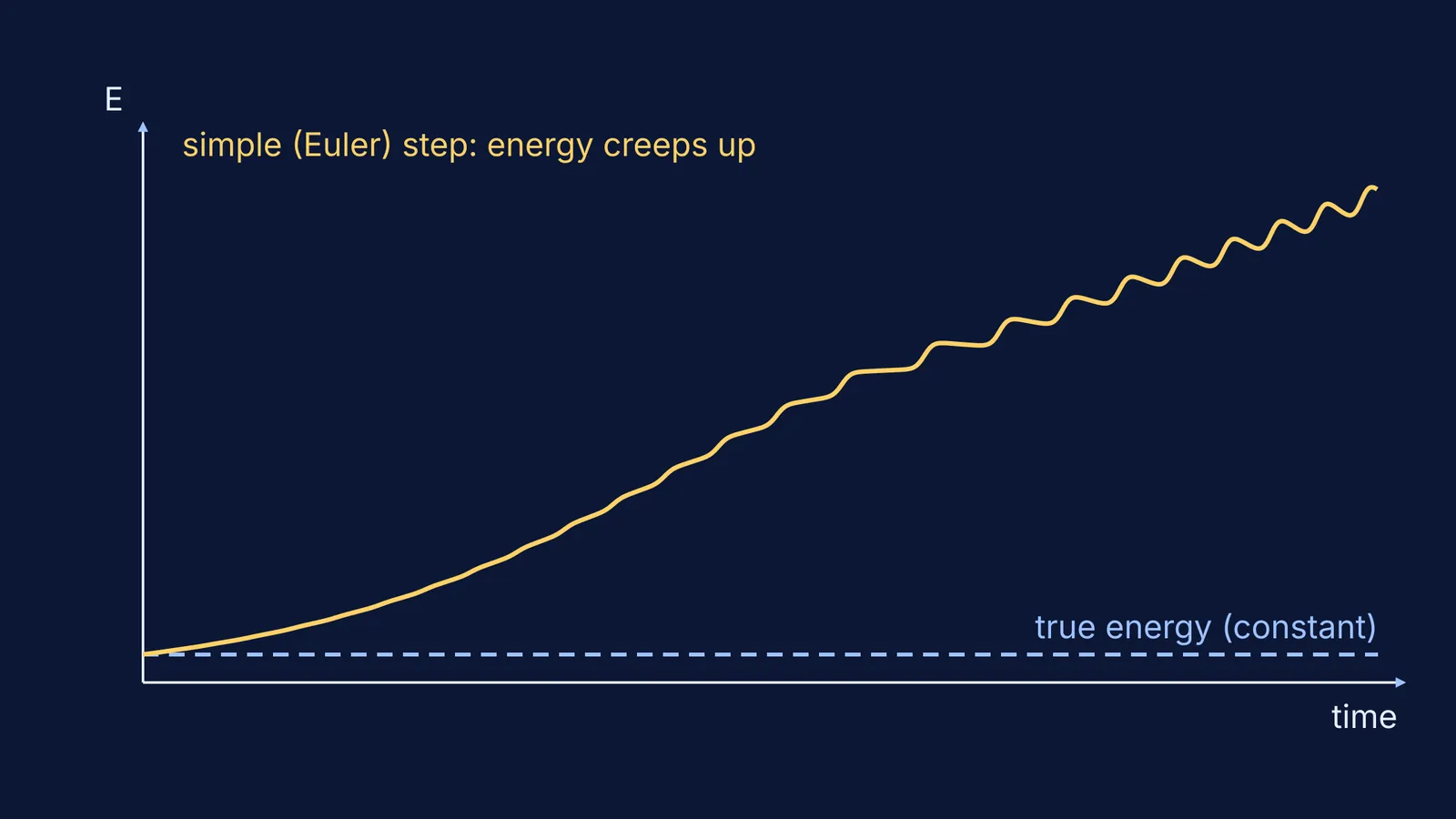
2. Numerical artefacts. A computer cannot solve motion continuously; it steps forward in small chunks of time. The same Durham notes show that the simple Euler method makes a pendulum's swing grow over time, and that its energy increases at every step, for any choice of time step. Better methods exist: Hairer, Lubich and Wanner (2003) explain why the Störmer–Verlet method keeps energy well behaved over long runs. You cannot see which method a simulation uses, so a growing swing might be a bug, not physics.
3. Passive clicking. Watching is not the same as thinking. In a study of lecture demonstrations, Crouch, Fagen, Callan and Mazur (2004) found that students who passively watched understood the concepts no better than students who saw no demonstration at all, while students who predicted the outcome first understood significantly more. A simulation is a demonstration you control, and the same trap applies.
Do simulations actually help students learn physics?
Yes, when used well. In a large introductory course, Finkelstein and colleagues (2005) found that students who learned DC circuits with a simulation outperformed students who used real bulbs and wires, both on a concept test and when building a real circuit. A review by Rutten, van Joolingen and van der Veen (2012) found robust evidence that simulations can improve traditional teaching, especially lab work, but noted that most studies ignored teacher support and how the lesson was set up.
Guidance is the deciding factor. Drawing on about 250 think-aloud interviews with PhET simulations and on watching classes and labs, Adams, Paulson and Wieman (2008) reported that with strongly guided 'cookbook' worksheets, students used the simulation only to find each answer, with no real exploration. With no instructions or a few open driving questions, students explored and asked their own questions, as long as the simulation was well designed. Their conclusion: minimal but nonzero guidance works best.
How should you use a simulation so it teaches rather than misleads?
This routine draws on the heuristics in Rehn, Moore, Podolefsky and Finkelstein (2013), which include predict-observe-explain, testing illuminating or limiting cases, and redrawing what you see on paper.
Predict. Write one sentence and a rough sketch of what you expect before you touch anything.
Observe. Change one control at a time and note what happens.
Explain. If the result differs from your prediction, write down why. This is where the learning happens.
Find the assumption. Ask: what has this model left out? Friction, air drag, mass of the string, size of the angle?
Push to the limits. Try zero, very large and very long values. Turn friction off, run for a long time, and watch whether energy that should stay constant creeps up.
Close the screen and redraw. Sketch the graph or diagram from memory, then solve one numerical without the simulation.
What does this look like for a pendulum?
Say you are revising simple harmonic motion for Class 11 or JEE Main. Open a pendulum simulation and predict: will the period change if you double the amplitude? Write your answer, then test a small angle and a large one.
If the period never changes, ask whether the model uses the small-angle formula, since T = 2π√(L/g) comes from that approximation. Then switch off damping and let it run. If the swing slowly grows, you have probably spotted a numerical artefact like the Euler drift above, not new physics. Finish with two lines: what the simulation got right, and what it assumed.
The Fermi Simulation Lab has interactive simulations for ideas that are easier to see than to read, and the routine above works on any of them. Fermi's AI tutor can also run the simulation with you and check your understanding as it goes, so the explain step does not get skipped.
Next time you open a simulation, start with a pen, not the play button.


